
Medical device and lab equipment designs impose material, cleanliness, noise, and documentation requirements that differ from general automation. This article explains what changes when specifying stainless steel linear guideways for medical applications and what to confirm with the supplier before ordering.
Specifying linear motion for a medical device or laboratory instrument involves more than selecting a bearing that fits the load and stroke. The operating environment, cleaning protocols, acoustic requirements, and documentation expectations differ from those of general industrial automation. A linear bearing that performs well in a pick-and-place machine may not be suitable for a diagnostic analyzer or a sample handling system.
This article focuses on stainless steel linear guideways used in medical devices and lab equipment. It covers what changes when the application is medical—material choice, noise and smoothness limits, ground precision, cleanliness, and documentation—and what to confirm with the supplier before placing an order.
Key Takeaways
- Martensitic stainless steel (9Cr18Mo, HRC 54–58) is available for medical, food, and cleanroom applications where corrosion resistance matters.
- Ground raceways (P5/H standard) with roughness Ra ≤0.4 µm support smooth, low-noise operation; bench tests show running noise ≤48 dB at 0.5 m/s.
- End seals and side seals help protect the bearing from contaminants, but the seal material and cleaning compatibility must match the device's cleaning protocol.
- Ask for full inspection documentation—CMM reports and material certificates—and verify that any compliance claims (e.g., FDA food-grade, ISO 9001, CE) apply to your specific device and region.
Material Choice: Why Stainless Steel Matters
In medical devices, the linear guideway may be exposed to cleaning agents, humidity, or repeated wipe-downs. Standard chrome steel (GCr15, HRC 58–62) offers high load capacity and wear resistance, but it is not inherently corrosion-resistant. For environments where corrosion protection is needed, stainless steel is often specified.
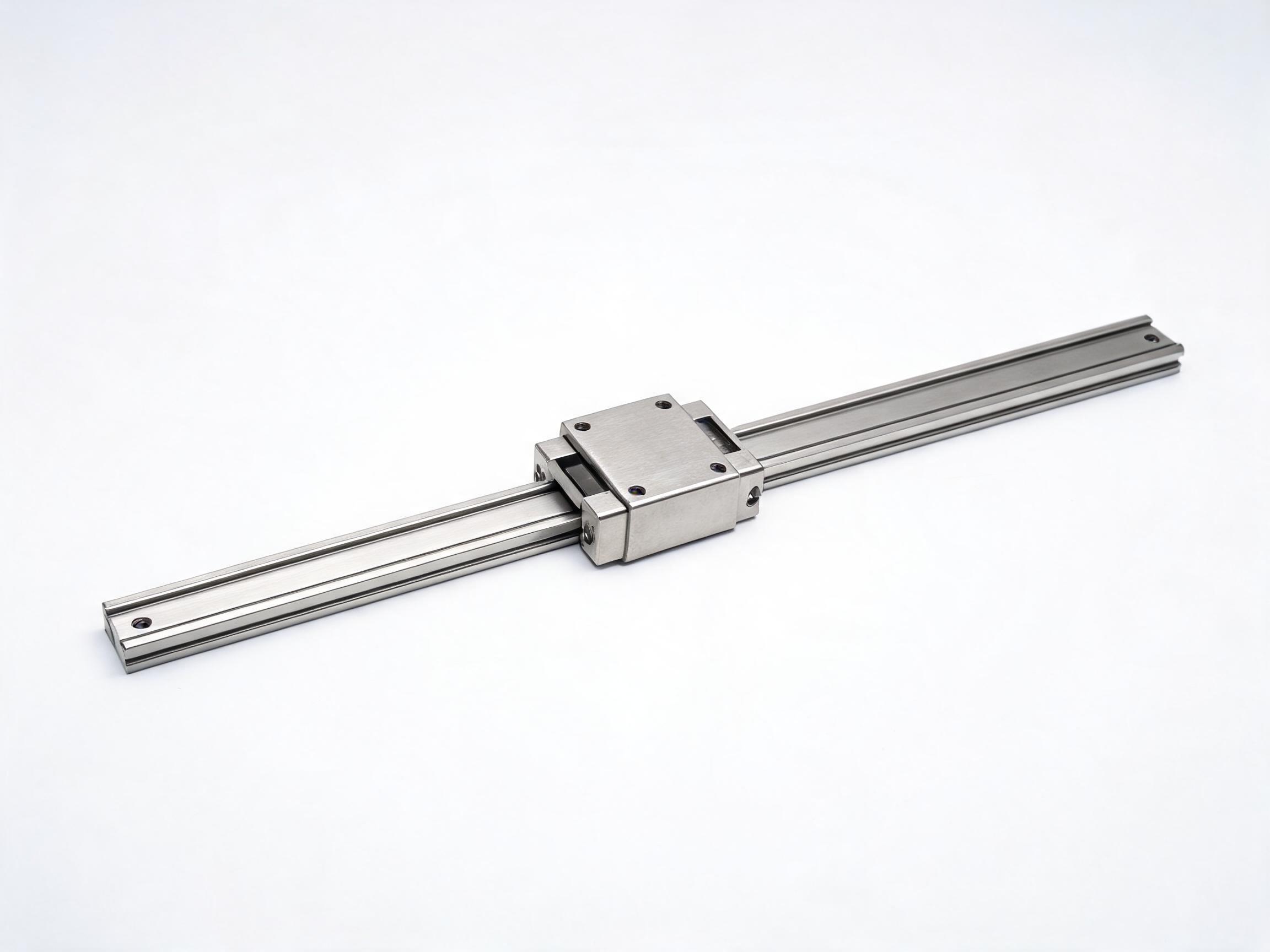
The EGH series miniature guideway is available in martensitic stainless steel 9Cr18Mo (HRC 54–58) for medical, food, and cleanroom applications. This material provides a balance of hardness and corrosion resistance. The chrome steel variant (GCr15, HRC 58–62) remains an option for applications where corrosion is not a primary concern.
When selecting the material, consider the cleaning agents and disinfectants used on the device. Not all stainless steels resist every chemical. Ask the supplier for material certificates and, if needed, compatibility data for the specific cleaning regimen.
Noise and Smoothness: Acoustic Limits in Medical Settings
Medical devices often operate in quiet environments—patient rooms, laboratories, or diagnostic suites. Noise from linear motion can be a concern for both user comfort and equipment performance. The EGH series uses a two-row Gothic-arch circuit, which contributes to smooth running characteristics. Bench tests of the EGH15CA show running noise ≤48 dB at 0.5 m/s. This is a measured value under specific test conditions; actual noise in your device will depend on mounting, load, speed, and surrounding structure.
Smoothness is also affected by raceway finish. All EGH rails are ground to H (P5) standard, with raceway roughness Ra ≤0.4 µm. This level of surface finish helps reduce friction variation and vibration, which can be important for precision instruments.
When evaluating noise and smoothness, request test data or samples to verify performance in your own setup. The supplier's bench test provides a reference, but your application conditions may differ.
Ground Precision: What P5/H Means for Your Design
Precision grade affects running accuracy, repeatability, and service life. The EGH series is supplied with ground rails at H (P5) standard. This grade is suitable for many medical and lab applications where moderate to high precision is required. If your design demands higher precision, discuss the available grades with the supplier.
Ground raceways also contribute to smoother motion and lower noise, as noted above. The combination of material, heat treatment, and grinding process determines the final performance. For critical dimensions, always refer to the product datasheet and confirm tolerances with the supplier.
Cleanliness and Sealing: Protecting the Bearing in a Medical Environment
Medical devices may be exposed to dust, liquids, or cleaning solutions. The EGH series offers end seal and side seal options to help keep contaminants out of the raceway. Seal material and design should be selected based on the cleaning agents and temperatures involved. Standard seals may not be compatible with certain solvents or autoclave cycles—confirm with the supplier.
In cleanroom environments, the bearing should not generate particles. While stainless steel construction helps, the lubricant and seal materials also matter. Ask for information on outgassing or particle generation if your device operates in a controlled environment.
Documentation and Compliance: What to Request
Medical device manufacturers often need to maintain traceability and demonstrate due diligence. The supplier's site materials indicate that full inspection documentation—including CMM reports and material certificates—is available on request. These documents can support your quality records.
Regarding compliance, the supplier states that FDA food-grade compliance exists for stainless steel linear bearing variants (material requirements for food-contact equipment). The company also holds ISO 9001:2015, CE conformity, and has undergone an SGS factory audit. These are company-level certifications and claims; they do not automatically mean that a specific bearing model is approved for your medical device. Regulatory approval is device-specific and depends on your entire system, not just the bearing. Always verify that the documentation and certifications meet your regional requirements and confirm with the supplier that they apply to the exact product you are ordering.
What to Confirm with the Supplier Before Ordering
Before finalizing a purchase order for linear bearings for medical equipment, clarify the following points with your supplier:
- Material grade and certificate: Confirm the stainless steel grade (e.g., 9Cr18Mo) and request the material certificate for the production lot.
- Seal compatibility: Specify the cleaning agents and operating temperature; ask whether the standard seals are suitable or if alternative seal materials are needed.
- Noise and smoothness data: Request test reports or arrange for samples to evaluate in your application.
- Precision grade and tolerances: Verify that the H (P5) grade meets your design requirements; discuss any need for higher precision.
- Documentation package: Confirm what inspection documents (CMM reports, material certificates) will be provided and in what format.
- Compliance claims: Ask for evidence that the product meets the specific standards you require (e.g., FDA food-grade, ISO 9001) and verify applicability to your device and market.
- Rail length and splicing: The maximum rail length is 1000 mm, with a splice option for longer strokes. Confirm that the splice design meets your alignment and load requirements.
- Load capacity: For the EGH15CA, dynamic load is 5.5 kN and static load is 9.2 kN. Check that these ratings suit your application with an appropriate safety factor.
Product Example: EGH Series Miniature Guideway
The EGH series miniature linear guideway is available in stainless steel (9Cr18Mo) and chrome steel (GCr15), with a two-row Gothic-arch circuit. It offers ground rails at H (P5) standard, raceway roughness Ra ≤0.4 µm, and running noise ≤48 dB at 0.5 m/s in bench tests. Seal options include end seals and side seals. Maximum rail length is 1000 mm, with a splice option. For detailed specifications and to discuss your medical device requirements, please visit the product page or contact our technical team.
FAQ
Is stainless steel always required for medical linear bearings?
Not necessarily. The need for stainless steel depends on the cleaning agents, humidity, and corrosion risk in your device. Chrome steel may be adequate in dry, controlled environments. Evaluate your operating conditions and consult the supplier.
Can the EGH series be used in an autoclave?
The standard seals and lubricant may not withstand autoclave cycles. Autoclave compatibility depends on the specific materials and lubricant. Confirm with the supplier and consider alternative seal materials or lubricants if needed.
What is the lead time for stainless steel versions?
Lead time varies by configuration and order quantity. Please contact the supplier for current lead times.
Do you provide FDA food-grade certification for the bearings?
The supplier's site materials indicate that FDA food-grade compliance exists for stainless steel linear bearing variants, based on material requirements for food-contact equipment. This is a material-level claim; verify that it satisfies your regulatory requirements for the specific device.
Note: The performance figures and compliance statements in this article are based on supplier materials and bench tests. Buyers should verify all specifications and certifications against their own requirements and confirm with the supplier before ordering.