
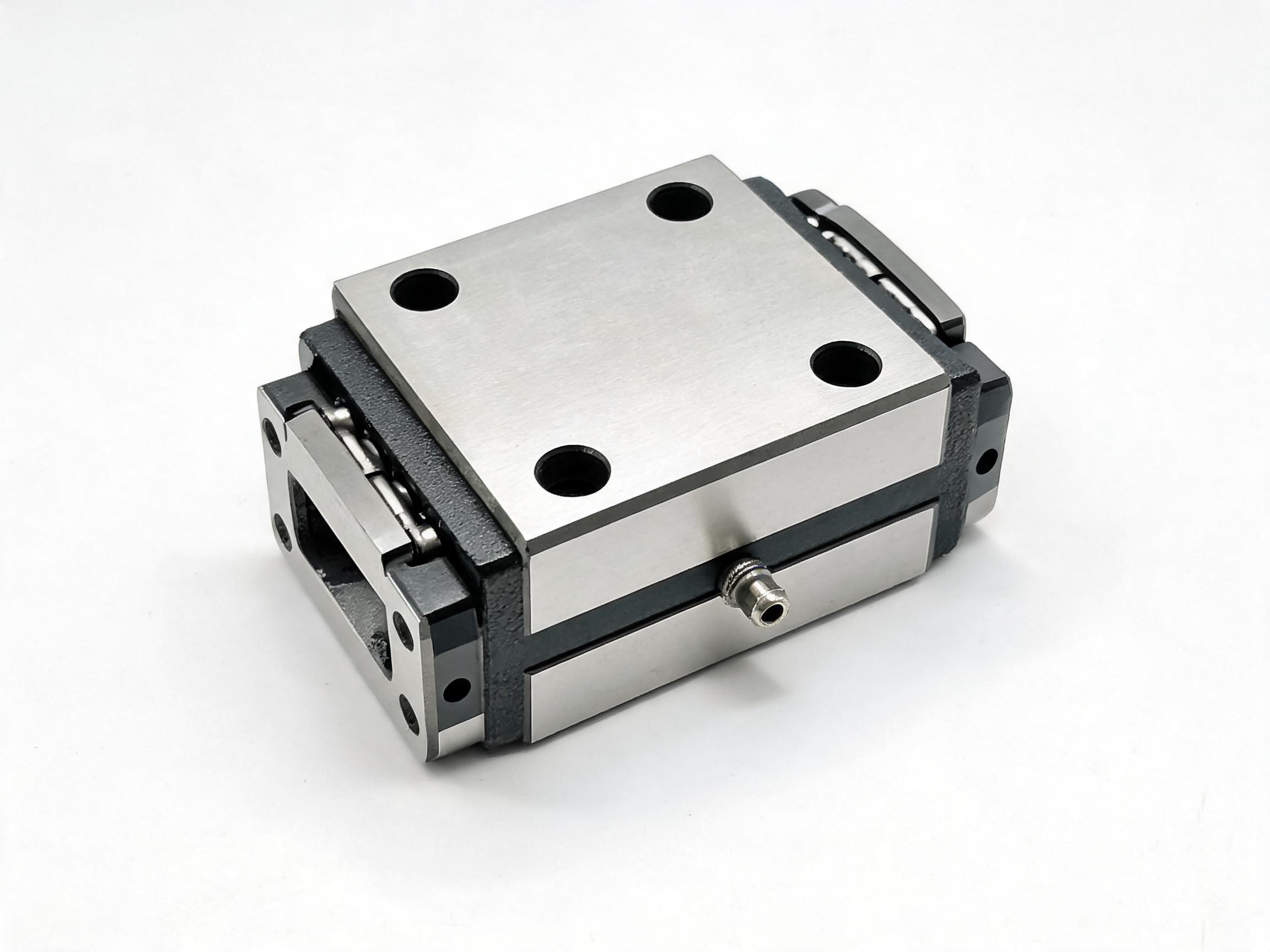
Choosing between HGR, HGH, and HGW rail linear guideways comes down to load direction, moment stiffness, and mounting space. This guide breaks down the dimensional differences, load ratings, and typical applications for each series so you can spec the right linear guideways for your automation project.
ENGINEERING BUYER GUIDE
If you are sourcing rail linear guideways for a heavy-duty automation line, you have likely seen three carriage designations: HGR, HGH, and HGW. They look similar at a glance. They share the same rail profile in many sizes. But the carriage geometry differs, and that difference determines which one survives your application's loads and moments.
This guide covers the mechanical differences, load tables, and selection logic for each configuration. It is written for engineers and procurement teams who need to make a spec decision, not for a general audience.
- HGR uses a narrow, low-profile carriage. Best for space-constrained axes with primarily vertical loads.
- HGH is the standard square-flange carriage. Balanced for radial loads and moderate moments. The most common choice for general automation.
- HGW is the wide-flange carriage. Higher moment rigidity (pitch and roll) than HGH in the same rail size. Use it when the load center is offset from the carriage center.
- All three share the same rail dimensions for a given size, so you can often swap carriages on the same rail if the mounting bolt pattern fits.
What the Designations Mean
These designations come from the HIWIN-style naming convention, which has become a de facto standard in the linear guideway industry. Many manufacturers produce interchangeable products under these model numbers. The letters break down as follows:
- HG – the series family (heavy-duty, ball-type linear guideway).
- R – narrow carriage (reduced width).
- H – square flange type carriage, normal width.
- W – wide flange type carriage.
So HGR is the narrow version, HGH is the standard square type, and HGW is the wide version. The rail itself is identical across all three for a given nominal size (e.g., 20, 25, 30, 35, 45, 55).
Dimensional Differences at a Glance
The table below compares the three carriage types for a common size, HGR/HGH/HGW 25. Dimensions are in millimeters. These are standard values you can verify against any major manufacturer's catalog.
| Parameter (Size 25) | HGR25 (Narrow) | HGH25 (Square) | HGW25 (Wide) |
|---|---|---|---|
| Carriage width (W) | 34 mm | 48 mm | 70 mm |
| Carriage length (L) | 79.6 mm | 83.4 mm | 83.4 mm |
| Carriage height (H) | 28 mm | 36 mm | 36 mm |
| Mounting bolt spacing (B × L1) | 26 × 40 mm | 32 × 50 mm | 50 × 50 mm |
| Rail width (WR) | 23 mm | 23 mm | 23 mm |
| Basic dynamic load rating (C) | 12.1 kN | 17.6 kN | 17.6 kN |
| Basic static load rating (C0) | 15.4 kN | 20.6 kN | 20.6 kN |
Notice that the rail width is the same for all three. The load ratings for HGH and HGW are identical in the vertical direction. The difference appears when you compare moment ratings.
Moment Rigidity: Where HGW Pulls Ahead
Heavy-duty automation rarely loads a carriage purely vertically. You get offset loads, overhung tooling, and cantilevered arms. These create moments around the X, Y, and Z axes. The wider the carriage, the longer the lever arm between the ball tracks, and the higher the moment capacity.
Here is how the three configurations compare for moment ratings on size 25:
| Moment Rating (Size 25) | HGR25 | HGH25 | HGW25 |
|---|---|---|---|
| Mr (pitch, kN·m) | 0.18 | 0.28 | 0.36 |
| Mp (yaw, kN·m) | 0.14 | 0.26 | 0.36 |
| My (roll, kN·m) | 0.14 | 0.26 | 0.36 |
The HGW25 carriage offers roughly 28% higher pitch moment capacity and 38% higher yaw capacity than the HGH25, despite identical vertical load ratings. If your application has an offset load or a cantilevered structure, HGW is the safer choice.
Rule of thumb: If the load center is offset from the carriage center by more than half the carriage width, switch from HGH to HGW before increasing the rail size. It is usually cheaper than upsizing the whole rail.
HGR: The Space-Saver
HGR carriages are significantly narrower than HGH or HGW. This makes them useful in compact axes where space is tight. They are common in:
- Pick-and-place gantries with limited Z-axis width.
- Light-to-medium duty assembly machines.
- Secondary axes where loads are mostly vertical and centered.
The trade-off is lower load capacity and much lower moment rigidity. If your application involves any significant side load or overhung moment, HGR is likely undersized. Many engineers use HGR for the Y-axis (vertical) of a gantry and HGH or HGW for the X and Z axes.
HGH: The Workhorse
HGH is the default choice for general-purpose automation. It offers a good balance of load capacity, rigidity, and mounting flexibility. The square flange carriage has four bolt holes in a rectangular pattern, which provides stable mounting on most machine frames.
Typical applications include:
- CNC machining centers (X and Y axes).
- Cartesian robots.
- Packaging and food processing machinery.
- Transfer lines and indexing tables.
If you are not sure which configuration to use, start with HGH. It is the most widely stocked, the easiest to source replacements for, and the most interchangeable across manufacturers.
HGW: The Moment Specialist
HGW uses a wider carriage with a wider bolt pattern. The ball tracks are spread further apart, which directly increases moment stiffness. Use HGW when:
- The load center is offset from the carriage center.
- You have an overhung tool or workhead.
- The axis experiences significant pitch or yaw moments.
- You need higher rigidity without increasing rail size.
HGW is common in heavy milling machines, large gantry loaders, and press-feeding automation. The wider carriage also spreads the load over a larger rail surface, which can improve service life in dirty environments.
Selection Logic: Which One Do You Need?
Follow this sequence to narrow down your choice. It assumes you have already calculated the applied loads and moments for your worst-case cycle.
- Calculate the vertical load (radial load) per carriage. Divide the total moving mass by the number of carriages, accounting for uneven distribution.
- Calculate the moments. Multiply the offset distance by the force to get pitch, yaw, and roll moments.
- Compare against the dynamic and static ratings. Use the basic dynamic load rating (C) for fatigue life calculations. Use the basic static load rating (C0) for shock loads and momentary overloads.
- Check moment capacity. If any moment exceeds 80% of the carriage's rated moment, move to the next wider configuration (HGR → HGH → HGW) before increasing rail size.
- Verify the bolt pattern. Make sure the carriage mounting holes match your machine frame. HGW uses a wider bolt spacing, which may require frame modifications.
Interchangeability and Sourcing
Because HGR, HGH, and HGW share the same rail profile for a given size, you can mix carriage types on the same rail in some cases. This is useful for prototyping or retrofitting. However, verify the mounting hole pattern on the carriage matches your existing brackets before ordering.
When sourcing, confirm the following with your supplier:
- Rail length and end machining (drilled holes, chamfers, or custom ends).
- Carriage preload class (light, medium, or heavy).
- Accuracy grade (normal, high, precision, or super precision).
- Seal configuration (standard, double seal, or scraper).
- Lubrication type (grease fitting, oil port, or centralized lubrication).
These parameters affect both price and lead time. For large quantities or custom rail lengths, lead times typically range from 2 to 6 weeks depending on the manufacturer's production schedule. Exact lead times are available upon request for your specific order.
Common Mistakes to Avoid
Here are the most frequent errors we see in heavy-duty automation projects:
- Using HGR for an overhung load. The narrow carriage has low roll moment capacity. The carriage will wear unevenly and fail prematurely.
- Ignoring moment ratings entirely. Many engineers only check vertical load capacity. Moments are often the limiting factor in real machines.
- Oversizing the rail instead of widening the carriage. Moving from HGH25 to HGH30 increases cost and weight. Moving to HGW25 on the same rail is often cheaper and sufficient.
- Mismatching preload classes. Heavy preload increases rigidity but also increases friction and heat. Light preload is for high-speed, low-load applications.
Frequently Asked Questions
Can I replace an HGH carriage with an HGW on the same rail?
Yes, if the rail size is the same. The rail profile is identical. However, the HGW carriage has a wider mounting bolt pattern, so your machine frame must accommodate the new hole spacing.
Is HGW always better than HGH?
No. HGW is wider and heavier, and it requires more mounting space. If your application has centered loads and no significant moments, HGH is more compact and cost-effective.
What does "rail linear" mean in a product spec?
"Rail linear" is a general term for linear guideway systems. It refers to the combination of a hardened steel rail and a carriage with recirculating balls. The HGR, HGH, and HGW series are specific configurations within this category.
How do I calculate service life?
Service life is calculated using the dynamic load rating (C) and the actual applied load (P). The formula is L = (C/P)^3 × 50 km for ball-type guideways. Most manufacturers provide a life calculation tool or formula in their technical catalog.
Next Steps for Your Project
If you are specifying rail linear guideways for a new machine or replacing an existing system, send us your load calculations and mounting dimensions. We can confirm which configuration—HGR, HGH, or HGW—fits your application, and provide a quotation with lead time.
For custom rail lengths, special seals, or non-standard preload classes, include those requirements in your inquiry. We will confirm availability and pricing based on your specific specifications.
Contact us with your drawings or load data, and we will respond with a technical recommendation within one business day.