
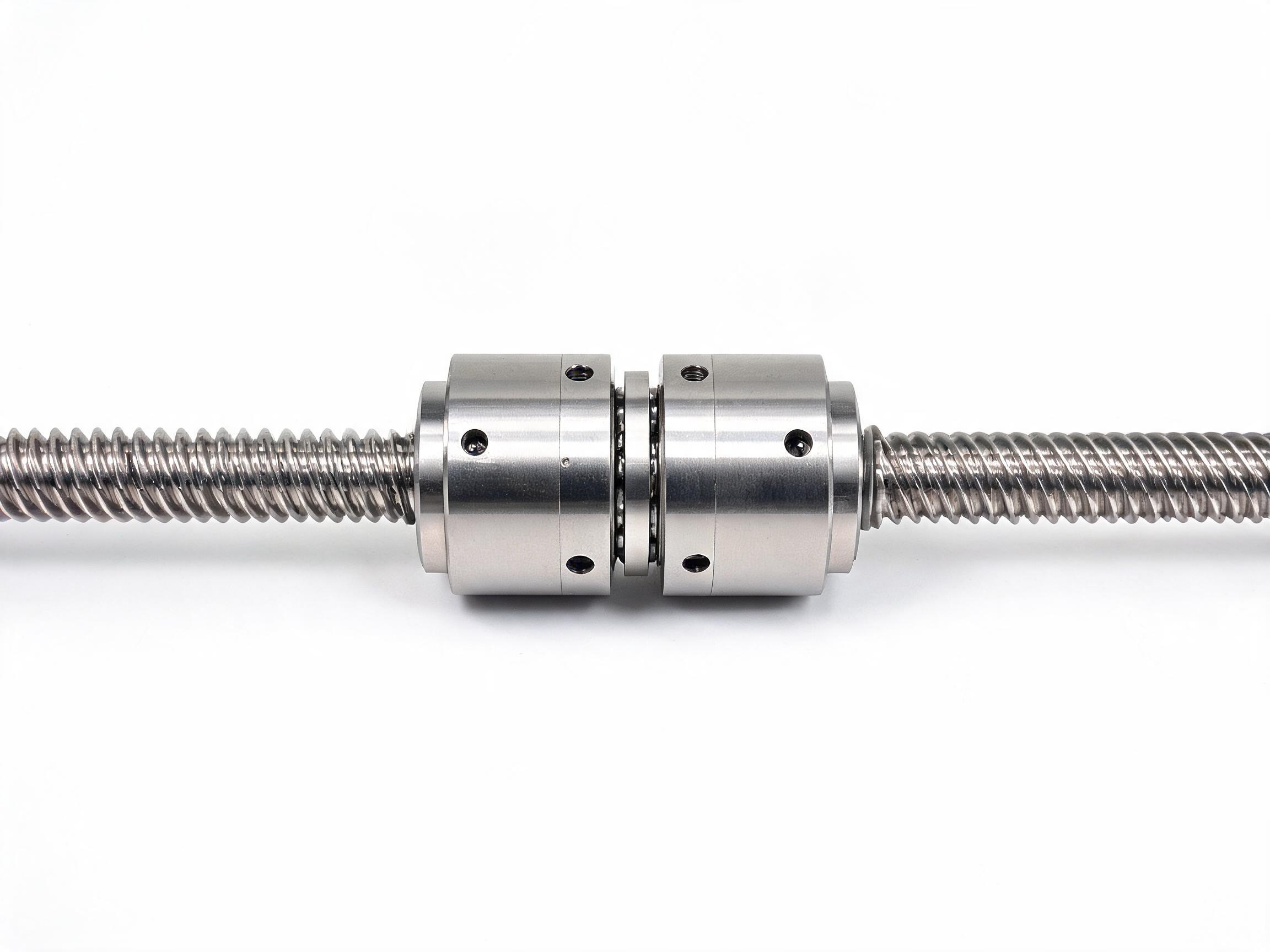
A pre-order checklist for custom linear motion systems — drive, guide, accuracy, environment, and order terms. Covers SFU, DFU, HGR, and SFE series so buyers know what must be fixed before a supplier can quote.
Buyer guide · linear motion system custom
A custom linear motion system is a drive plus a guide, sized and machined for one application. Before a supplier can quote either part, several decisions have to be fixed on your side: the ball screw series and length, the guideway size and rail length, the preload and accuracy class, how the ends are machined, and the order quantity. This checklist walks through those decisions using the three ball screw series and the one guideway series this product line actually offers.
What this checklist covers
- 1. Drive side: screw series, length, accuracy, preload
- 2. Guide side: rail size and rail length
- 3. Accuracy: which number to fix and which to ask about
- 4. Environment: the condition that changes the answer
- 5. Order terms: MOQ and what “custom” actually covers
- 6. A one-page specification template
- 7. FAQ
1. Drive side: screw series, length, accuracy, preload
The drive side of a linear motion system is usually a ball screw. Three ball screw series are available for the drive side, and they differ in ways that change what you can request:
| Series | Process / accuracy class | Length range | Key order-definable items | MOQ |
|---|---|---|---|---|
| SFU rolled | Rolled, C7; axial accuracy ±0.05 mm per 300 mm | 300–1500 mm | Length, end machining, preload class | 50 |
| DFU double nut | Rolled C7 or ground C5; preload P0/P1/P2; axial play listed as below 0.003 mm for the series; shaft 16–40 mm | 300–2000 mm | Length, end machining, preload class (P0/P1/P2) | 20 |
| SFE ground | Ground, C5 | 200–1200 mm | Length, end machining, preload class | 10 |
Source: product records. Length, end machining and preload class are order-definable per product records; anything beyond these — special materials, coatings, special accuracy — must be written as “confirm with the supplier / refer to the datasheet”. The axial play figure is listed for the DFU series as a whole; which value applies to each P0/P1/P2 preload grade is a separate item to confirm with the supplier before either is written on a purchase order.
What each column tells you
Series and process. The SFU rolled series uses rolled screws with C7 axial accuracy ±0.05 mm per 300 mm. The DFU series comes in rolled C7 or ground C5, with a double nut and preload classes P0/P1/P2, and the series lists axial play below 0.003 mm. The SFE series is ground C5. If your application needs the tightest axial play available, the DFU double-nut series with a specified preload grade is the place to look; if you need a ground screw at low volume, SFE has a MOQ of 10.
Shaft diameter. The DFU series covers 16–40 mm. For the SFU and SFE series, state the shaft diameter you need and confirm the available sizes with the supplier, because it sets the screw blank as well as the nut and the end-support size.
Length. SFU covers 300–1500 mm, DFU covers 300–2000 mm, and SFE covers 200–1200 mm. Fix the length early, because it drives both the screw blank and how much travel the system can support.
End machining. This is order-definable per product records. You need to supply a journal, shaft, or drawing for the motor/ coupling interface. If your drawing is not final, say so: the supplier can only quote end machining once the interface is defined.
Preload class. The DFU series lists P0/P1/P2. Preload is not a free-floating preference: it has to be specified because it changes how the screw is assembled. SFU and SFE also list preload class as order-definable in product records; confirm the available classes for each series with the supplier.
2. Guide side: rail size and rail length
The guide side is the HGR series heavy-duty linear guideway rail. It comes in six sizes: 15, 20, 25, 30, 35, and 45. Maximum rail length is 4000 mm, and MOQ is 50.
Two numbers matter most on the guide side:
- Rail size (15/20/25/30/35/45) sets the rail profile and the matching carriage. It is not a length decision; it is a load and stiffness decision.
- Rail length (up to 4000 mm) sets the travel and the mounting footprint. If your travel exceeds what one rail can provide, the system needs more than one rail or a different layout, not a longer rail from this catalog.
Rail size selection is normally driven by the required load and moment capacity. That data should come from the load calculation for your machine, not from a generic default. If you have not calculated loads yet, specify the load case and let the rail size be an open item until the calculation is done.
3. Accuracy: which number to fix and which to ask about
Accuracy is the most common source of back-and-forth in custom linear motion system orders, because “accurate” is not a number. Fix the specific number you need:
- SFU rolled C7: axial accuracy ±0.05 mm per 300 mm is the listed number. If your requirement is tighter than that, this series is not the match.
- DFU double nut: axial play below 0.003 mm is listed for the series as a whole. That is a play figure, not the same measurement as axial accuracy; they answer different questions. Which value applies to the P0/P1/P2 grade you order must be confirmed before it goes on a purchase order.
- SFE ground C5: listed as ground C5. If you need a specific per-300-mm accuracy figure for C5, confirm with the supplier / refer to the datasheet.
Special accuracy beyond the listed classes must be written as “confirm with the supplier / refer to the datasheet”. Do not assume a tighter class is available; ask explicitly and record the answer on the purchase order.
4. Environment: the condition that changes the answer
The environment affects what the product line can actually be ordered in. The listed order-definable items are length, end machining, and preload class. That means:
- Standard materials and coatings are what the listed series come in. If your environment requires a special material or coating, that is a “confirm with the supplier / refer to the datasheet” item, not a routine option.
- Ambient conditions (temperature, dust, washdown, vacuum) should be stated on the inquiry even when no special material is requested, because the answer may affect which series is recommended.
- Mounting orientation matters because vertical or inclined axes load the screw and guide differently. State the orientation, not just the stroke.
For a first quote, write the environment as a short paragraph rather than a checklist. The supplier needs the condition; whether a special material is available is a separate question to confirm.
5. Order terms: MOQ and what “custom” actually covers
MOQ varies by series: SFU is 50, DFU is 20, SFE is 10, and HGR is 50. A system order mixes at least one screw series with one guideway series, so the effective order has to satisfy both MOQs. If your quantity is below one series’ MOQ, that series is not the right match for this order.
The custom scope, in one sentence
Length, end machining, and preload class are order-definable per product records. Anything beyond these — special materials, coatings, special accuracy — must be written as “confirm with the supplier / refer to the datasheet”. If your request falls outside those three items, put it in a separate “to confirm” line on the inquiry so it does not get mixed into the standard quote.
Related product references for each part of the system:
- SFU series rolled ball screw assembly
- DFU series double nut zero-backlash ball screw
- HGR series heavy-duty linear guideway rail
6. A one-page specification template
Use this structure in the inquiry. It fixes the decisions a supplier needs before quoting and leaves the genuinely open items visible.
| Item | What to write | Fixed or to confirm? |
|---|---|---|
| Screw series | SFU, DFU, or SFE | Fixed |
| Screw shaft diameter | DFU within 16–40 mm; SFU and SFE: state the size and confirm availability | Fixed or confirm |
| Screw length | Within the series range (SFU 300–1500; DFU 300–2000; SFE 200–1200 mm) | Fixed |
| Screw process / class | Rolled C7 or ground C5, as listed for the series | Fixed |
| Preload class | DFU: P0/P1/P2; other series: state the class and confirm | Fixed or confirm |
| Axial play figure | DFU series lists below 0.003 mm; confirm the value for the chosen preload grade | To confirm before the PO |
| End machining | Journal drawing or interface definition | Fixed |
| Rail size | 15/20/25/30/35/45 | Fixed |
| Rail length | Up to 4000 mm | Fixed |
| Environment | Temperature, dust, washdown, vacuum, orientation | Fixed (condition) |
| Special material / coating / accuracy | State the requirement | To confirm with supplier / datasheet |
| Quantity | At or above the relevant MOQ (SFU 50; DFU 20; SFE 10; HGR 50) | Fixed |
7. FAQ
Can I mix a DFU screw with an HGR rail in one system?
Both are listed in this product line, and the guide and drive are separate parts. The order still has to meet both MOQs: DFU at 20 and HGR at 50. If your quantity is between those numbers, the MOQ, not the compatibility, is the constraint.
Is preload class available on all three screw series?
The DFU series lists P0/P1/P2 explicitly. For SFU and SFE, preload class is listed as order-definable in product records, but the specific available classes should be confirmed with the supplier.
What accuracy figure should I put on the purchase order?
Put the figure the series lists for the characteristic you are buying. SFU rolled lists C7 axial accuracy ±0.05 mm per 300 mm, which is an accuracy figure. The DFU series lists axial play below 0.003 mm for the series, which is a different measurement from axial accuracy, and the value for the specific P0/P1/P2 grade should be confirmed before it is written on the purchase order. Do not write a generic “high accuracy” note; it cannot be checked against the datasheet.
Can I order a rail longer than 4000 mm?
The HGR series lists a maximum rail length of 4000 mm. A longer single rail is outside that listed maximum; treat it as an open item to confirm with the supplier rather than a standard request.