Two quotes for the same 20 mm linear bushing can land far apart. The gap usually traces back to material and hardness, precision grade, seal and type configuration, flange construction, order quantity, and which dimensional standard the supplier builds to. Here is how each factor works, and a checklist for comparing quotes on a like-for-like basis.
Price comparison
Buyers often ask how much bushings cost, expecting one number they can carry across three suppliers. There is no single market price for a linear bushing. Two quotes for the same nominal bore can describe different products, built to different tolerances, packed and shipped on different terms — and the price reflects those differences rather than a supplier's mood.
Key points
- Price is requested per size and per quantity; it is not published as a single figure for a series.
- Material hardness, precision grade, seal and type configuration all change what is being quoted.
- Standard-compliance and envelope dimensions decide whether two quotes cover the same fit at all.
- A like-for-like comparison fixes grade, seal type, quantity, and the freight and packaging basis.
Material and hardness set the base cost
A linear bushing carries load through a rolling contact between balls and a hardened raceway surface. The bearing steel and its heat treatment therefore define the base of the price, before any dimensional work is quoted.
Both the LM Series and the LME Series metric flange bearing are built from GCr15 chrome steel hardened to HRC 60–64. If a quote for the same bore comes in below a known supplier, the first thing to check is whether the hardness range is stated at all. A specification that repeats the steel grade but never names a hardness band is not comparable to one that does, because the load-carrying capability is set by the hardened surface, not by the steel name alone.
Hardness and material are also where much of the hidden variation sits in low-cost quotes: softer races, unspecified heat treatment, or a steel grade stated without confirmation. None of this is visible in a price column, which is why the specification line matters more than the number next to it.
Precision grade changes the metrology cost
Linear bushings are offered in Normal precision grade, with H5 available on request for LM8 through LM40 (shaft diameters 6–60 mm). Tightening from Normal to H5 means the bore, the outside diameter, and the running clearance are held to a narrower band, which means more gauging, more selective assembly, and more rejects.
That cost is real, and it is the reason two quotes can diverge on a dimension that reads the same on paper. A buyer specifying H5 for a precision application is buying a different inspection regime from one who accepts Normal grade for a general-motion duty. Before comparing two prices, confirm which grade each quote covers; a quote that never names a grade is usually quoting the looser band.
Closed and open types, and the seal configuration
The LM Series is supplied as a closed type (UU) and as an open type (OP). Both share an identical envelope per JIS B 1185 / ISO 10285, so the housing bore and the mounting dimensions do not change when you move between them. What changes is how the load zone is arranged and how the bearing is protected.
Seals are a frequent silent difference between quotes. A sealed configuration adds components, adds assembly time, and adds a sealing step that has to be checked. A quote that lists the type but omits the seal arrangement may be pricing an unsealed or differently sealed part against a sealed one. On a dusty or coolant-exposed machine, that distinction decides service life long before it decides price.
The open type carries a longitudinal slot, which lets the bushing accommodate minor radial adjustment in the housing. That slot is a manufacturing feature, not an accessory, so an open-type quote and a slotless quote cover different parts even at the same nominal bore.
Flange bushings are not plain bushings with a plate added
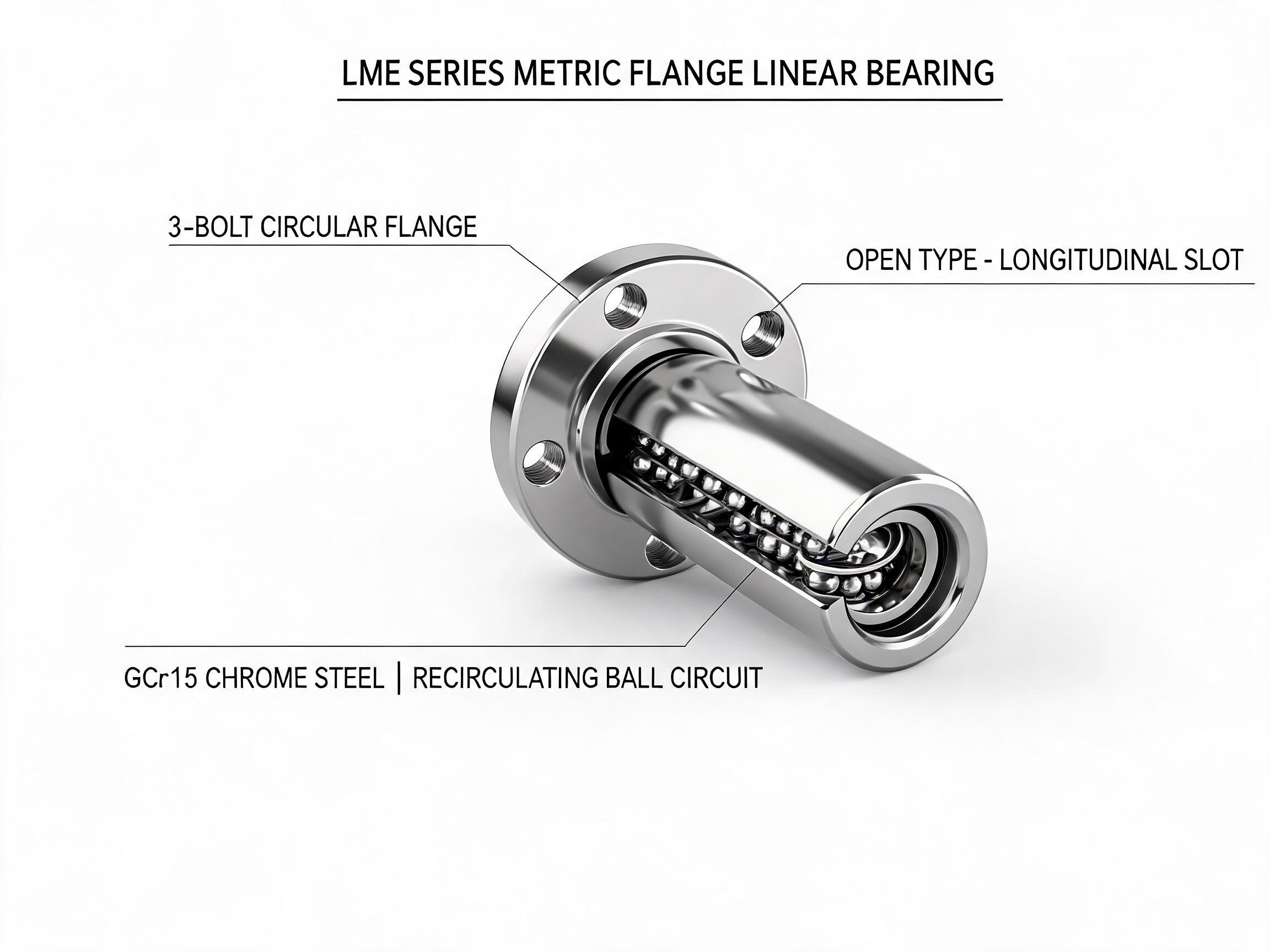
The LME Series metric flange linear bearing uses a circular 3-bolt flange and follows the DIN ISO 10285 LME envelope. It is an open type with a longitudinal slot for minor radial adjustment, and it is dimensionally positioned as a replacement for the SKF LMEF and INA KGNOZ series — subject to verification against your housing drawing, because pilot diameter, bolt circle, and overall length must all match before the part will seat correctly.
That construction involves a flanged outer ring with a bolt pattern and, in the open form, the slot. It is a different manufacturing route from a plain cylindrical bushing, so the two cannot be expected to price alike even when the bore is the same.
The shaft diameter range for the LME Series is 8–60 mm, which overlaps the LM range but does not map onto it one-to-one. A buyer who needs a flanged mounting point is not choosing between two prices for one part; they are choosing between two different mounting solutions.
Order quantity and MOQ
Both the LM Series and the LME Series carry a minimum order quantity of 100 pcs per size. That figure is the point at which a production run is set up and inspected as a batch, and it is the natural basis for quoting.
Quantity affects price for structural reasons: setup and inspection are fixed costs spread across the run, and packaging and documentation scale with the shipment rather than the unit. This is why a price requested for a single size at a single quantity is the only price that can be compared honestly. Asking for "the price of a linear bushing" invites an answer that has to assume a quantity, a grade, and a seal type — and the assumption will differ between suppliers.
Prices should be requested per size and per quantity. Any figure given without both of those inputs is an assumption, not an offer.
JIS and DIN compliance: same size, different envelope
Nominal bore is a designation. Two bushings marked 20 mm can sit in different housing envelopes if one is built to a JIS dimensional system and the other to a DIN system. The LM Series follows JIS B 1185 / ISO 10285; the LME Series follows the DIN ISO 10285 LME envelope. These are related but not interchangeable on every dimension.
When a quote omits the standard, the price cannot be placed against a competing quote, because the underlying part may not fit the same housing. This is the single most common reason a like-for-like comparison fails before price is even discussed.
| Comparison point | LM Series | LME Series metric flange bearing |
|---|---|---|
| Type | Closed (UU), open (OP) | Open type with longitudinal slot |
| Envelope / standard | JIS B 1185 / ISO 10285 | DIN ISO 10285 LME |
| Mounting | Cylindrical housing bore | Circular 3-bolt flange |
| Shaft diameter range | 6–60 mm | 8–60 mm |
| Precision grade | Normal; H5 on request (LM8–LM40) | Per series specification |
| Material | GCr15 chrome steel, HRC 60–64 | GCr15 chrome steel, HRC 60–64 |
| MOQ | 100 pcs per size | 100 pcs per size |
A like-for-like quote comparison checklist
Before placing two quotes side by side, confirm that both describe the same thing. The list below is the minimum set of fields that have to match.
- Same precision grade. Normal or H5, stated explicitly on both quotes.
- Same type and seal configuration. Closed (UU) or open (OP); sealed arrangement named.
- Same mounting form. Plain cylindrical bushing or flanged, with the flange pattern identified.
- Same standard and envelope. JIS B 1185 / ISO 10285 or DIN ISO 10285 LME, with the housing drawing cross-checked.
- Same material and hardness. Steel grade plus the HRC band, not just one of the two.
- Same shaft diameter and quantity. One size, one quantity per line; MOQ noted.
- Same freight and packaging basis. Ex-works, FOB, or delivered — and what the packing quantity covers.
- Same documentation scope. Inspection records or dimensional reports included or not, agreed in advance.
Where a quote leaves a field blank, that field is the first question to send back. It is usually faster to close the gap on specification than to negotiate on a number that was never comparable.
Frequently asked questions
Can I get one price for a linear bushing size?
No. Price is quoted per size and per quantity, because grade, seal type, and order volume all change the part and the run. Supply the bore, the grade, the type and seal arrangement, and the quantity you intend to order.
Why is an H5 quote higher than a Normal-grade quote for the same bore?
H5 holds the critical dimensions to a narrower band, which requires more gauging and selective assembly across the production run. It is a stricter inspection regime for the same nominal size.
Are the LM and LME Series interchangeable?
They serve different mounting needs. The LM Series fits a cylindrical housing bore; the LME Series bolts to a housing through a circular 3-bolt flange. Even at the same bore, verify dimensions against your housing drawing before substituting one for the other.
What should I include in a price request?
Shaft diameter, precision grade, closed or open type, seal configuration, plain or flanged, quantity in pieces, and the freight and packaging basis you want quoted.
Where to go next
Review the full dimensional data for the LM Series linear ball bearing bush and the LME Series metric flange linear bearing, then send your size, grade, type, and quantity for pricing.