
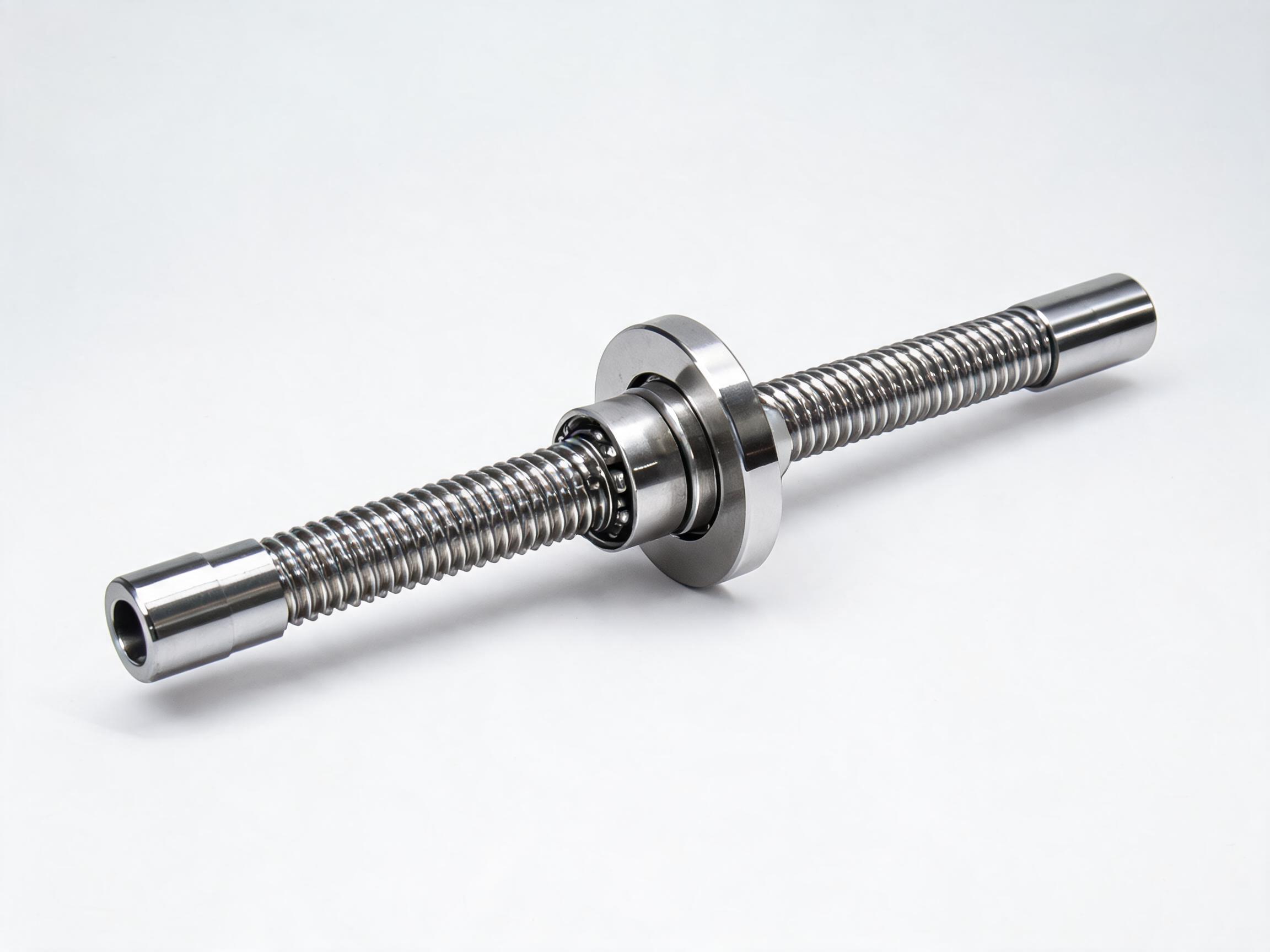
A buyer's guide to what ships in a ball screw nut assembly, how to choose between a flange nut and a nut housing, and the mounting checks that preserve preload. Covers SFU and DFU series from Xiamen Dongfeng Bearing.
When you order a ball screw nut assembly, what actually arrives in the crate depends on how you specify the order. A nut alone, a nut with a flange, or a complete shaft assembly with end machining and a pre-loaded nut fitted are three different purchasing decisions. Each one changes what you have to do in your own workshop before the axis moves.
This article covers the SFU and DFU series from Xiamen Dongfeng Bearing: what ships complete, when to choose a flange nut versus a separate nut housing, which bearing blocks match, and the mounting checks that keep preload intact after installation.
- Contents of a complete SFU assembly, including end machining and preload.
- Flange nut versus nut housing: who owns the interface decision.
- Bearing block pairing for SFU1605 and SFU2510.
- Mounting checks that protect the preload you paid for.
- FAQ on lubrication, backlash, and custom housings.
What arrives in the box when you order a complete ball screw assembly
The SFU rolled ball screw assembly ships as a complete unit. Both shaft ends are machined, and a pre-loaded flange nut is fitted to the shaft before packing. For standard BK/BF block configurations, no secondary turning is needed on your side. You mount the bearing blocks, attach the nut housing to the machine frame, and the axis is ready for commissioning.
That matters for schedule and for risk. End machining is where dimensional errors most often appear when a buyer tries to finish a shaft in-house, and a nut that has been removed and refitted without the right preload procedure can lose its original setting. Ordering the assembly complete removes both steps from your critical path.
The SFU1605 and SFU2510 are representative of the series:
- SFU1605 — 16 mm shaft, 5 mm lead, pre-loaded flange nut with a four-hole M4 flange pattern that matches standard SFU1605 nut housings following the same pattern, and end-machined for BK12/BF12 bearing blocks. It drops into existing designs without a new housing drawing.
- SFU2510 — 25 mm shaft, 10 mm lead, pre-loaded single flange nut, end-machined for BK25/BF25 blocks.
- DFU series — double nut with a precision spacer pre-load, specified for backlash under 0.003 mm.
The nut body carries a lubrication port for grease or oil, so the lubrication point stays accessible after the housing is fitted. Exact flange dimensions and housing bore follow each datasheet; use those numbers when you check fit against your frame drawing.
Flange nut versus nut housing: who decides what
This is the decision that most often causes a delay between order and installation. A flange nut and a nut housing are not alternatives to each other. The flange nut is the load-carrying element; the housing is the adapter that connects the nut flange to your machine frame.
On SFU1605, the four-hole M4 flange pattern matches standard SFU1605 nut housings that follow the same pattern. If your design already uses a standard housing, the flange nut is the part you specify and the housing is a commodity item you can source locally or with the screw. The interface is defined by the standard pattern.
The decision becomes yours when one of the following applies:
- Your frame has a non-standard bolt pattern or offset, and no standard housing will seat squarely.
- You need a specific housing bore or overall height to clear other components on the axis.
- You are designing a new machine and want the nut housing to be part of the screw supply rather than a separate purchase.
For custom nut housing designs, availability depends on order size; confirm with the supplier before you freeze your drawing. For standard configurations, the flange pattern on the nut is the reference, and the housing is chosen to match it.
One practical point: if you buy the nut and housing from different suppliers, check the flange pattern against the housing drawing before you commit. The M4 four-hole pattern on SFU1605 is widely standardized, but the housing bore and mounting face still need to match your datasheet.
Matching support bearing blocks
Bearing blocks carry the axial load and set the shaft position. The assembly is end-machined to match specific block sizes, so the block model and the screw model must be ordered as a pair.
| Assembly | Shaft / lead | Bearing blocks | Nut configuration |
|---|---|---|---|
| SFU1605 | 16 mm / 5 mm | BK12 / BF12 | Pre-loaded single flange nut, four-hole M4 flange pattern |
| SFU2510 | 25 mm / 10 mm | BK25 / BF25 | Pre-loaded single flange nut |
| DFU series | 16–40 mm shaft, 5 / 10 / 20 mm lead (size-dependent) | BK / BF series, size-matched | Double nut with precision spacer pre-load, backlash under 0.003 mm |
If your design uses a different block size, the end machining has to match it. That is a specification item at the order stage, not something to correct after delivery.
Mounting checks that protect preload
Preload is set at assembly. The checks below are about not disturbing it during installation.
Clean the shaft and the housing seat
Contamination on the shaft or under the housing seat can tilt the nut or introduce a point load. Wipe the shaft and the mounting face before assembly, and keep the protective wrapping on the nut until the moment it is fitted.
Seat the housing square
The nut housing must sit flat on the frame. A housing that rocks on a burr or a paint run will transfer a bending moment into the nut. Check the seat with a straightedge before tightening, and confirm the housing bore matches the datasheet.
Keep the lubrication port accessible
The nut body has a lubrication port for grease or oil. Route the housing and nearby components so the port can be reached with a grease gun or oil line after assembly. A port that is blocked by the frame is a maintenance problem that shows up later.
Do not clamp the nut while it is unclamped from the shaft
This is the check that most directly protects preload. If the nut is held in a vise or clamped to a fixture while it is off the shaft, the balls can shift and the preload setting can change. Keep the nut on the shaft or in its supplied retainer during handling. When the assembly is complete, mount the bearing blocks first, then attach the nut housing, and tighten in a sequence that does not pull the nut off-axis.
For DFU double-nut assemblies, the spacer sets the preload. Do not adjust or remove the spacer during installation; if the backlash specification matters to your application, confirm the assembly is undisturbed before commissioning.
FAQ
Does the SFU1605 nut fit standard nut housings from other suppliers?
The SFU1605 nut has a four-hole M4 flange pattern that matches standard SFU1605 nut housings following the same pattern. Check the housing bore and mounting face against your datasheet before ordering.
Can I order a custom nut housing?
Custom nut housing designs are available on larger orders. Confirm the drawing and order quantity with the supplier before finalizing your design.
What is the backlash on the DFU series?
The DFU series uses a double nut with a precision spacer pre-load, specified for backlash under 0.003 mm.
Do I need to machine the shaft ends after delivery?
No, for standard BK/BF block configurations. The SFU rolled ball screw assembly ships with both shaft ends machined and a pre-loaded flange nut fitted.
How is the nut lubricated?
The nut body has a lubrication port for grease or oil. Keep the port accessible after the housing is fitted.
Next step
If you are specifying a ball screw for a new axis or replacing a worn assembly, start with the shaft diameter and lead, then match the bearing blocks. The SFU series rolled ball screw assembly covers the standard range with end machining and pre-loaded flange nuts. For a 25 mm shaft with 10 mm lead, see the SFU2510 assembly with flange nut. Where backlash under 0.003 mm is required, the DFU series double nut zero-backlash ball screw uses a precision spacer pre-load.