
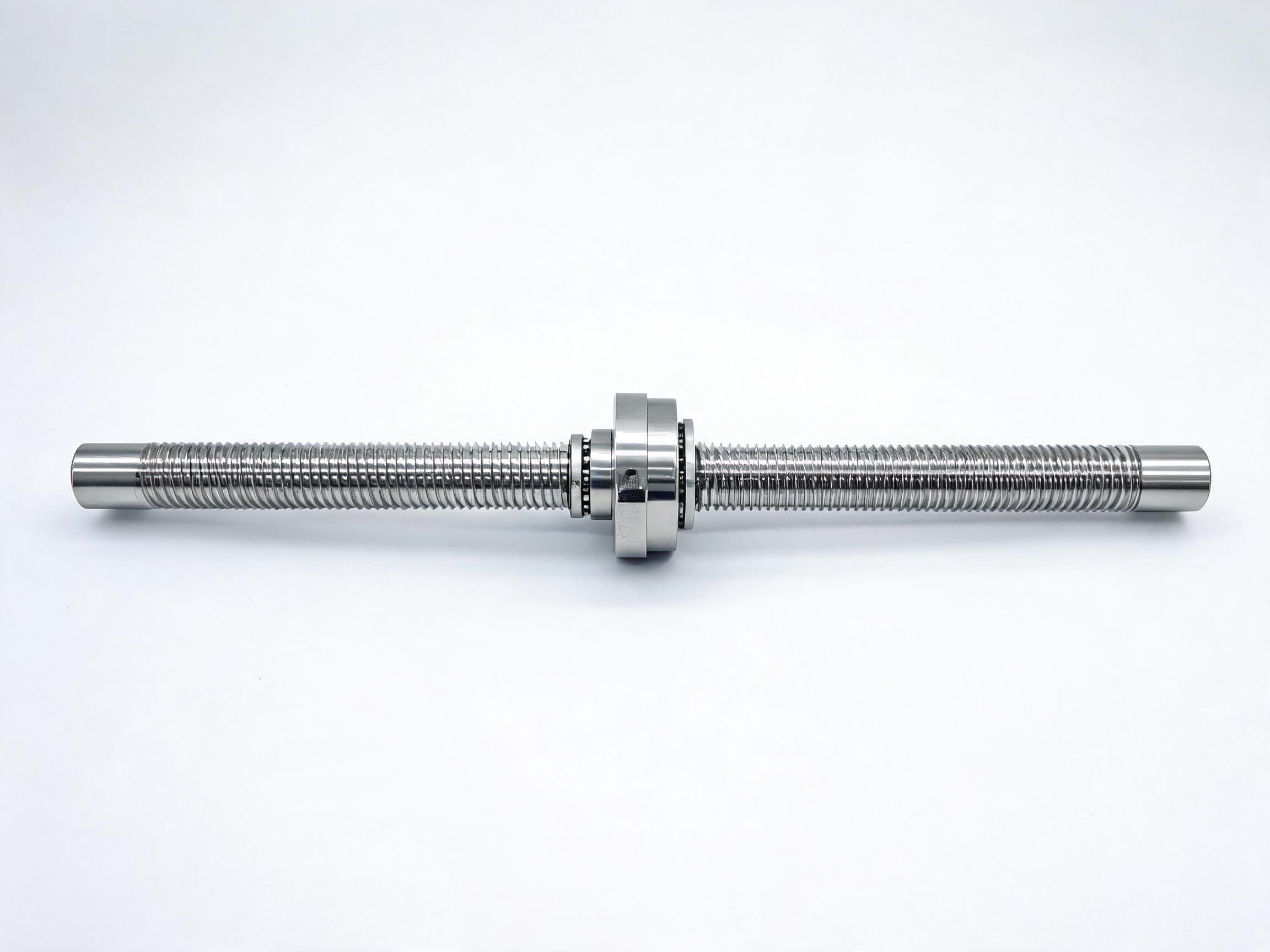
Ball screw datasheets list two load figures, and they answer different questions. This article explains what the static and dynamic ratings mean, where each one limits a machine axis, and how to choose between them using published figures for the SFU3205 and DFU/SFU2005 series as worked examples.
Open any ball screw datasheet and you will find two load figures side by side: a static load rating and a dynamic load rating. The dynamic rating is usually the one engineers quote first, because it drives the life calculation. That is fine for a horizontal axis running continuously, and it is exactly the wrong number to design against on a vertical axis that has to hold a load at standstill or survive a crash. This article sets out what the two ratings actually describe, where each one governs your design, and how to size an axis with them using published figures for our SFU3205 and SFU/DFU2005 screws as examples.
- The static load rating caps the load a ball circuit can take without permanent raceway deformation, including shock and holding loads while stationary.
- The dynamic load rating is the input to rated travel life under a moving load; it does not describe the axis at standstill.
- For the rolled screws covered here, the static rating is higher than the dynamic rating. On SFU3205 it is 34.8 kN against 22.5 kN dynamic.
- Vertical axes, clamp and hold positions, and crash protection are static-rating problems, even if the screw also runs every day.
- What the static load rating means
- What the dynamic load rating means
- The two ratings side by side, with real figures
- Which rating limits which axis
- Why ball contact area changes the numbers: single nut vs double nut
- A practical sizing checklist
What the static load rating means
The static load rating is the maximum non-operating load the ball circuit can take without permanently deforming the raceways. "Non-operating" does not mean the screw is switched off. It means the balls are essentially at rest relative to the raceway at the point of peak load: a machine sitting with its Z axis parked, a clamp holding a workpiece, a load left hanging overnight, or the instant a slide is driven into a hard stop.
In each of those cases, the balls press into the grooves under the full load. If that pressure passes the static rating, the grooves take a permanent flat, and the screw loses smoothness and positioning consistency from that point on. The damage is not recoverable by re-lubrication. This is why the static figure should be read as a deformation limit rather than a life number.
Shock loads deserve attention here because a crash can put a multiple of the normal running load into the screw in a fraction of a second. The inertia of a moving gantry, or an accidental rapid into a mechanical stop, is exactly the kind of event the static rating covers, and the running load is not a useful guide to it.
What the dynamic load rating means
The dynamic load rating is used for rated travel life calculations under a moving load. It is the figure you pair with the load profile of the axis, over the distance the axis actually travels, to estimate how long the screw will last before fatigue. The load is not constant in most real axes, so the calculation uses an equivalent load that reflects the mix of cutting forces, acceleration and idle segments over a cycle.
What the dynamic rating does not tell you is how much load the screw can sit under without damage. A screw that easily meets a life target with a 5 kN running load can still be undersized if the same axis has to hold 30 kN at standstill.
We deliberately avoid reproducing a life formula here, because the constants and application factors belong on the datasheet and with our engineering team. The principle is simple: dynamic rating in, equivalent moving load in, rated travel life out. Confirm the exact calculation basis for your application before you size the screw to a life target.
The two ratings side by side, with real figures
The easiest way to see how the two figures behave is to put them next to each other for screws from the same families. Note the direction of the gap: in these rolled series the static rating is the higher number.
| Ball screw | Dynamic load rating | Static load rating | Configuration notes |
|---|---|---|---|
| SFU3205 heavy-duty rolled, 32 mm shaft, 5 mm lead, C7 | 22.5 kN | 34.8 kN | Single pre-loaded flange nut; lead accuracy ±0.05 mm/300 mm; standard lengths 500–4000 mm; BK32/BF32 support blocks |
| SFU2005 single nut | 6.8 kN | Not listed in the source figures | Single-nut reference point in the same comparison |
| DFU2005 double nut | 10.2 kN | Not listed in the source figures | About 1.5× the SFU2005 dynamic rating due to doubled ball contact |
SFU3205 is the worked example throughout this article because it is a screw where the gap between the two ratings is large enough to matter. A 34.8 kN static capability against a 22.5 kN dynamic rating means a designer who only reads the dynamic column will assume the screw has one limit when it actually has two, and they are separated by roughly half the smaller figure.
The full specification for this screw, including dimensions and nut configuration, is on the SFU3205 heavy-duty rolled ball screw page. The other rolled assemblies, including the smaller sizes, are listed under the SFU series rolled ball screw assembly.
Which rating limits which axis
The single question that decides which number governs your design is: does the screw ever carry load while the balls are not rolling? If the answer is yes, the static rating applies to that condition, regardless of what the axis does the rest of the time.
Vertical axes
On a Z axis, the screw often carries the weight of the slide, spindle or tooling while the axis is holding position. If the axis is parked with the brake engaged and the load on the screw, that is a static condition. The static rating is the ceiling for that holding load, not the dynamic rating. The same applies to a counterbalance failure case, where the screw may briefly take the whole vertical load alone.
Clamping, pressing and hold positions
Any axis that dwells under load, such as a press, clamp or indexing station, has a static condition at every dwell. A duty cycle full of holds can therefore be governed by the static rating even though the axis moves a short distance between them.
Crash and end-stop protection
Mechanical hard stops, over-travel events and emergency stops produce loads that are far above the running load. The static rating is the figure that describes the screw's tolerance to that event. Where a crash is plausible, the static rating and the way the load reaches the screw deserve to be checked explicitly rather than left to the axis's normal rating.
Horizontal axes with continuous motion
On a horizontal axis that only ever moves, the static condition is rare and small, and the dynamic rating plus a life calculation is the correct basis. Even here, check for a park position, a clamp or a hard stop before you dismiss the static side entirely.
Why ball contact area changes the numbers: single nut vs double nut
Both ratings scale with the number of balls carrying load, which is why nut configuration changes the load figures on screws of the same shaft diameter. The SFU2005 single nut carries a dynamic rating of 6.8 kN. The DFU2005 double nut reaches 10.2 kN, about 1.5× higher, because the doubled ball contact spreads the load over more balls.
This comparison is useful for two reasons. First, it shows that when you compare screws, you must compare like configurations: a single nut and a double nut on the same shaft are not interchangeable load-wise. Second, it illustrates the mechanism behind both ratings: more balls sharing the load means a higher limit in both the static and dynamic cases. The DFU series double nut zero-backlash ball screw page gives the full configuration details for that family.
The practical point for sizing is that if a single nut is marginal on either rating, a double nut on the same shaft is one way to raise the ceiling, and it also changes the pre-load and backlash behaviour. That trade should be made on the datasheet figures, not on the shaft diameter alone.
A practical sizing checklist
The checklist below is the sequence we would walk through with a customer before confirming a screw for a given axis. It is deliberately about which figures to use, not about fixed safety factors, because application factors depend on the machine, the duty cycle and the consequence of failure. Confirm those factors with the datasheet and our engineering team.
- Map the load cases. List every condition the screw sees: normal running, acceleration peaks, any dwell or hold under load, any parked position, and any credible crash or over-travel event.
- Split them into moving and stationary. Cases where the balls are rolling go to the dynamic side; cases where the screw is at rest under load go to the static side.
- Size the moving cases against the dynamic rating. Use the equivalent moving load over the actual travel and cycle, and check the result against the life the machine needs.
- Size the stationary cases against the static rating. The peak stationary load, including shock and holding loads, is compared with the static figure for the nut configuration you intend to use.
- Compare configurations, not just diameters. A double nut raises both ratings on the same shaft. If either check is marginal, look at the nut configuration before changing shaft size.
- Confirm application factors with the datasheet and engineering team. The consequence of a bearing or screw failure, the shock profile and the duty cycle all affect the factors that should be applied.
For an axis where the initial check comes out close to either limit, the honest answer is that the sizing needs another iteration with the real load data, not a rule of thumb. A screw chosen on shaft diameter alone has not been checked at all.
Frequently asked questions
Why is the static rating higher than the dynamic rating?
The two ratings describe different failure modes. The static rating is a deformation limit at rest, where the balls do not have to survive repeated rolling contact. The dynamic rating is a fatigue life rating, which accounts for the repeated stress cycling of a moving load. In the rolled series covered here, the static figure is the higher of the two, as shown on SFU3205: 34.8 kN static against 22.5 kN dynamic.
Can I use the dynamic rating for a vertical axis holding a load?
No. A holding load with the axis stationary is a static condition and should be checked against the static rating. The dynamic rating only describes the running portion of the cycle.
Does the SFU3205 static rating cover a crash?
The static rating is the deformation limit for the ball circuit. Whether a specific crash event stays within it depends on the energy and the way the load reaches the screw, so that case needs to be worked through with the actual machine data rather than assumed from the rating alone.
How much does a double nut raise the load capability?
On the 20 mm comparison in our range, the DFU2005 double nut reaches 10.2 kN dynamic against 6.8 kN for the SFU2005 single nut, about 1.5×, because the doubled ball contact shares the load across more balls. The same mechanism raises the static side, but the exact figure should be read from the datasheet for the specific nut you intend to specify.
What lead accuracy comes with the SFU3205?
The SFU3205 is a C7 grade screw with lead accuracy of ±0.05 mm/300 mm. It is supplied in standard lengths from 500 mm to 4000 mm and pairs with BK32/BF32 support blocks.
Next step
If you are sizing a new axis, the useful input is your load cases: the moving load and travel per cycle, any hold or parked load, and the shock event you need to survive. With those, the static and dynamic checks can be run against the published figures for the screw you are considering. The SFU3205 page is a reasonable starting point for a heavy-duty rolled screw in the 32 mm size, and the SFU series overview covers the smaller sizes if the vertical requirement turns out lower than expected.