
A practical guide for machine builders and maintenance buyers on choosing between closed, open, and sealed linear bearings. Learn how each design affects running fit, dust exposure, and shaft wear, with selection criteria and examples from LME and LMUU series.
Why clearance is the decision that shapes linear bearing performance
When replacing a worn linear bearing or specifying one for a new machine, the mounting interface and shaft support often matter more than the bearing's static load rating. The clearance between the bearing's running surface and the shaft determines how the assembly handles misalignment, how easily it moves, and how vulnerable it is to contamination. Three common approaches dominate: closed-type bearings with fixed clearance, open-type bearings that allow adjustment, and sealed variants that add protection. Each has a distinct role in machine design, and the right choice depends on your shaft layout, environment, and maintenance expectations.
This article explains how each approach works, using the LME series metric flange linear bearing and the LMUU series sealed extended-length bearing as examples, and provides a selection checklist for buyers.
Key takeaways
- Closed linear bearings offer a fixed running clearance and suit unsupported shaft ends or simple two-bearing layouts.
- Open linear bearings have a longitudinal slot in the outer ring, allowing fine adjustment of the running fit and accommodating minor shaft deflection.
- Sealed bearings (such as LMUU) add double-lip NBR seals and a labyrinth groove to block dust, with a temperature range of -30°C to +110°C.
- Clearance values per size are given in the datasheet; always verify mating dimensions against drawings when replacing cross-brand bearings.
Closed linear bearings: fixed clearance, simple installation
Closed-type linear bearings are the most straightforward option. The outer ring is a complete cylinder, and the bearing runs on a shaft with a fixed internal clearance determined at manufacture. This design is typically used with unsupported shaft ends, where the shaft is anchored at one end and the bearing supports the load at the other. It also suits simple two-bearing layouts where each shaft carries one or two bearings and the alignment is set by the housing bore.
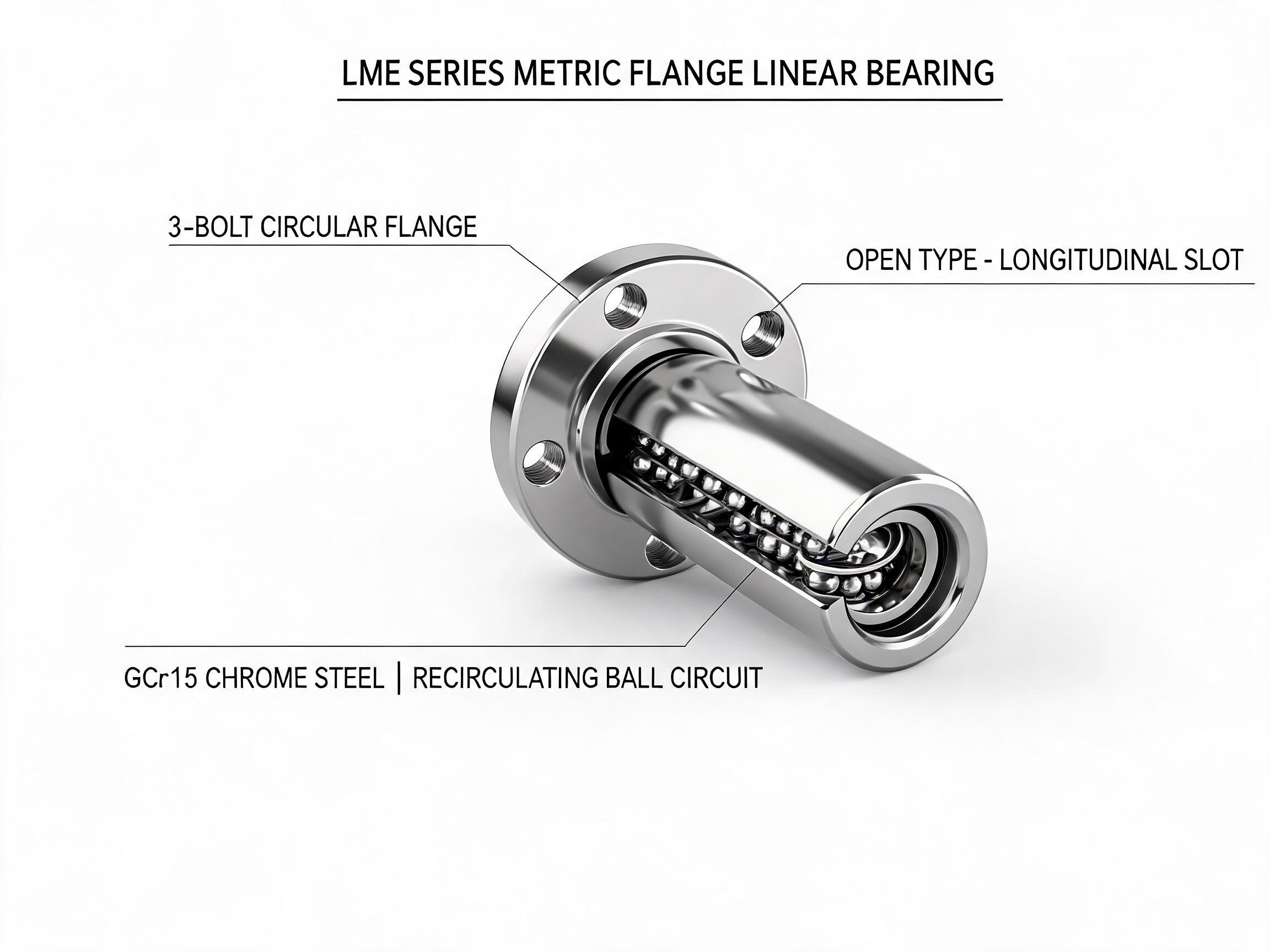
The LME series metric flange linear bearing is a closed-type bearing with a 3-bolt circular flange. The flange allows direct mounting to a vertical or horizontal surface, eliminating the need for separate housing blocks. The UU suffix indicates a sealed version with fixed running clearance around the shaft. Shaft diameters range from 8 mm to 60 mm, and the series follows the DIN ISO 10285 reference for boundary dimensions. Because the clearance is fixed, installation is simply a matter of pressing or sliding the bearing onto the shaft and bolting the flange in place—no adjustment is required or possible.
Fixed clearance works well when the shaft is rigid and well-aligned. However, if the shaft deflects under load or if the housing bore is not perfectly parallel to the shaft, the bearing may run tight on one side and loose on the other, leading to uneven wear and higher friction. In such cases, an open or adjustable bearing is often a better choice.
Open linear bearings: adjustable running fit for supported shafts
Open-type linear bearings feature a longitudinal slot cut through the outer ring. This slot allows the bearing to be compressed slightly when mounted in a housing with an adjustment mechanism—typically a pinch bolt or a tapered wedge—so the running fit against the shaft can be fine-tuned. The slot also provides a location for an anti-rotation pin, preventing the bearing from spinning in its housing.
In the LME series, the open type carries the OP suffix. It is designed for supported shafting, where the shaft is continuous and supported along its length. The ability to adjust the clearance lets you set a slightly firmer or freer fit to compensate for minor shaft deflection over long spans—common in applications with wide travel distances or heavy loads. A firmer fit reduces play and improves positioning accuracy; a freer fit reduces friction and accommodates misalignment.
Open bearings are also easier to install on continuous shafts because the slot allows the bearing to be slipped over the shaft without removing other components. However, the slot makes the bearing more vulnerable to dust ingress, so sealed versions are recommended in contaminated environments.
Sealed variants: protection for harsh environments
Sealing interacts with the closed/open decision rather than combining with it freely. In this range, the LMUU series is the sealed extended closed-type bearing, and the LME series is offered as a sealed closed type (UU suffix) or as an open type (OP suffix). If your layout requires an open bearing in a contaminated environment, plan a separate cover or wiper, because the slot in an open bearing leaves the track exposed.
The LMUU series sealed extended-length linear bearing illustrates a robust sealing approach: it combines double-lip NBR seals with a labyrinth groove. The NBR seals wipe the shaft as it moves, while the labyrinth groove creates a tortuous path that traps particles before they reach the ball raceway.
The extended sleeve body of the LMUU provides additional length for better support and allows drop-in replacement into standard LM housings. The NBR seal material operates from -30°C to +110°C, covering most industrial environments. For machine builders, the key advantage is that the seal is integrated into the bearing, so no separate wiper or cover is needed. This reduces assembly time and ensures consistent protection.
Sealed bearings are particularly valuable in applications exposed to chips, coolant, or fine dust—such as machining centers, woodworking equipment, and packaging lines. The trade-off is additional seal drag: modest at typical industrial speeds, but worth evaluating against the datasheet for high-speed or low-friction axes, and set against the cost of premature bearing failure in a dirty environment.
How to choose: a selection checklist
Use the following criteria to decide between closed, open, and sealed variants. The checklist assumes you have already selected the bearing size based on load and life requirements.
- Shaft support: If the shaft is supported along its full length (continuous), consider open-type bearings for adjustability. If the shaft is unsupported at the end, closed-type bearings are simpler and adequate.
- Alignment and deflection: For long spans or heavy loads where shaft deflection is expected, open bearings allow you to compensate and maintain a consistent fit. Closed bearings may bind if deflection is significant.
- Environment: In dusty, wet, or chip-laden conditions, prefer a sealed type (UU or LMUU) where your layout allows it; if an open bearing is required, add a separate cover. In clean, controlled environments, unsealed bearings may suffice and reduce friction.
- Installation and maintenance: Closed bearings are easiest to install and require no adjustment. Open bearings need a housing with an adjustment feature and a bit more installation time. Sealed bearings simplify maintenance by eliminating separate sealing components.
- Replacement considerations: When replacing a worn bearing, note that envelope dimensions follow the series' JIS/DIN envelope references (DIN ISO 10285 for the LME series), but mating dimensions (such as shaft tolerance and housing bore) must be verified against drawings before ordering. This is especially important when switching brands.
Examples: LME and LMUU in practice
The LME series metric flange linear bearing is available as a sealed closed type (UU suffix) and as an open type (OP suffix). The closed type provides a fixed running clearance and is ideal for unsupported shaft ends; the open type allows adjustment for supported shafts. Both share the same 3-bolt circular flange mounting and cover shaft diameters from 8 mm to 60 mm, conforming to DIN ISO 10285 boundary dimensions.
For harsh environments, the LMUU series sealed extended-length linear bearing offers double-lip NBR seals and a labyrinth groove. Its extended sleeve body fits standard LM housings, making it a drop-in upgrade for applications that previously used unsealed bearings. The seal temperature range of -30°C to +110°C covers most industrial needs.
For detailed specifications and dimensional drawings, refer to the product pages: LME series metric flange linear bearing and LMUU series sealed extended-length linear bearing.
Frequently asked questions
Can I adjust the clearance on a closed linear bearing?
No. Closed bearings have a fixed internal clearance set at manufacture. If you need adjustable clearance, choose an open-type bearing and mount it in a housing with an adjustment feature.
Are sealed bearings available in both open and closed types?
Sealing and the open/closed design are related but distinct choices, and the variants in our range are specific: the LME series is offered as a sealed closed type with the UU suffix and as an open type with the OP suffix, while the LMUU series is a sealed extended-length closed-type bearing. Confirm the exact variant code on the product page or datasheet before ordering.
What is the temperature range of the NBR seals in LMUU bearings?
The NBR seals in LMUU bearings operate from -30°C to +110°C.
How do I know which clearance is right for my application?
Clearance values per size are given in the datasheet. For open-type bearings, the adjustable range allows you to fine-tune the fit on the shaft. For closed-type, the clearance is fixed and specified in the datasheet. Consider shaft support, load, and environment when selecting.
Can I use open-type bearings on unsupported shafts?
Open-type bearings are designed for supported shafting. Using them on unsupported shafts may not provide sufficient rigidity and could lead to misalignment. Closed-type bearings are recommended for unsupported shaft ends.
For further assistance in selecting the right linear bearing for your application, or to request a quote, please contact our technical sales team.