A practical document checklist for qualifying a ball screw supplier: company-level certifications, per-order quality records, material traceability, and how to request verification without relying on published certificate numbers.
When you send a ball screw inquiry, the quotation is only half the answer. The other half is the paperwork that tells you whether the supplier can hold the lead accuracy you specified and whether you can prove it if a shipment goes wrong. This guide covers the documents to request at three levels — company certification, per-order quality records, and material traceability — and how to ask for verification without wasting weeks chasing certificates.
Key Takeaways
- A credible supplier should hold a quality management certificate (ISO 9001:2015 or equivalent) covering design, production and inspection — not just a sales office.
- Per-order documents matter more than company certificates for acceptance: CMM reports, hardness data, lead accuracy measurements and material certificates should accompany every shipment.
- For ground ball screws, request heat-number traceability (e.g., GCr15) at the inquiry stage, because inspection time extends the lead time.
- Certificate numbers and third-party verification links are not always published online. Ask for scanned certificates together with your quotation — a supplier that hesitates to share scans is worth a second look.
What This Article Covers
Level 1: Company-Level Certifications
Company certificates describe the management system, not the specific ball screw in your shipment. They still belong in your qualification file because they show whether design, production, inspection and after-sales run under a documented process. For a ball screw supplier, ask for a quality management certificate that explicitly covers these functions. A certificate that only covers trading or warehousing doesn't tell you much about the machining and inspection steps that determine lead accuracy.
At the company level, a credible supplier should be able to provide:
- ISO 9001:2015 quality management certification covering design, production, inspection and after-sales — check the scope statement on the certificate, not just the logo.
- CE conformity for applicable product lines. For linear guideway and bearing products, CE conformity is relevant; it is not a blanket mark for every ball screw model, so check which products the declaration covers.
- RoHS compliance certificate confirming that components, lubricants and surface treatments are free of restricted substances — relevant if your machine ships into the EU or if your own customer requires it.
- REACH registration compliance for chemical substances in components and treatments, again most often requested for European deliveries.
- SGS material test reports covering bearing steel composition, hardness (58–62 HRC) and dimensional accuracy — these are typically shared as scanned reports.
One practical point: many suppliers, including ours, do not publish certificate numbers or third-party verification links on the website. Scanned certificates are shared with buyers on request. So ask for the scans together with your quotation. A PDF scan with a visible certificate number, issuing body and validity date is what you need for your compliance file; a logo on a homepage is not.
Level 2: Per-Order Quality Documents
Company certificates won't help you accept or reject a specific lot. For that, you need documents generated for the order itself. The standard per-shipment documents are:
- CMM inspection reports — coordinate measuring machine data for critical dimensions.
- Hardness test data — typically reported in HRC, consistent with the 58–62 HRC range for bearing steel.
- Lead accuracy measurements — reported against ISO 3408 grades, so you can compare the result to the grade you ordered.
- Material certificates — see the traceability section below.
Beyond these standard documents, some records are only produced on request: for ground ball screws, GCr15 heat-number traceability and dimensional inspection reports must be specified at the inquiry stage, with the inspection time factored into the lead time. State them when you ask for the quotation, not after the PO.
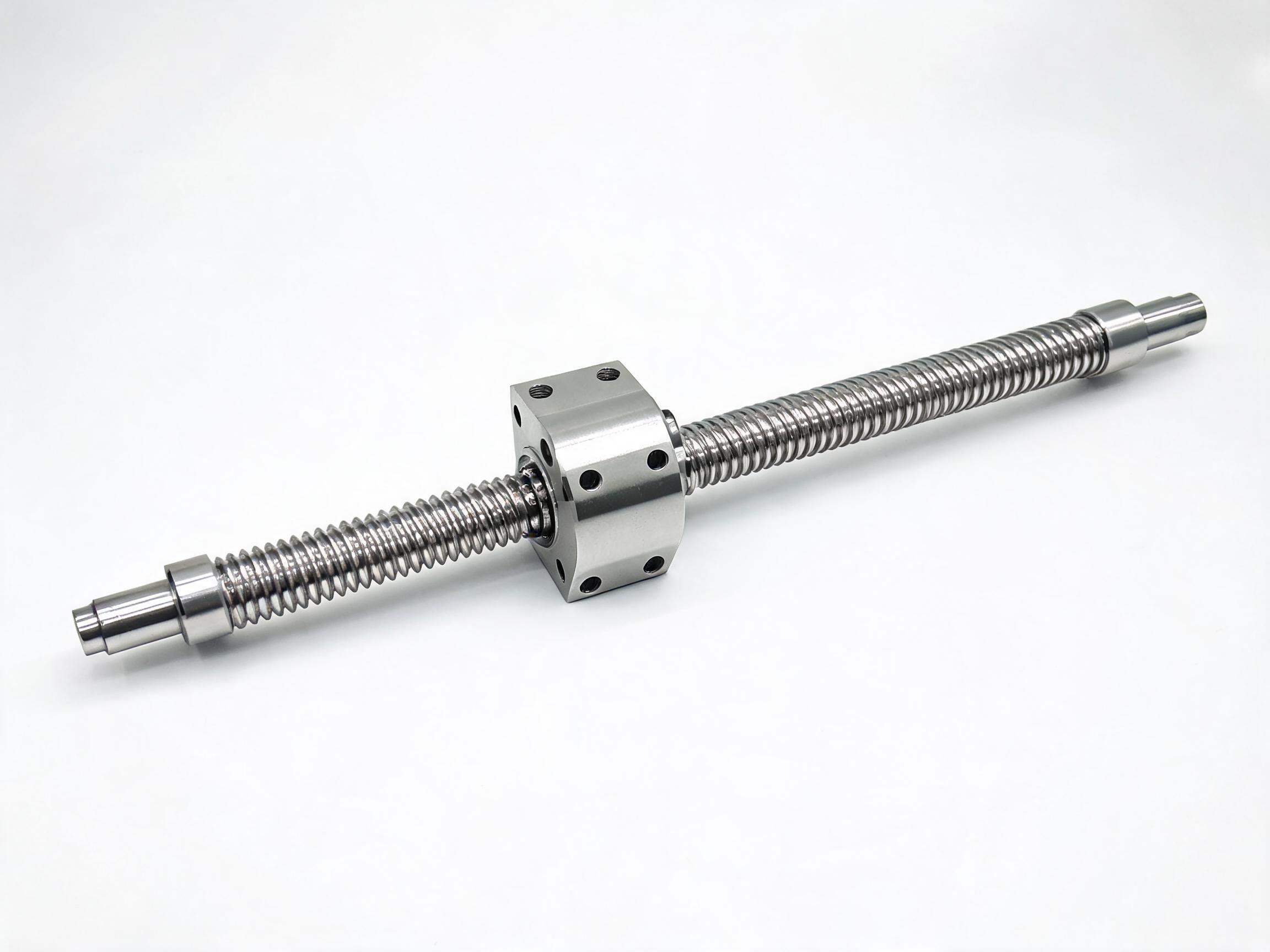
The lead accuracy grade is where per-order data becomes concrete. ISO 3408 grades ball screws by travel deviation; rolled and ground are manufacturing processes, and each can be supplied in different grades. In this catalogue, the SFU1605 rolled screw is supplied at grade C7, ±0.05 mm/300 mm lead accuracy, and the SFE2005 ground screw at grade C5, ±0.008 mm/300 mm. If your drawing or application calls for C5, the per-order report should show measured values consistent with that grade — not just a statement that the product "meets C5."
Similarly, preload data matters for double-nut designs. The DFU series double-nut zero-backlash ball screw is specified with axial play below 0.003 mm. Ask for the preload or axial play measurement on the inspection report if that figure is part of your acceptance criteria.
Level 3: Material Traceability and the GCr15 Heat Number
Material traceability is the step most buyers skip, and it is the one that matters when a failure needs to be investigated. For ball screws made from GCr15 bearing steel, traceability means the heat number on the material certificate can be linked to the lot used for your screws.
What to request depends on the product type:
- For ground ball screws (such as the SFE series ground ball screw assembly), material certificates with GCr15 heat-number traceability and dimensional inspection reports are available on request. Specify this at the inquiry stage, because the inspection time is factored into the lead time.
- For rolled ball screws (such as the SFU series rolled ball screw assembly), standard per-order documents apply; if you need heat-number traceability specifically, state it in the inquiry so the supplier can confirm feasibility before quoting.
The hardness range (58–62 HRC) and steel grade (GCr15) are the two material facts most often checked in a first article inspection. A material certificate that names the grade but omits the heat number is only half a traceability document.
How to Request Verification Honestly
Requesting documents is straightforward; verifying them is where buyers get stuck. A few practical rules:
- Ask for scans with the quotation, not after the PO. A supplier that can send certificate scans alongside pricing is usually working from a real compliance file. Waiting until after payment to see documents puts you in a weak position.
- Match the certificate scope to the product. An ISO 9001 certificate covers the management system, not every product's performance. A CE declaration for linear guideways does not automatically apply to a ball screw. Read the scope line.
- Do not treat a certificate as a product test. A management-system certificate says the process is documented; it does not say your specific screw passed a specific inspection. That is what the per-order CMM and hardness reports are for.
- If a certificate number is not published, ask for the scan. Suppliers may withhold certificate numbers from public pages for privacy or commercial reasons; that is normal. What is not normal is refusing to share a scan with a qualified buyer.
- Note what the supplier cannot confirm. If a supplier cannot provide a document you need, ask what alternative evidence exists. Do not assume the absence of a document means the product is non-compliant — but do factor it into your risk assessment.
A Request Checklist You Can Send Today
Use this table as a template for your first email to a ball screw supplier. It separates what you need at qualification from what you need per order.
| Document | Level | What to Check |
|---|---|---|
| ISO 9001:2015 certificate (scan) | Company | Scope covers design, production, inspection and after-sales; valid date |
| CE conformity declaration | Company | Which product lines it covers (e.g., linear guideway, bearings) |
| RoHS compliance certificate | Company | Components, lubricants and surface treatments listed |
| REACH registration compliance | Company | Substances covered; relevance to your market |
| SGS material test report (scan) | Company | Bearing steel composition, hardness 58–62 HRC, dimensional accuracy |
| CMM inspection report | Per order | Critical dimensions vs. drawing |
| Hardness test data | Per order | HRC values within agreed range |
| Lead accuracy measurement | Per order | Consistent with ordered ISO 3408 grade (e.g., C7 ±0.05 mm/300 mm; C5 ±0.008 mm/300 mm) |
| Material certificate with heat number | Per order | GCr15 heat-number traceability (ground screws: specify at inquiry) |
Two consistent themes run through this checklist. First, company certificates qualify the supplier; per-order documents qualify the shipment. You need both, but they answer different questions. Second, the documents you request late cost you time. Heat-number traceability and dimensional reports on ground ball screws take inspection time, so state them in the inquiry and let the supplier factor them into the lead time. That is a more reliable path than discovering after the PO that a document you assumed was standard is actually a special request.
For a broader view of how these documents map to specific product families, see the SFU rolled ball screw, SFE ground ball screw and DFU double-nut ball screw pages. Each page lists the relevant specifications; the documents above are what you request alongside them. Send the checklist above with your inquiry, and request the scanned certificates in the same email as the quotation.
Frequently Asked Questions
Is ISO 9001 enough to qualify a ball screw supplier?
No. ISO 9001:2015 confirms a documented quality management system covering design, production, inspection and after-sales, but it does not certify the lead accuracy or material of a specific shipment. Pair it with per-order CMM reports, hardness data and material certificates for the lot you receive.
Do ball screws carry FDA certification?
No. FDA registration applies to certain stainless linear bearing variants, not to ball screws. If a supplier claims FDA certification for a ball screw, ask for the specific registration document and the product it covers.
Why don't some suppliers publish certificate numbers online?
Certificate numbers can be withheld from public pages for privacy or commercial reasons. Ask for scanned certificates with your quotation; a scan with a visible issuing body and validity date is what your compliance file needs.
What does ISO 3408 measure?
ISO 3408 grades ball screws by travel deviation; rolled and ground are manufacturing processes, each of which can be supplied in different grades. The per-order lead accuracy measurement should match the grade you ordered (for example, ±0.05 mm/300 mm for a C7 SFU1605 rolled screw, ±0.008 mm/300 mm for a C5 SFE2005 ground screw).