
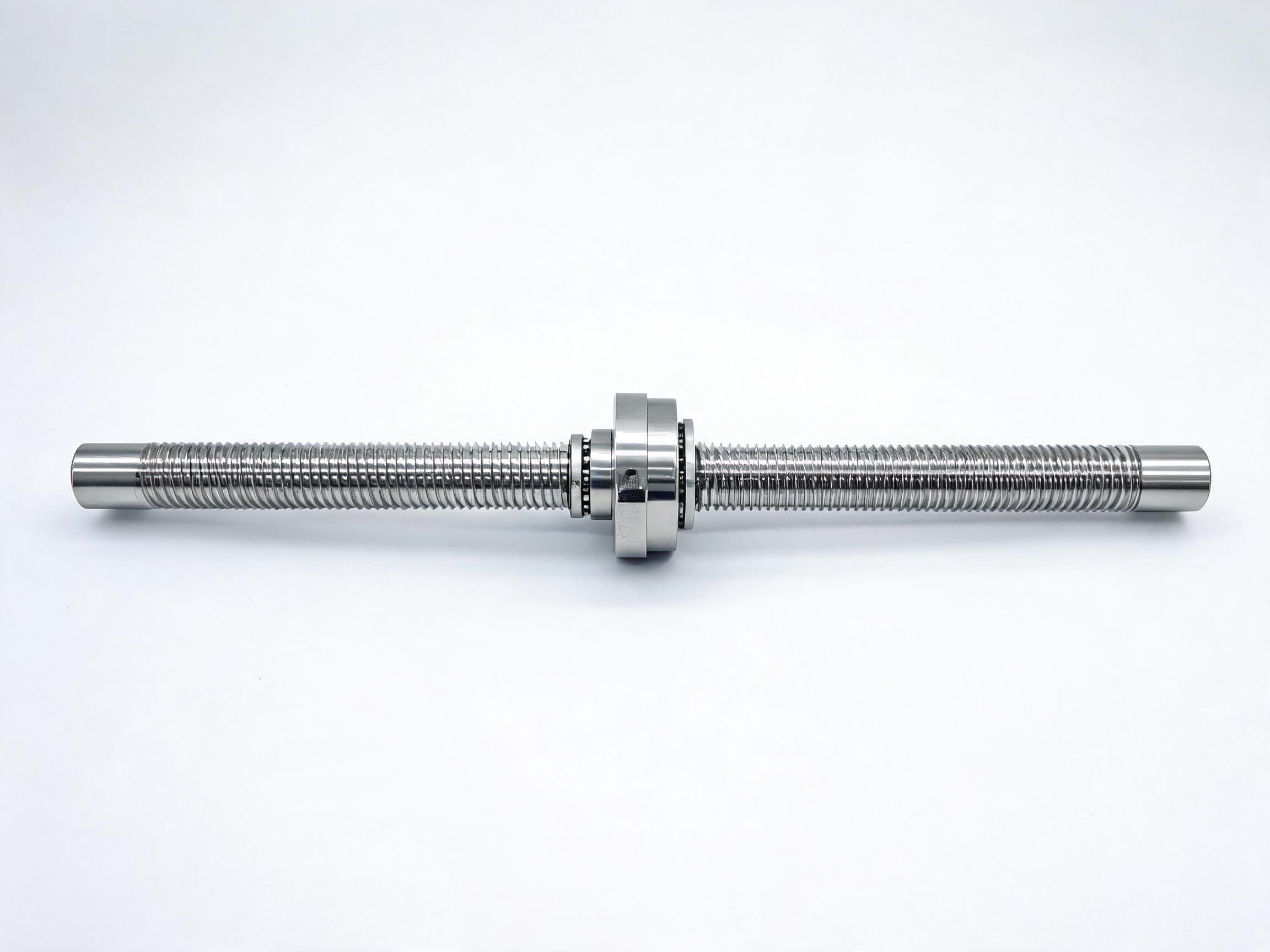
Temperature does not change one number on the datasheet — it changes lubrication behavior, preload stability and accuracy drift. This specification checklist helps OEM buyers select ball screws for warm or hot duty without relying on a fake temperature rating.
Specification Guide
Specifying Ball Screws for High Temperature Service
When you engineer a ball screw axis into a warm or hot environment, you will not find a single temperature rating on the datasheet that tells you whether the screw will work. That is not an oversight. Temperature affects a ball screw through several separate mechanisms—lubrication behavior, preload stability, and accuracy drift—and each requires its own specification decision. The useful approach is a checklist that forces you to state the operating conditions and verify the selected configuration, rather than trusting a generic “max temperature” figure.
Key takeaways
- No verified temperature rating exists for ball screws as a category; permissible temperature depends on lubricant and seal selection for the specific configuration.
- Lubrication is applied through the nut lubrication port; grease or oil are both acceptable, but their high-temperature behavior must be matched to the duty.
- Preload, set by spacer ring width in double-nut designs, can shift as components heat and expand.
- Lead accuracy and axial play are separate from temperature tolerance and must be specified independently.
- Send your operating temperature with the inquiry so the supplier can confirm the lubricant and seal combination.
In this article
What actually degrades in a warm environment
A ball screw is a precision mechanical assembly. Heat changes the dimensions of its steel components and the properties of its lubricant. The shaft is made from GCr15 (52100 equivalent) chrome steel, through-hardened and induction hardened to HRC 58–62. That hardness is stable under the temperatures a ball screw is likely to see, but the assembly around the shaft is where the variables sit.
Lubricant viscosity falls as temperature rises. A grease that performs well at room temperature may thin out or oxidize faster in a warm duty cycle. Oil behaves differently again. Because lubrication is applied through the nut lubrication port, the choice of grease or oil is a maintenance and selection decision, not a fixed feature of the screw.
Preload is set by mechanical interference. In a double-nut design, the spacer ring width determines the preload force. As the screw and nut heat and expand at different rates—or as the spacer ring itself changes dimension—the preload force can shift away from its set value. That affects stiffness and, over time, axial play.
Accuracy drift is the third mechanism. Lead accuracy is specified at a reference condition. In a warm axis, thermal expansion along the screw length changes the effective lead over the stroke. This is not a defect in the screw; it is a condition you must account for when you set the accuracy requirement.
Lubrication: the first decision
Both grease and oil are acceptable for ball screws, and both are fed through the nut lubrication port. The question for a warm or hot axis is which lubricant grade suits the temperature and duty. The product record for the rolled SFU series notes that grease or oil are both acceptable; it does not assign a temperature limit to either. That limit comes from the lubricant supplier and must be confirmed for the specific configuration you order.
This means you should treat lubrication as a line item in your specification, not an afterthought. State whether you intend to use grease or oil, and state the operating temperature you expect at the nut. The supplier can then confirm whether the standard lubricant path is suitable or whether a different seal or lubricant grade is needed. Do not assume that a ball screw sold for general industrial use will accept any warm-environment duty without that confirmation.
Preload stability and accuracy drift
Preload classes for the DFU double-nut series are P0 (light), P1 (medium), and P2 (heavy). The spacer ring width sets the preload force. In a warm axis, the choice of preload class interacts with thermal expansion: a heavier preload leaves less margin for the nut and screw to expand without overloading the contact, while a lighter preload may allow more axial play if the assembly cools and contracts.
Standard lengths for the DFU series run from 300–2000 mm. Over that length, thermal expansion accumulates, so the longer the screw, the more the effective lead changes with temperature. If your accuracy budget is tight, you need to state the expected temperature range and check whether the selected lead accuracy grade leaves room for that drift.
For ground screws, the SFE series offers C5 grade per ISO 3408, with lead accuracy of ±0.008 mm per 300 mm and axial play below 0.005 mm when fitted with a preloaded double nut. The product record also notes that the ground thread geometry produces lower friction heat at high feed rates, described as low thermal growth. That is a design characteristic of the ground thread, not a temperature rating, but it is relevant when you are comparing a ground screw against a rolled screw for a warm duty.
The SFU rolled series is C7 grade with lead accuracy of ±0.05 mm per 300 mm. It uses the same GCr15 shaft material and the same lubrication port arrangement. If your accuracy requirement can accept C7 lead accuracy, the rolled series is a valid starting point, but the temperature question still has to be answered through lubricant and seal selection.
Product family comparison
The table below compares the three ball screw families on the attributes that matter for a warm or hot axis. Note that no column gives a temperature rating, because no verified figure exists; the permissible temperature is a configuration question.
| Attribute | SFU rolled series | SFE ground series | DFU double-nut series |
|---|---|---|---|
| Shaft material | GCr15 (52100 equiv.), through-hardened, induction hardened to HRC 58–62 | GCr15, through-hardened, induction hardened to HRC 58–62 | GCr15, through-hardened, induction hardened to HRC 58–62 |
| Lead accuracy | ±0.05 mm per 300 mm (C7) | ±0.008 mm per 300 mm (C5, ISO 3408) | Depends on nut configuration; preload classes P0/P1/P2 |
| Axial play | Standard | Below 0.005 mm with preloaded double nut | Set by spacer ring width |
| Preload | Not specified in record | Preloaded double nut option | P0 (light), P1 (medium), P2 (heavy) |
| Standard lengths | Not specified in record | Not specified in record | 300–2000 mm |
| Thermal behavior note | — | Ground thread geometry produces lower friction heat at high feed rates (low thermal growth) | — |
| Lubrication | Grease or oil via nut lubrication port | Via nut lubrication port | Via nut lubrication port |
Values are as listed in the product records. Permissible temperature for any configuration depends on lubricant and seal selection and must be confirmed against the datasheet for that specific configuration.
Specification checklist
Use the following checklist to organize your requirement before you contact a supplier. It is not a maintenance routine; it is a selection and verification sequence.
- State the operating temperature at the nut. Give the expected steady-state temperature and any warm-up or cool-down range. This is the input the supplier needs to confirm lubricant and seal selection.
- Declare the lubrication method. Grease or oil, and the intended lubricant grade if already chosen. Both are acceptable through the nut lubrication port, but the grade must suit the temperature.
- Define the accuracy budget including thermal drift. If you need C5 lead accuracy of ±0.008 mm per 300 mm, state whether that budget includes the change in effective lead over your expected temperature range.
- Select a preload class with margin. For DFU double-nut screws, P0, P1, or P2. Consider whether the spacer ring width leaves enough margin for thermal expansion without overloading the contact.
- Confirm axial play requirement. If you need axial play below 0.005 mm, specify the preloaded double nut configuration.
- State the length and stroke. The DFU series covers 300–2000 mm; longer screws accumulate more thermal expansion along the lead.
- Ask for the datasheet for the specific configuration. The permissible temperature is not a catalog constant; it is a property of the lubricant and seal combination you order.
What to send with your inquiry
The most useful single step is to include your operating temperature in the inquiry. With that number, the supplier can check the lubricant and seal selection against the configuration and tell you whether the standard build is suitable. Without it, any answer about temperature is only a general statement, not a confirmation for your axis.
You can review the DFU double-nut series for preload classes and lengths, or the SFU and SFE pages for rolled and ground accuracy grades. When you compare, remember that the temperature question sits outside the accuracy and preload numbers: it is answered by the lubricant and seal specification, and that answer must come from the datasheet for the exact configuration you will install.