Buyers specifying round-shaft linear bearings for lab instruments, medical devices and office-adjacent machines can reduce noise through up-front selection decisions on sealing, fit and preload, shaft surface, support stiffness and lubrication. This guide explains the noise drivers in each area and how the available product lines address them, without implying guaranteed dB outcomes.
Selection Guide
Engineers building lab instruments, medical devices and office-adjacent machines often find that the linear bearing becomes audible once the enclosure is closed. This article treats noise as a selection problem for round-shaft linear bearings, not a fault to trace after commissioning. It covers the conditions that drive noise — sealing, fit and preload, shaft surface, support stiffness, lubrication — and explains how the available product lines address each one, so you can state requirements before ordering rather than troubleshoot after assembly.
Key takeaways
- Noise in round-shaft bearings arises from contact and vibration, so it is decided mostly by sealing, fit, shaft finish, rail rigidity and lubricant condition.
- Seals add drag and can add audible friction; choose them when dust control matters more than the lowest possible running sound.
- Support-rail units such as SBR16/SBR20 stiffen the shaft path and help reduce deflection-related noise compared with unsupported shaft ends.
- Load ratings differ between bare bearings and complete units; verify the figure that applies to the deliverable.
Where noise comes from in round-shaft bearings
A linear bearing is not silent by nature: balls recirculate, seals rub, and the shaft and housing move relative to one another under load. In a quiet instrument, the question is which of these sources will dominate after the machine is assembled. The five levers below each shift the balance. Treat them as requirements to specify, not as guarantees of a dB result — published linear-bearing noise figures are rarely available, and the only bench dB figure referenced in this article is for a ball-screw drive, not a bearing.
Sealing: dust control versus added drag
Contact seals keep contaminants out of the ball circuit, but they also add friction that can become audible. The trade-off is explicit in the LMUU sealed extended-length series: NBR contact seals are rated for 95% dust reduction and an operating range of −30 to 110 °C. If the machine runs in a clean enclosure and the dominant requirement is the lowest running sound, an open bearing may be preferable; if dust, chips or fibres are present, the seal is the more important selection. The spec sheet does not publish a noise penalty for the seal, so the choice is a judgement about the environment, not a dB calculation. Details of the sealed construction are available on the LMUU sealed extended-length linear bearing page.
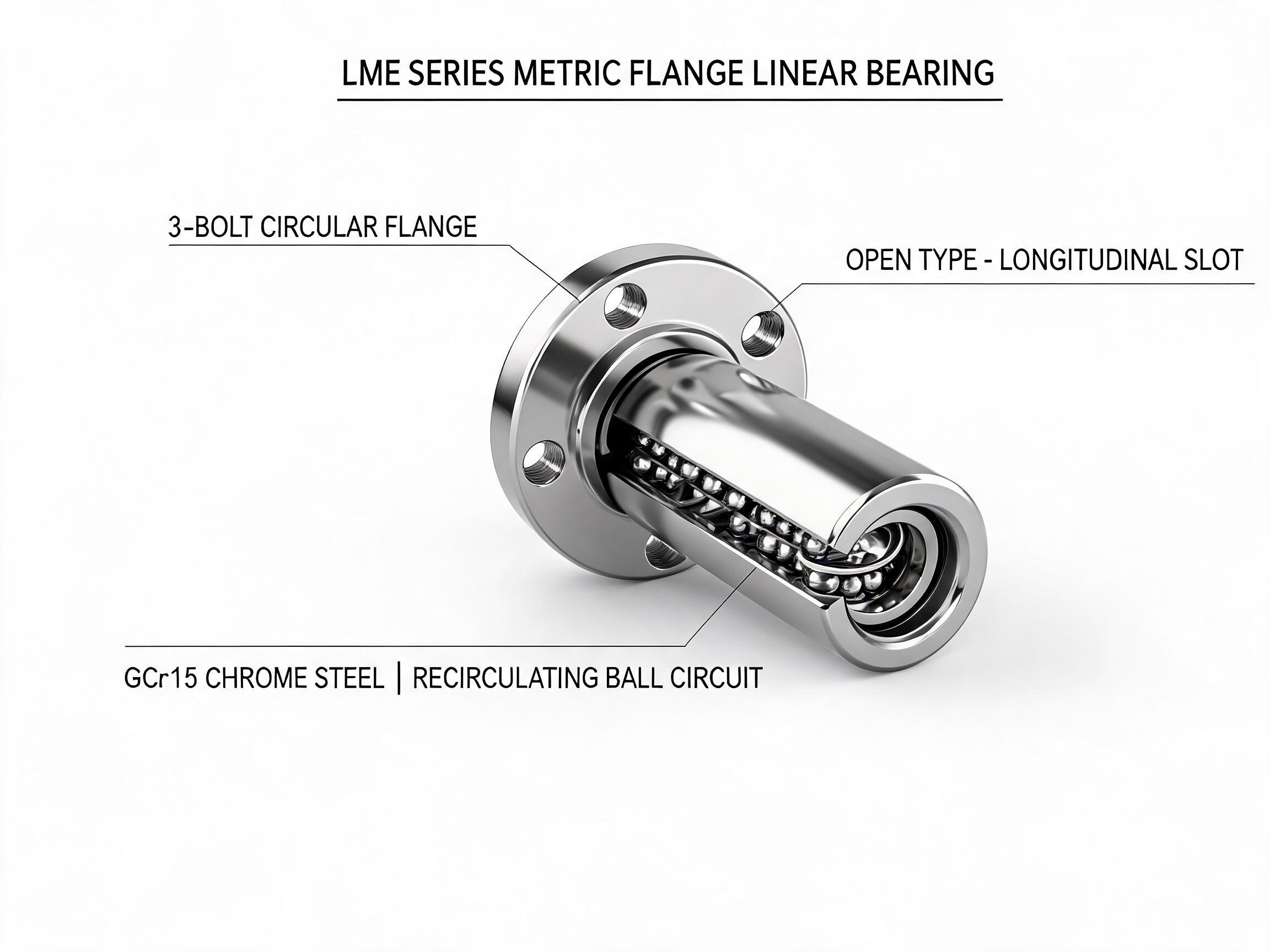
Open designs also exist for applications where the seal is unwanted. The LME flange linear bearing series uses a GCr15 chrome steel recirculating ball circuit to DIN ISO 10285, sizes 8–60 mm, and is available as an open type with a longitudinal slot. That openness suits supported-shaft arrangements where the shaft itself acts as the dust shield, but it removes the seal's exclusion effect.
Fit and preload: clearance is a noise decision
Bearing clearance changes how the balls sit in the raceway and how the housing sits on the shaft. A loose fit allows micro-movement that can be heard as rattle or ticking; an over-tight fit raises friction and can produce a higher-pitched running sound. The available product data do not publish a clearance class or preload grade for these bearings, so the fit should be specified from the housing and shaft tolerances in the drawing and confirmed against the datasheet for the selected model. For assembly that may need realignment after installation, the KH pillow block offers self-aligning capability of ±3° and tool-free bearing replacement — useful when the shaft path and housing are not perfectly parallel during build.
Shaft surface and support stiffness
The shaft is half of the bearing's contact pair. Surface finish, hardness and straightness all affect how smoothly the balls roll. These are shaft-supplier specifications, not bearing specifications, so they belong in the shaft drawing rather than the bearing order. Support stiffness is easier to select: an unsupported shaft deflects under load, and that deflection can produce vibration and noise. The SBR16 support-rail unit is rated at 7.8 kN dynamic and 12.0 kN static, while SBR20 is rated at 11.2 kN dynamic per block (22.4 kN per axis with dual blocks) and 17.5 kN static per block. Those figures describe the complete supported unit, not a bare bearing, and they show why a supported rail is often chosen where the shaft span is long. The SBR16 linear motion guide rail unit with bearing block page lists the full configuration.
Lubrication and the drive comparison
Lubricant condition changes friction and, with it, the sound of the bearing. Grease type and re-lubrication interval are not published for the models discussed here; refer to the datasheet for the selected bearing and follow the supplier's guidance. It is also worth separating bearing noise from drive noise at the specification stage. As a point of comparison, SFU-series ball screws have been measured at typically under 55 dB at 600 RPM in bench tests; that is a bench measurement of the drive, not of linear bearings, and it should not be used as a target for the bearing itself. If the machine's acoustic budget is tight, ask for the drive and bearing contributions to be considered separately.
How the product lines differ for quiet applications
| Consideration | LMUU sealed extended-length | LME flange (open option) | SBR16 / SBR20 support rail | KH pillow block |
|---|---|---|---|---|
| Sealing | NBR contact seals, 95% dust reduction | Open type with longitudinal slot | Refer to the datasheet | Refer to the datasheet |
| Load basis | Bare bearing: LM16UU dynamic 1580 N / static 2450 N | GCr15 circuit, DIN ISO 10285, sizes 8–60 mm | Complete unit: SBR16 7.8 kN dynamic / 12.0 kN static; SBR20 11.2 kN dynamic per block, 17.5 kN static per block | Refer to the datasheet |
| Temperature | −30 to 110 °C | Refer to the datasheet | Refer to the datasheet | Refer to the datasheet |
| Alignment / service | Refer to the datasheet | Refer to the datasheet | Refer to the datasheet | Self-aligning ±3°, tool-free replacement |
Load figures are quoted as listed: LM16UU values are bare-bearing ratings for that size, while SBR values apply to the complete supported unit. Do not compare the two directly.
Specifying a low-noise bearing requirement
A practical order inquiry states the environment, the shaft and housing tolerances, the expected load direction, and whether dust exclusion or minimum running friction takes priority. Where the datasheet does not publish a value — clearance, lubricant, noise — the honest step is to ask the supplier to confirm rather than assume. That applies to all five levers above: sealing, fit and preload, shaft surface, support stiffness and lubrication. Selecting them up front is the difference between a quiet instrument and a commissioning problem.