
Lead accuracy grade, axial backlash, and rigidity get mixed together when buyers specify ball screws. This article separates the three, explains what C7 rolled and C5 ground screws actually hold, and maps nut design choices to bidirectional repeatability targets.
Selection Guide
A buyer searching for ball screw repeatability usually has a number in hand: a positioning tolerance on reversal, often sub-0.01 mm, and an open question about whether a C7 rolled screw or a C5 ground screw will get there. The number alone does not answer it. Lead accuracy grade, axial play, and axial rigidity are three separate properties, and only one of them is what the grade letter describes.
In this article
- What the C7 and C5 grade actually measures
- Why backlash, not grade, sets reversal repeatability
- Rigidity and deviation under load
- Mapping specifications to product choices
- A worked selection example
- What to confirm before ordering
What the C7 and C5 grade actually measures
Lead accuracy is the error between commanded rotation and resulting linear travel, expressed over a reference length. It is defined in ISO 3408 and quoted per 300 mm. Two grades come up most often in general automation and machine building:
- C7: rolled screws such as the SFU series are specified at ±0.05 mm/300 mm.
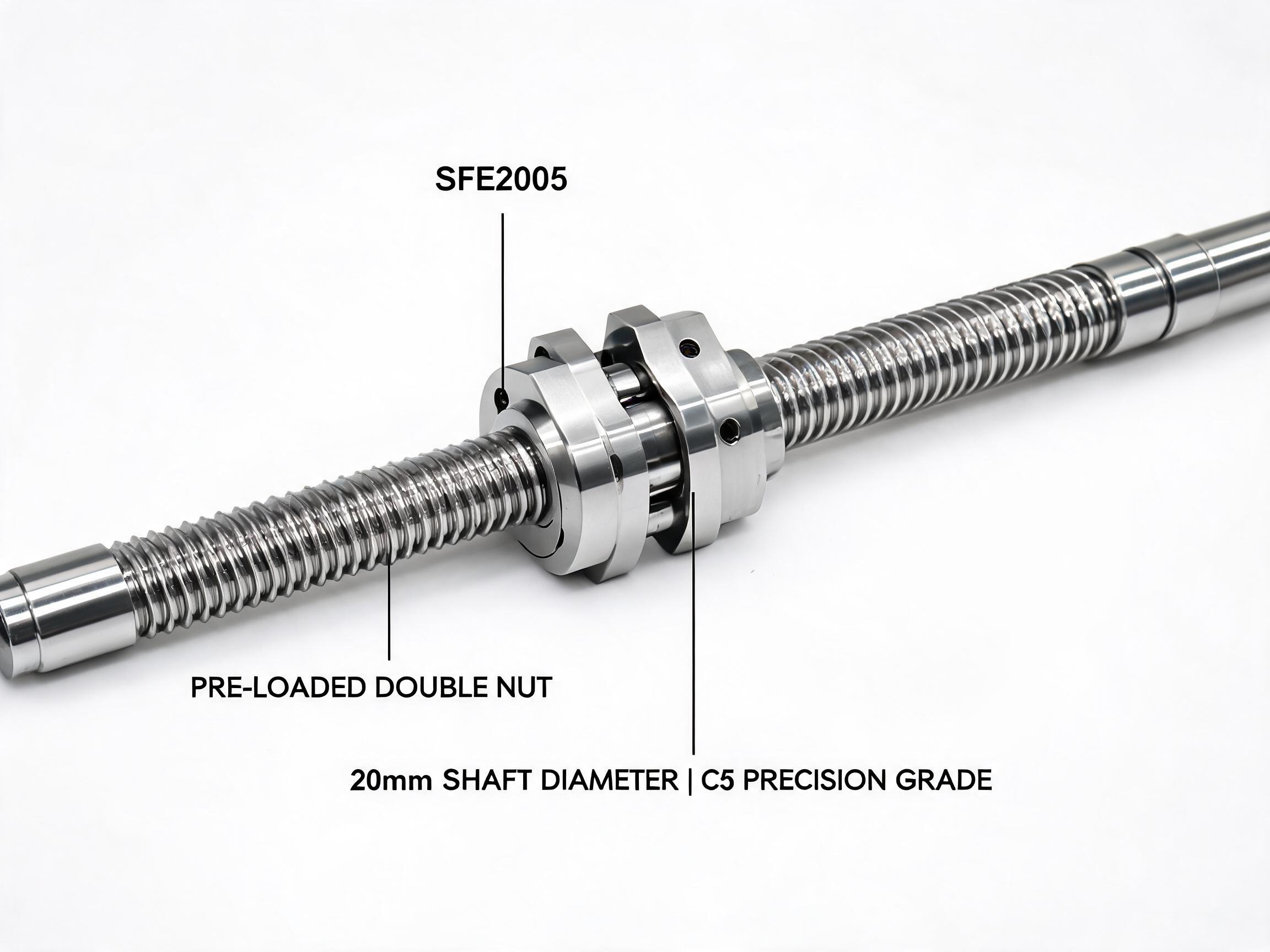
- C5: ground screws such as the SFE2005 are specified at ±0.008 mm/300 mm. That screw has a 20 mm shaft diameter and a 5 mm lead, with the ball track ground after heat treatment, and is offered in standard lengths of 200–1200 mm.
The physics behind the difference is straightforward. A rolled screw forms the groove by plastic deformation, and the resulting lead curve drifts gradually along the shaft. A ground screw cuts the finished groove after heat treatment, which allows a tighter lead tolerance and a more controlled thread profile. Neither process changes what the grade means.
What matters for selection is this: lead accuracy is a systematic error over distance. It is largely predictable and, in many control architectures, largely compensable. If a machine's controller can be calibrated against the actual screw, a large part of the ±0.05 mm/300 mm deviation on a C7 screw can be mapped out. A tighter grade reduces the residual error you have to live with, but the grade by itself tells you nothing about what happens when the axis reverses direction.
Key distinction
Grade describes travel error over 300 mm. It does not describe the step that occurs when the load reverses. That step comes from axial play and preload, and it is what usually decides whether a bidirectional positioning target is met.
Why backlash, not grade, sets reversal repeatability
On a single-nut ball screw, there is an inherent axial gap between the balls and the raceway. When the axis moves in one direction, the nut is pushed to one side of that gap. When the command reverses, the screw must rotate through the free play before the nut starts moving the load. That lost motion appears as a repeatability error on reversal, and no lead accuracy grade removes it.
The mechanical answer is a preloaded double nut. Two nut bodies are forced apart (or together) against the balls, eliminating the axial gap and keeping the ball set in contact on both flanks of the groove at all times. How that preload is generated and how much is applied determine the residual axial play figure you get.
| Series | Nut construction | Axial play held | Grades available | Shaft range |
|---|---|---|---|---|
| SFU rolled | Single nut (typical) | Inherent axial play | C7, ±0.05 mm/300 mm | — |
| SFE2005 ground | Preloaded double nut | Below 0.005 mm | C5, ±0.008 mm/300 mm | 20 mm dia., 5 mm lead |
| DFU double nut | Precision spacer preload | Below 0.003 mm | C7 rolled or C5 ground | 16–40 mm |
The DFU series illustrates the point most directly. Its precision spacer preload holds axial backlash under 0.003 mm, and it is offered with preload classes P0 (light), P1 (medium) and P2 (heavy). Note that the same series is available in either C7 rolled or C5 ground form. That pairing is the clearest evidence that the two properties are independent choices rather than a single ladder: you can buy a C7-lead screw with a tightly preloaded nut, or a C5-lead screw with a lighter preload, depending on which error actually constrains your application.
Rigidity and deviation under load
The third factor is axial rigidity: how far the nut and screw deflect when the cutting or positioning force acts on them. This is not a repeatability error in the free-state sense. It is a compliance, and it shows up as a position shift whenever load changes, for example when a tool engages or when an axis accelerates.
Preload affects rigidity directly. A more heavily preloaded nut keeps more balls in contact under load, so axial stiffness rises. The SFE2005 is quoted at up to 280 N/µm axial rigidity with its preloaded double nut. The DFU series exposes the same trade-off as a selection: P0 light, P1 medium, P2 heavy.
Heavier preload is not automatically better. It increases drag torque, generates more heat at speed, and shortens the working life of the ball set. The engineering question is the minimum preload that keeps deflection under load inside your error budget, not the maximum the nut can take.
Mapping the three factors to product choices
Once the factors are separated, selection becomes a short decision sequence rather than a grade comparison:
- If the dominant error is travel accuracy over long distance and the control can compensate it, a C7 rolled screw is usually adequate. The SFU series at ±0.05 mm/300 mm fits this case.
- If the dominant error is the reversal step — the classic bidirectional positioning problem — the specification that matters is axial play, and the answer is a preloaded double nut, not a better grade letter.
- If both matter — tight absolute accuracy plus tight reversal — a C5 ground screw with a preloaded double nut is the combination to look at. The SFE2005 and the C5 variant of the DFU series both sit in this category.
- If load-induced deviation is significant, set the preload class against the actual axial load and speed, and check rigidity alongside backlash.
On numbers not stated here: This article does not quote an assembled-axis positioning figure for any machine class. Nut axial play and screw lead accuracy are component-level properties; how they combine in a completed axis depends on bearings, coupling, structure and control. Confirm the required repeatability for your application against the datasheet figures and with the supplier's application engineering.
A worked selection example
Take a hypothetical requirement: an axis must hold sub-0.01 mm positioning on reversal, carries a moderate load, and runs at moderate speed. The travel accuracy over the stroke is not critical because the controller is calibrated.
- Lead accuracy: a C7 screw at ±0.05 mm/300 mm is acceptable once compensated, but the reversal requirement rules out a single nut.
- Axial play: a double nut holding play below 0.003 mm gives more margin inside the 0.01 mm reversal budget than one holding below 0.005 mm. The DFU series in C7 rolled form meets the backlash requirement without paying for a ground screw.
- Preload class: P1 medium is the starting point for a moderate load at moderate speed. P2 heavy would add drag and heat without a corresponding need.
- Rigidity check: if the axial load is high enough that P1 deflection consumes a meaningful share of the budget, either move to P2 or move to a larger shaft within the 16–40 mm range.
Change one condition and the answer changes. If the axis also needs tight absolute accuracy without relying on compensation, the C5 ground variant of the same double-nut series becomes the better fit. The structure of the decision stays the same; only the grade selection moves.
What to confirm before ordering
A few items determine whether the specification on paper translates into the axis you build:
- Whether the repeatability target is free-state or under load. The two require different checks: axial play for one, rigidity for the other.
- Which direction the target applies to. Unidirectional repeatability tolerates axial play that bidirectional repeatability does not.
- The preload class that matches your load and speed, not the heaviest available.
- Shaft diameter and lead against the required thrust and speed, within the ranges offered — 16–40 mm for the DFU series, 20 mm diameter and 5 mm lead for the SFE2005, standard lengths 200–1200 mm.
Product references
- SFE Series Ground Ball Screw AssemblyC5 ground screw, ±0.008 mm/300 mm lead accuracy, 20 mm shaft, 5 mm lead, preloaded double nut below 0.005 mm axial play, up to 280 N/µm.
- DFU Series Double-Nut Zero-Backlash Ball ScrewPrecision spacer preload below 0.003 mm axial backlash, P0/P1/P2 preload classes, C7 rolled or C5 ground, 16–40 mm shafts.
- SFU Series Rolled Ball Screw AssemblyC7 rolled, ±0.05 mm/300 mm lead accuracy.
FAQ
Can a C7 screw hit sub-0.01 mm reversal repeatability?
The grade does not decide that. A C7 screw with a single nut has inherent axial play that will appear on reversal. A C7 screw with a preloaded double nut, such as the DFU in rolled form holding play below 0.003 mm, addresses the reversal error. Whether the assembled axis then meets your number depends on the full drive train — confirm against the datasheet figures and with application engineering.
Is C5 always the better choice?
No. C5 ground screws give tighter lead accuracy and are the right call when absolute travel accuracy matters and cannot be compensated. If your error budget is dominated by reversal, a C7 double-nut screw may meet the requirement at lower cost. The grade and the nut design are separate decisions.
How much preload is enough?
Enough to keep play and load-induced deflection inside the error budget, and no more. The DFU series offers P0 light, P1 medium and P2 heavy for this reason. Excess preload raises drag torque and heat.
Does the nut preload figure replace a rigidity specification?
They are different properties. Axial play describes lost motion at reversal; rigidity describes deflection under load. A nut can hold very low play and still deflect measurably under a large axial force, so check both if your application applies significant load.
Next step
Write down the error budget first: the reversal requirement, whether it applies bidirectionally, the axial load, and the speed. Match the axial play and preload class to that budget, then choose the lead accuracy grade based on whether compensation is available. If you send the application details — shaft diameter, lead, stroke, load and the repeatability target — the supplier's engineering team can confirm which series and preload class fit.