
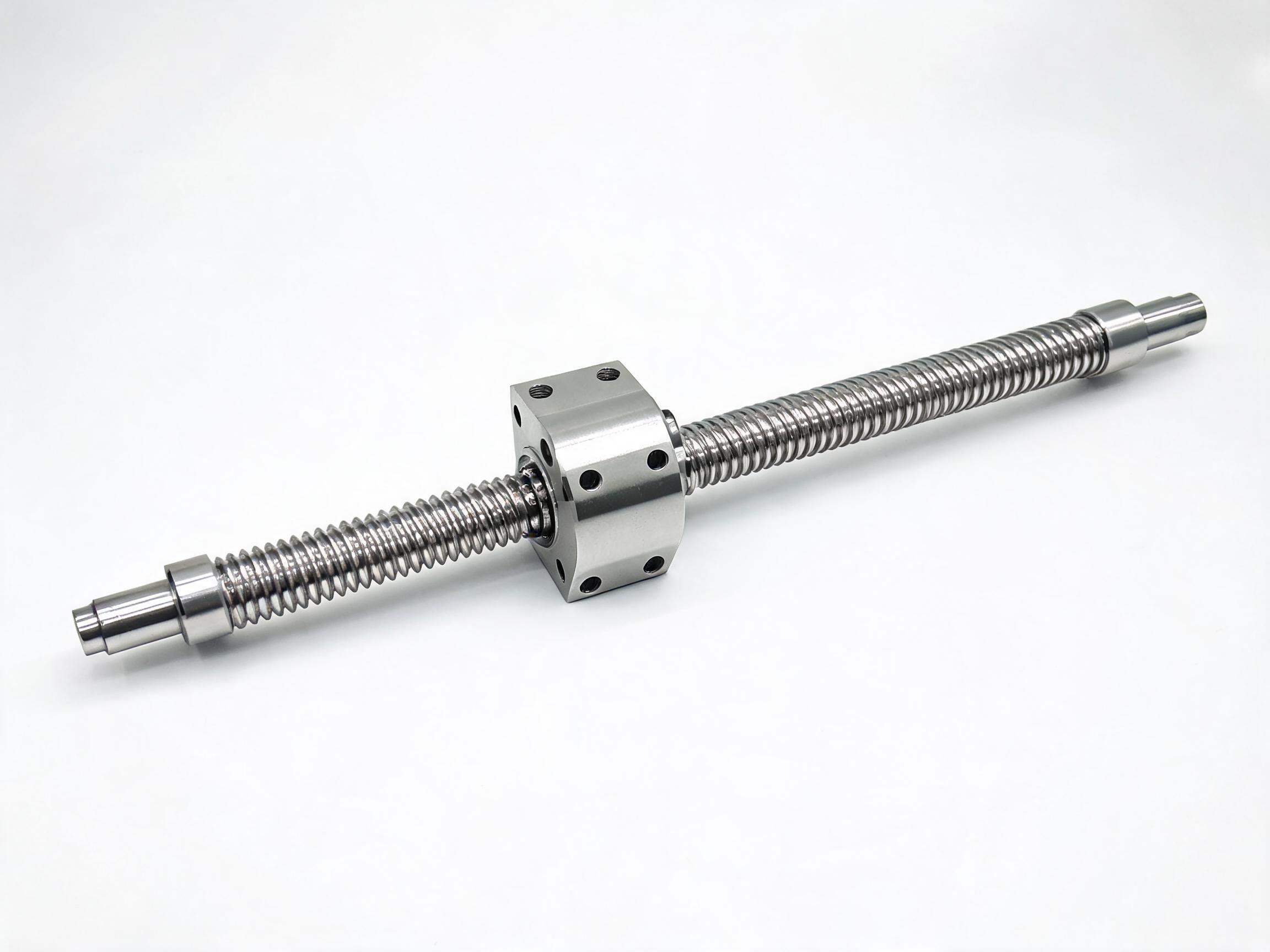
When you order a ball screw assembly, the nut is the part that decides whether the unit mounts, how it behaves under preload, and how much axial load it can take. This guide covers flange hole patterns, single versus double nut selection, preload specification at order, and the details worth fixing before a quotation is issued.
A ball screw assembly is usually treated as one item on a purchase order, but it is really two parts with two different sets of decisions. The screw defines stroke length and end machining; the ball nut assembly defines how the unit bolts to your machine, what preload you get, and what axial load the assembly carries. Buyers who lock the screw dimensions first and leave the nut to the supplier often receive a unit that runs correctly but does not drop into their existing housing — or one whose backlash is tighter or looser than the application needs.
This guide looks at the nut side of the order: flange pattern, single versus double nut, and the details to fix in writing before a quotation is issued. It assumes you are buying a complete assembly with an end-machined shaft, not a nut on its own.
Key takeaways
- The flange hole pattern is a mounting constraint, not a rounding error. Confirm it against your nut housing before ordering.
- Single-nut assemblies are simpler to install; double-nut assemblies with a precision spacer are how backlash below 0.003 mm is achieved.
- A double nut carries 1.5× the dynamic load of the single-nut equivalent in the same series, but adds length and a spacer to manage.
- Preload class and lubrication are order-line decisions — they should appear on the purchase order, not be assumed.
On this page
- Why the nut decides the fit
- Flange pattern: what to check before ordering
- Single nut or double nut
- Preload: class, spacer and backlash
- Lubrication and the nut body port
- MOQ and configuration context
- What to put on the order
Why the nut decides the fit
On a rolled ball screw assembly, the shaft can be cut and machined to your drawing, but the nut comes as a defined casting or forging with a fixed flange geometry and a fixed set of mounting holes. You cannot re-drill a flange to suit a housing without losing the reference surface the nut was machined against. That makes the nut the least negotiable part of the assembly: get the flange pattern wrong and the whole unit is unusable regardless of how well the screw is machined.The nut also sets the assembly's behaviour in service. Preload is built into the nut — either by grinding the nut to an oversize ball set or by loading two nut halves against a spacer — and the resulting axial stiffness and backlash figure are properties of the nut, not the screw. Load capacity follows the same logic: the number of ball circuits and the nut length determine how much axial force the assembly can transmit.
Flange pattern: what to check before ordering
Metric flange ball nuts in common series use a standardised bolt pattern, but "standard" only guarantees compatibility within a well-defined family. The practical approach is to take your nut housing drawing and compare it, hole position by hole position, against the supplier's flange drawing for the specific model.
For a concrete reference: an SFU1605 nut is a metric flange with four M4 mounting holes and is compatible with standard SFU1605 nut housings that follow the same flange drawing. That is the level of specificity you want from any supplier — the series, the bolt size and the number of holes — rather than a general statement that the nut is "standard flange".
Items to compare
- Bolt diameter and thread pitch of the flange holes.
- Number of holes and whether they are symmetrical about the screw axis.
- Hole centre spacing and the position of the pattern relative to the screw centre line — confirm with the datasheet.
- Flange outer dimensions and any locating boss or spigot diameter — confirm with the datasheet.
- Overall nut length, which affects clear travel and whether the nut can pass under a fixed cover.
If your machine uses a purpose-built housing rather than an off-the-shelf one, supply the mating drawing with the enquiry. A flange pattern that matches on paper but differs in the locating boss will still cause runout once bolted down.
Single nut or double nut
The choice comes down to backlash requirement against installation space. Both options are supplied pre-loaded as complete assemblies in the product lines described here, but they achieve preload differently and behave differently over life.
| Configuration | How preload is set | What it gives you | What it costs you |
|---|---|---|---|
| Single flange nut (for example SFU2510, supplied pre-loaded) | Ball set sized to the nut | Shorter nut length, simpler mounting, fewer parts to align | Backlash reduction is limited by the single-nut design |
| Double nut with precision spacer (DFU) | Two nut halves loaded against a spacer; spacer ring width sets the preload | Axial backlash below 0.003 mm; 1.5× dynamic load versus the single nut | Longer overall nut length; preload depends on the correct spacer being fitted |
| Pre-loaded double nut, selectable class (SFE) | Preload class chosen at order: light or medium | Preload matched to the application rather than fixed by the model | The class must be specified on the order line; it is not interchangeable after delivery |
The 1.5× dynamic load figure for the DFU double nut applies to a like-for-like comparison within the same series. It is not a claim that a double nut outperforms every other design in every machine; it is the difference between two configurations of the same product family, and it comes with the extra length and the spacer as part of the package.
When the single nut is the right answer
Where the nut must fit inside a confined envelope and the positioning requirement tolerates a small amount of axial play, a single flange nut keeps the assembly compact and removes a component from the stack. A pre-loaded single nut from the SFU range, such as the SFU2510 rolled ball screw assembly with flange nut, is also compatible with BK25/BF25 support blocks, so the end-support decision is already covered if you are using that block size.
When the double nut earns its space
Backlash below 0.003 mm is a manufacturing property of the double-nut arrangement, not a figure you can tune on a single nut after installation. If the application is bidirectional positioning where reversal error shows up directly in the work, the double nut is the configuration that addresses it. The trade-off is axial length: check that the longer nut clears your bearing housing, bellows or way covers at full travel.
Preload: class, spacer and backlash
Preload should be treated as a specification, not a default. On the DFU range, the spacer ring width sets the preload — so the spacer is a controlled part, and replacing it with a generic washer changes the preload and the backlash figure along with it. On the SFE range, the preload class is selectable at order between light and medium, which means the class has to be written on the purchase order.
Two practical points follow. First, if your application has a defined backlash limit, state the number in the enquiry rather than asking for "zero backlash" — a supplier can then confirm whether the standard configuration meets it or whether a different spacer or class is needed. Second, do not plan to adjust preload in the field. Double-nut preload is set by the geometry of the matched parts; loosening or tightening the mounting bolts does not change it and may distort the flange.
Lubrication and the nut body port
SFU nuts carry a lubrication port on the nut body, and the assembly can be lubricated with grease or oil through it. This matters at the ordering stage for two reasons: the port position has to remain accessible after the nut is bolted into the housing, and the lubrication method determines what you need to connect to it.
- Check that the port is not blanked off by the housing or the flange bolts in the mounted orientation.
- Decide grease or oil before delivery so the correct fittings can be discussed with the supplier.
- For oil, confirm the supply arrangement with the datasheet and the supplier — the port is the interface, not a complete lubrication system.
MOQ and configuration context
Configuration choices affect order quantities because each variant is a separate SKU. In the lines described here, SFU standard configurations carry an MOQ of 50 pieces per SKU, while DFU is quoted at 20 pieces per configuration. If your requirement combines, say, two preload classes or two nut lengths, treat them as separate order lines when planning quantities and lead time.
This is a planning constraint rather than a barrier: it tells you where to consolidate variants and where a single configuration is worth standardising across a machine range.
What to put on the order
A nut specification that survives quotation and inspection usually contains the following. None of it is unusual; the value is in writing it down before the order is placed.
- Series and model, with the nut configuration named explicitly (single flange nut or double nut).
- Flange pattern: bolt size, hole count and a drawing reference for the mating housing.
- Preload class where selectable, or the required axial backlash figure where the standard configuration must be checked against a limit.
- Lubrication method (grease or oil) and confirmation that the port stays accessible in the mounted orientation.
- Overall nut length and the clear travel available in the machine.
- Quantity per configuration, checked against the MOQ for each SKU.
Where a dimension is not on the published datasheet — hole pitch, flange thickness, port thread — write "confirm with the datasheet" in your own notes and ask the supplier for the drawing rather than filling the gap with an assumption.
Where this leaves the decision
The screw determines stroke and end machining; the nut determines whether the assembly mounts, how tight it positions, and how much axial load it carries. Buyers who specify the nut first — flange pattern against the housing, single versus double nut against the backlash requirement, preload class and lubrication on the order line — avoid the most common mismatch in ball screw purchasing, which is a correctly made assembly that does not fit. Start from the housing drawing and the backlash limit, then let the series and configuration follow.
Related assemblies
- SFU series rolled ball screw assembly — standard metric flange nuts, supplied pre-loaded with an end-machined shaft.
- SFU2510 rolled ball screw assembly with flange nut — single flange nut, compatible with BK25/BF25 support blocks.
- DFU series double-nut zero-backlash ball screw — precision spacer preload, axial backlash below 0.003 mm.