For equipment builders sourcing linear bearings under their own brand, an OEM supply relationship turns on three things: documented standard compliance, a real sample approval process, and controlled batch-to-batch consistency. This article explains how each applies to LME, LMUU, LMK and KH series bearings and what to lock down before a repeat build.
OEM Linear Bearing Sourcing
Sourcing linear bearings under your own brand is not a bigger version of a one-off purchase. A one-off order is judged on the units in the box. An OEM relationship is judged on the third, fifth and twentieth shipment, when a bearing that looked identical to the approved sample has to mount at the same position, take the same load, and carry the same drawing number. Three things decide whether that holds: documented standard compliance, a real sample approval, and a controlled approach to batch-to-batch consistency.
Key takeaways
- Compliance is confirmed by the standard a series is built to and by the drawing, not by a brand name or a photo.
- Sample approval should end with a signed drawing and a specific approval method, not just a satisfied inspection of a sample.
- Batch consistency depends on what you fixed at approval: series, tolerance class, cage material and housing configuration.
- Material certificates and inspection reports are available on request, but the exact document list belongs in the supply agreement.
- Why an OEM relationship is judged differently from a purchase
- 1. Standard compliance: from series designation to drawing
- 2. Sample approval: the step that fixes what “the same” means
- 3. Batch-to-batch consistency: what has to stay fixed
- Documentation: the boundary to settle up front
- An OEM supply checklist
Why an OEM relationship is judged differently from a purchase
When a machine builder buys a linear bearing once, the acceptance question is simple: does the unit match the specification in the request. When the same bearing goes into a repeat build and carries your brand, the acceptance question changes. A bearing that passes on its own can still fail the build if it is dimensionally compatible with the original mounting drawing but not with the flange callout, or if a cage material has been changed between lots with no visible difference in the box.
That is why the meaningful comparison is between the three pillars below rather than between two catalogs. Each pillar answers a different part of the same question: what the bearing is built to, what was actually approved, and what will be the same next time.
| Pillar | Question it answers | Evidence used |
|---|---|---|
| Standard compliance | Is the bearing built to the series standard the drawing assumes? | Standard designation and series code; verified drawing |
| Sample approval | Is the sample the same as what will be delivered, in writing? | Approved sample plus signed drawing |
| Batch consistency | Are subsequent lots held to the approved configuration? | Fixed specifications and lot inspection documentation |
1. Standard compliance: from series designation to drawing
The most common OEM mistake is treating “linear bearing” as one interchangeable object. It is not. Each series in the supply is built to its own standard, and the drawing you approve should name the standard and the series code together.
What each series is built to
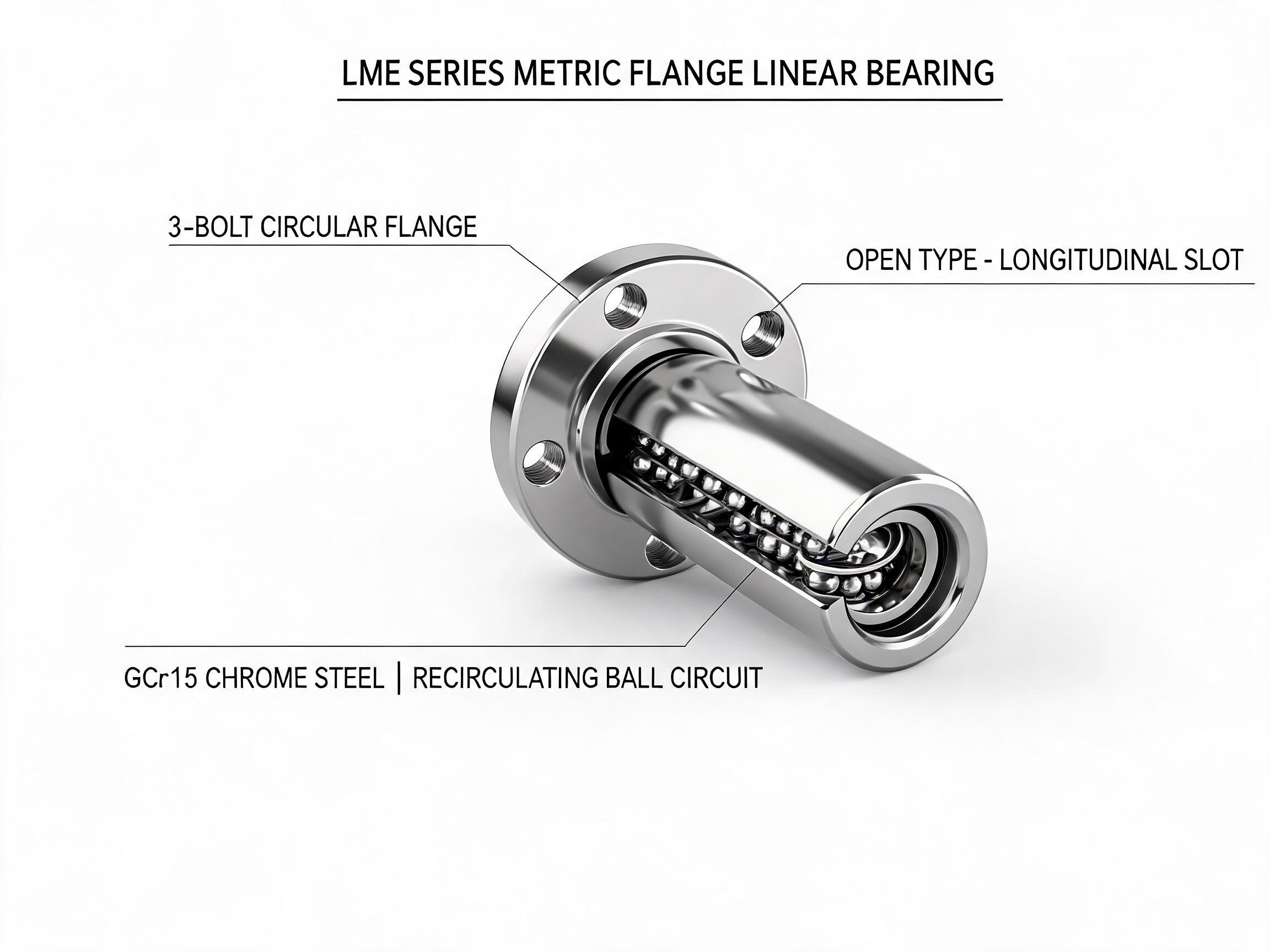
- The LME series follows DIN ISO 10285. It is dimensionally compatible with SKF LMEF and INA KGNOZ flange units, but substitution requires drawing verification before the change is accepted.
- LMUU and LMK follow JIS B 1185 designations.
- KH pillow block units follow JIS B 1185 KH, and use an ADC12 cast aluminium housing, with a 304 stainless housing optional.
Two practical consequences follow from this. First, a claim of “equivalent to” a European flange unit is a statement about dimensional compatibility, and dimensional compatibility is verified on the drawing, hole pattern by hole pattern. It is not verified by the box label or by a photograph. If a machine design was originally drawn around SKF LMEF or INA KGNOZ flanges, the LME option is the natural starting point — but the drawing check has to happen before any substitution is released to production.
Second, an LMK or LMUU request should be written against JIS B 1185, not against a general “metric linear bearing” description. The designation is what keeps a repeat order from drifting into a similar-looking but differently toleranced unit.
Two construction details have the same status: they are part of the specification, not of the marketing. Both LMK and LME offer an H5 bore fit option, and the cage material is PA66-GF. The LMUU outer race is GCr15 hardened. Each of these belongs on the approved drawing because each of them can be changed without changing the outside dimensions — which is exactly the sort of change an OEM buyer cannot see coming.
Where the H5 bore fit option fits
An H5 bore fit option is a tolerance choice, and like any tolerance choice it should be stated as a requirement rather than assumed. Whether that option belongs in your build depends on the shaft tolerance and fit you have designed — not on the standard a generic catalog page lists. If the approved drawing is silent on bore fit, the supply has no fixed target to hold across lots.
For the flange and housing series, the same rule applies to materials: the ADC12 cast aluminium housing on KH units and the optional 304 stainless housing are two distinct configurations. An order that does not name which one it approved is an order that leaves the decision open.
2. Sample approval: the step that fixes what “the same” means
A sample is useful, but only if approval converts the sample into a written specification. Sending a unit back with “this one is good” gives the supplier a standard of one piece and gives you nothing enforceable at lot five. The approval step should end with two documents in hand: the approved sample, and a drawing that the supplier has signed as the basis for production.
What the approval should record
- The series code and the standard designation the sample was built to
- Bore fit selection, where relevant (for example, the H5 bore fit option on LMK or LME)
- Cage material and outer race material, where they form part of the specification
- Housing material for pillow block units, including whether the optional 304 stainless housing applies
- Whether the bearing is a dimensional equivalent of another maker's flange unit, and the drawing verification that supports the substitution
This list is the practical version of the “same” you will use later. It is also the point at which sample approval stops being a quality-experience exercise and becomes a purchasing control.
A sample that is approved is not a sample that is qualified
There is a distinction worth making explicit in the agreement. Approving a sample confirms the sample matches the intended design; it does not establish how the bearing will perform in your machine over its service life. Those are different questions with different evidence. For an OEM build, the practical position is that sample approval fixes the configuration, while any performance expectation remains a design question answered by your own machine testing and by the applicable standard.
This matters most when a substitution is on the table. A dimensionally compatible flange unit can be approved on the drawing, but the reviewer should be clear about what has been verified — dimensions and material callouts — and what has not been verified by that approval alone.
3. Batch-to-batch consistency: what has to stay fixed
Consistency is not a promise to be bought; it is the result of everything above being pinned to documents. If the standard, the sample and the drawing all agree, then the only remaining question is whether the next lot was produced to that drawing. The way to make that question answerable is to reduce the number of variables that can change silently.
Lock the variables that do not change the outline
The specifications most likely to drift are the ones that do not alter the mounting footprint. A cage material change, a different outer race hardening specification, or a housing material substitution from ADC12 cast aluminium to the optional 304 stainless version all keep the bearing looking the same from the outside. That is precisely why they must sit on the approved drawing rather than in a verbal understanding.
| Specification | Applies to | Why it belongs on the approved drawing |
|---|---|---|
| Series and standard designation | LME (DIN ISO 10285); LMUU, LMK, KH (JIS B 1185) | Defines the tolerance and geometry basis for every lot |
| Bore fit option | LMK, LME | H5 bore fit is a choice, not a default; it must be selected and recorded |
| Cage material | PA66-GF | A material change can pass unnoticed in inspection of outline |
| Outer race material | LMUU | GCr15 hardened is a specification, not a description |
| Housing material | KH pillow block units | ADC12 cast aluminium vs optional 304 stainless are distinct configurations |
| Dimensional equivalence | LME vs SKF LMEF / INA KGNOZ | Compatibility is a drawing claim that must be verified before substitution |
Agree the acceptance method, not only the result
“Inspect each lot” without a stated method leaves the acceptance judgement to whoever is doing the inspecting. For an OEM supply, the agreement should name which characteristics are checked on which lots and in what form the record is returned. That is also what makes a documented approval repeatable across a change of shift.
Because the exact document list is a commercial item, it belongs in the agreement rather than in an assumption. Material certificates and inspection reports are provided on request; what is provided, in what scope and at what frequency, should be confirmed with the supplier and written into the OEM arrangement before the first repeat order.
Documentation: the boundary to settle up front
Material certificates and inspection reports are available on request. That is the boundary: they are not automatically bundled with every shipment, and the exact document list must be confirmed with the supplier. Two buyers can place the same order and receive different documentation packs unless each has agreed its own list.
For an OEM relationship, the document question is best settled at the same time as sample approval, because that is when both sides still have the drawing in front of them. Ask which certificates and which inspection report formats you will receive, and record the answer alongside the approved sample. A documentation line that nobody owns is a documentation gap nobody notices until a build is audited.
An OEM supply checklist
The three pillars come down to a short list of things to settle before the first repeat build. None of them requires a new business relationship; all of them require a document.
- Name the standard per series. LME against DIN ISO 10285; LMUU, LMK and KH against JIS B 1185. If LME is chosen as a dimensional equivalent of SKF LMEF or INA KGNOZ flange units, complete the drawing verification before substituting.
- State the options explicitly. H5 bore fit on LMK or LME, PA66-GF cage, GCr15 hardened outer race on LMUU, and ADC12 cast aluminium versus optional 304 stainless housing on KH units.
- Approve a sample and a drawing together. The drawing, signed by the supplier, is what makes “the same as the sample” enforceable.
- Fix the inspection method and the document list. Agree what is reported and in what scope, confirming it with the supplier as part of the OEM arrangement.
- Check the minimum order. The MOQ for LMUU, LMK and LME is 100.
Equipment builders who treat these as details discover them at the worst time — when a substitution has been released, or when a lot arrives that mounts correctly but does not match what was approved. Nailing them down at the sample stage is cheaper than solving them at the production stage.
Where to go next
If you are specifying a flange series as a dimensional equivalent of a European unit, start with the LME series metric flange linear bearing and bring the mounting drawing to the conversation. For housing-style units, the KH series pillow block linear bearing housing unit page covers the ADC12 cast aluminium and optional 304 stainless configurations. For sealed, extended-length builds, the LMUU series sealed extended-length linear bearing is built to JIS B 1185 designations with a GCr15 hardened outer race.