
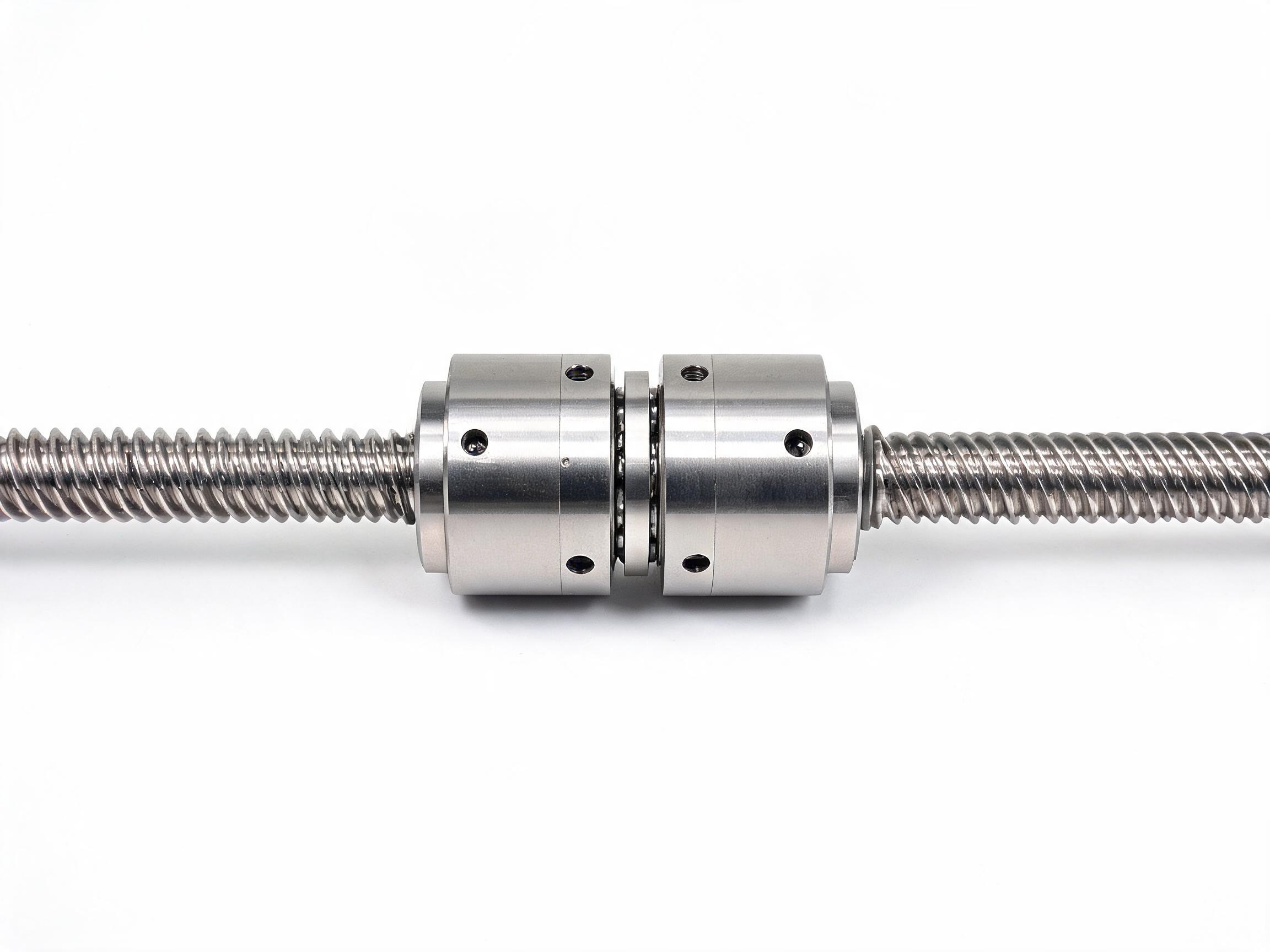
A recirculating ball screw turns rotary motion into linear motion through steel balls rolling between the shaft and nut. The way those balls return to the start of the raceway — and how many nut circuits you specify — determines friction, backlash, load capacity and noise. This article explains the mechanism and shows how to choose between a single preloaded nut and a double-nut, spacer-preloaded circuit.
Technical guide for buyers
The recirculating ball circuit is what separates a ball screw from a plain lead screw. It also decides where a given design runs out of headroom: speed, noise, backlash and load all trace back to how the balls leave the nut, return to the start of the raceway, and how many nut circuits carry the load.
Key takeaways
- Balls roll between the shaft and nut through return passages, so friction is low and the screw is not self-locking — an unbraked vertical axis can back-drive.
- Single preloaded nut: compact and cost-efficient, with inherent axial play of roughly 0.005–0.02 mm.
- Double nut with precision spacer preload: axial backlash under 0.003 mm and about 1.5x the dynamic load of a comparable single nut.
- Check four documents before ordering: backlash spec, preload class (P0/P1/P2), measurable noise figure, and accuracy grade (C7 rolled or C5 ground).
What a recirculating ball screw actually is
A recirculating ball screw is a threaded shaft paired with a nut that does not slide along the thread. Instead, a train of precision steel balls sits in the helical groove between shaft and nut, rolling as the nut advances or the shaft turns. Each ball follows the groove for one or more turns and then must be lifted out and returned to the start of the track, or the balls would simply run out of travel. That return path — the ball return passage built into the nut body — is the recirculating element.
Because the load passes through rolling balls rather than sliding contact, the friction that holds a plain lead screw together is largely removed. Two practical results follow. First, the drive is easier to turn and generates less heat. Second, and more important for machine design, the screw loses most of its self-locking behaviour: a ball screw will often back-drive under an axial load, so a vertical or heavily loaded axis needs a brake or a holding device in the drive train.
Why the ball return design changes performance
The return passage is not a passive detail. The balls have to enter and exit it smoothly at operating speed, and every ball crossing that transition is a small disturbance. That is the link between the circuit and the four properties buyers usually compare:
- Friction: rolling contact in the loaded raceway is low-friction; the returns need to keep the ball train circulating without jamming or skidding.
- Speed and noise: as rotational speed rises, ball-to-return impacts and ball-to-ball contact become audible. A clean, well-guided return keeps the noise band down. On the SFU1605 C7 assembly, recirculating-circuit noise is typically measured below 55 dB at 600 RPM on a bench setup — a figure taken at one speed; load and measurement distance are not stated in the series data, so treat it as a reference point, confirm the test conditions with the supplier, and never as a guarantee across the range.
- Backlash: a single nut always has a small amount of internal freedom between balls and grooves. Controlling it means preloading the ball train, which is where nut count and spacer design come in.
- Load capacity: the number of load-bearing ball circuits inside the nut, and the number of nuts sharing the load, set how much axial force the assembly can carry.
Linear guides use the same principle. The HGW series carriage relies on four-row ball recirculation, and the sizing logic is familiar: more loaded rows and a more controlled return path buy stiffness and capacity, at the cost of a more complex part.
Single preloaded nut versus double nut
This is the decision most buyers actually face. Both are recirculating designs; they differ in how they deal with the internal clearance inside the ball train.
Single preloaded flange nut
A single flange nut is compact and cost-efficient, and it is the right starting point when the application tolerates a small amount of axial play. In practice, single-nut designs carry inherent axial play in the region of 0.005–0.02 mm. Preload reduces it, but it does not eliminate it the way a two-nut arrangement can. For general positioning — pick-and-place without a closed loop, light material handling, adjustment axes — this is usually enough, and it keeps the nut short and the envelope small.
The SFU Series rolled ball screw assembly is a representative example: SFU1605 in C7 (ISO 3408), ±0.05 mm/300 mm lead accuracy, 6.8 kN dynamic load with a single nut, and a single preloaded flange nut. Compare that with the SFU2005, also 6.8 kN dynamic — the diameter changes the stiffness and shaft envelope, not necessarily the headline dynamic rating in this family.
Double nut with precision spacer preload
A double nut splits the ball train into two nuts separated by a precisely ground spacer. The spacer forces the two nuts slightly apart, so one nut loads the balls against one flank of the groove and the second nut loads them against the opposite flank. Clearance is taken out mechanically rather than absorbed by elastic preload alone. The result is axial backlash under 0.003 mm — the "zero backlash" in the product name refers to this datasheet figure, not an absolute zero — and roughly 1.5x the dynamic load of the same-size single nut: the DFU Series double-nut zero-backlash ball screw lists DFU2005 at 10.2 kN dynamic against 6.8 kN for SFU2005.
The trade-off is straightforward. A double nut is longer, heavier, more expensive, and demands that the mounting arrangement accommodate the extra nut length. If your axis reverses direction under load, or if you cannot close a position loop around the screw, the reduced backlash is usually worth it. If you can compensate electronically, a single nut may be the cheaper answer.
| Property | Single preloaded nut | Double nut, spacer preload |
|---|---|---|
| Axial backlash | Inherent play 0.005–0.02 mm | Under 0.003 mm |
| Dynamic load (reference) | 6.8 kN (SFU2005) | 10.2 kN (DFU2005), about 1.5x |
| Envelope | Short nut, compact mounting | Longer nut stack, more space needed |
| Cost position | Lower | Higher |
| Typical fit | General positioning, adjustment axes, closed-loop systems | Reversing or bidirectional load, high-accuracy positioning |
Load figures are series examples for the same nominal size and should not be extrapolated to other diameters. Confirm the rating for your size on the datasheet.
What to verify before you place the order
Four specifications do most of the work of protecting you from a mis-specified axis. Ask for them in writing, tied to the exact model number.
- Backlash specification: state it in millimetres, not as "zero backlash" alone. Compare it with the positioning tolerance your machine needs.
- Preload class: the DFU Series is offered in P0/P1/P2 preload classes. Preload class sets stiffness and running torque; a higher class is not automatically better if the drive motor cannot handle the added drag.
- Noise figure: ask at what speed and load the figure was measured. A sound level is only meaningful with its test condition attached.
- Accuracy grade and shaft specification: the DFU Series covers shafts from 16 to 40 mm, in C7 rolled or C5 ground accuracy, with shaft hardness HRC 58–62. Hardness matters because the raceway must resist indentation under the ball load; accuracy grade sets how much lead error you can expect over a given length.
Two items commonly vary by size and are worth confirming rather than assuming: the number of ball circuits per nut, and any speed limit tied to the screw diameter and length. Both affect the real ceiling on your axis, and neither should be inferred from a catalogue table for a different size.
Matching the circuit to the job
A useful way to settle the decision is to work backwards from the failure you cannot tolerate. If the problem is lost position on direction reversal, specify backlash first and accept the longer double nut. If the problem is envelope or budget, start with a single preloaded nut and check whether its 0.005–0.02 mm play falls inside your control loop's ability to compensate. If the problem is noise in an operator-adjacent machine, compare measured figures at your actual running speed rather than at a single reference point. If the problem is axial load, look at the dynamic rating for the exact size and nut count, not the family headline number.
Once those four answers are on the table, the choice between single-nut and double-nut circuits usually makes itself. The remaining question is whether the supplier's datasheet states each figure with the conditions attached.