
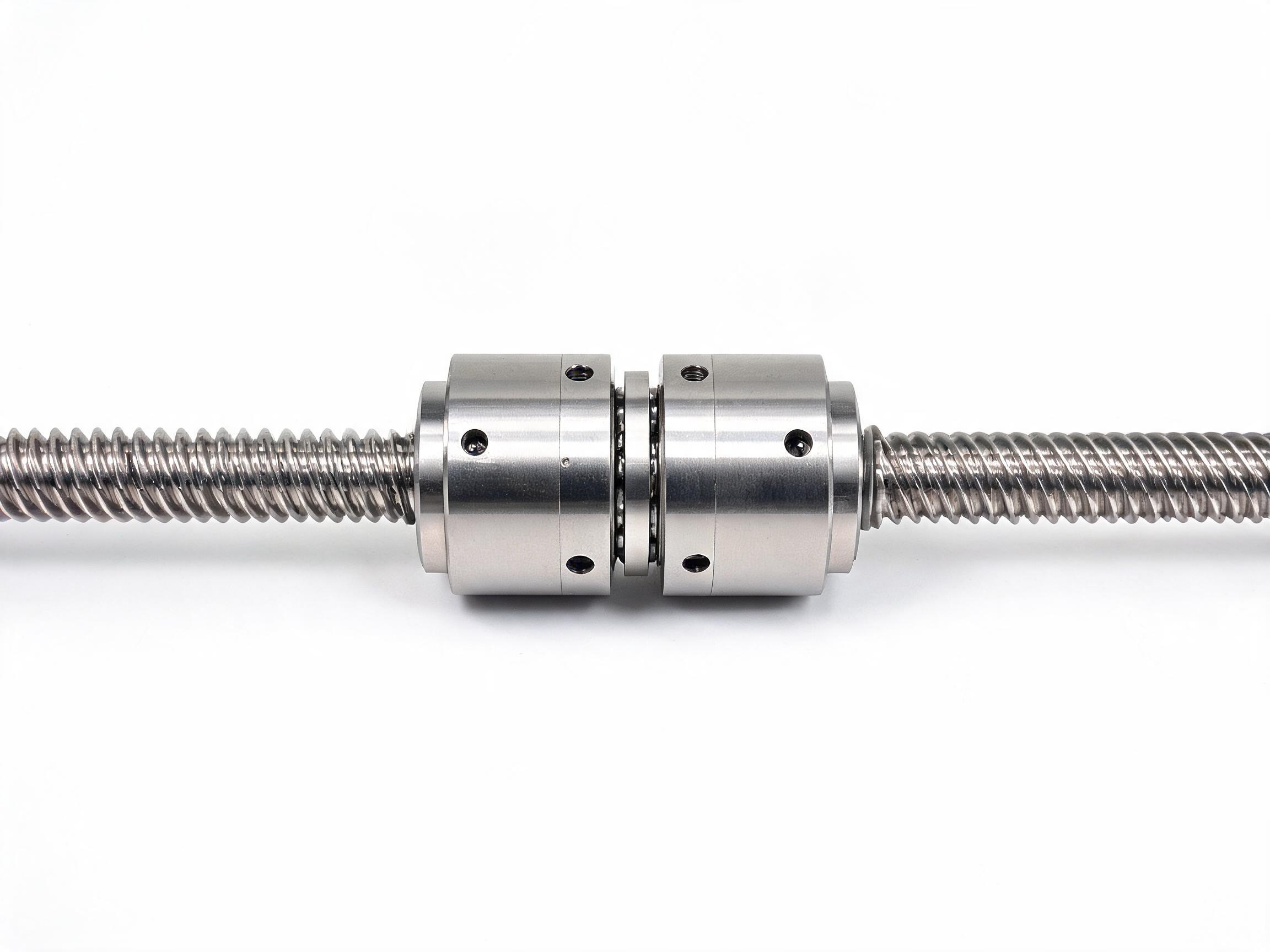
Axial clearance is the small end-to-end play every single-nut ball screw carries — 0.005–0.02 mm by the numbers on our datasheets. This explainer walks through where that play comes from, how a spacer-preloaded double nut drives backlash below 0.003 mm, and how to pick a preload class without over-specifying drag torque or under-specifying stiffness.
Axial clearance is the end-to-end play inside a ball screw nut before the balls and grooves resist a push. It exists on every single-nut screw, and it is the number that decides whether your positioning axis can hold a tolerance or will drift under a reversing load.
What axial clearance actually is
On a single-nut ball screw, the balls sit in grooves that are manufactured slightly larger than the balls themselves, so the nut can slide a few microns along the shaft before contact firms up. That movement is the ball screw axial clearance. Per our listed specifications, our rolled single-nut (SFU) series carries 0.005–0.02 mm of inherent axial play. The lower end suits small positioning workstations, the upper end appears on coarser rolled screws where the thread is produced by rolling rather than grinding; figures for ground single-nut screws should be confirmed with the datasheet.
This play is not a defect. It comes from the manufacturing clearance needed for smooth rolling and for thermal behaviour during operation. The consequence affects the buyer directly: whenever a load reverses direction, the nut travels through the clearance gap before it transmits force. On a CNC router doing contour milling that shows up as a witness mark on the part; on a pick-and-place axis it shows up as a small backlash at the encoder reading.
Why you cannot just tighten a single nut
Removing clearance requires loading the balls against both flanks of the groove at once. A single nut with a fixed internal geometry has no mechanism for that, unless the body is a two-piece nut preloaded against itself.
The two mechanisms in the trade are:
- Oversized ball loading — a single nut is assembled with balls slightly larger than the groove space, creating contact on both sides. This works, but the preload cannot be adjusted after assembly and the nut cannot be re-preloaded at the end of its life.
- Spacer-preloaded double nut — two nut halves are joined by a spacer ring whose width determines pre-load force. This is the standard industrial answer, and it is directly adjustable at the factory grinding stage rather than in the field.
How a spacer-preloaded double nut takes the play out
Two nuts threaded onto the same shaft are separated by a spacer ring. The spacer is ground slightly wider than the gap the two nuts would naturally close to, so the spacer forces each nut against the opposite groove flank. Each nut then bears load on one side only, and the pair has no free axial travel in either direction. The nut halves oppose each other, so a push from the left is taken by one half and a push from the right is taken by the other.
The numbers on our ground and rolled double-nut assemblies show the practical gap between the two designs:
| Property | Single nut (SFU series, rolled) | Double nut with precision spacer (DFU series) |
|---|---|---|
| Axial clearance / backlash | 0.005–0.02 mm inherent play | Backlash below 0.003 mm |
| Dynamic load (20 mm shaft, example) | 6.8 kN | 10.2 kN |
| Shaft range listed | Per series datasheet | 16–40 mm |
| Standard lengths listed | Per series datasheet | 300–2000 mm |
The dynamic load figure is not an independent bonus. It follows from geometry: dividing the load between two nut halves with opposing contact produces a nut assembly that carries about 1.5 times the dynamic load of a single nut of the same diameter, which is why DFU2005 is listed at 10.2 kN against 6.8 kN for SFU2005. If your axis was sized around a single nut's load capacity, the double nut usually allows a smaller diameter for the same thrust, with the trade-off being a longer nut body and greater mass.
The DFU double-nut assembly uses a ground spacer to fix pre-load; the SFE ground series offers a pre-loaded double nut with axial play below 0.005 mm and C5 accuracy on a 20 mm shaft, which suits buyers whose axis needs a finished accuracy class but does not need the finest backlash number.
The spacer ring is where the precision lives
Pre-load force is set by spacer width. A wide spacer pushes the nuts apart harder, which means high stiffness and higher drag torque; a narrow spacer means low torque and softer axial stiffness. Our DFU series specifies the spacer as ground to ±0.5 µm, which is the tolerance that makes pre-load repeatable across a production batch instead of varying screw to screw.
For a buyer this matters on incoming inspection. Axial stiffness and drag torque are both set by the spacer, so two DFU nuts that look identical can behave differently if the spacers are wrong. When you receive a batch, it is worth asking whether the supplier records spacer width against the pre-load class ordered, rather than only the nut model number.
Choosing a preload class for your axis
Preload is a purchasing decision, not an engineering default. Higher pre-load buys axial stiffness and reduces backlash further, but it costs drag torque and heat generation, and it can shorten bearing and motor life if the axis runs at high speed. The DFU series ships three classes:
| Class | Configuration | Typical fit |
|---|---|---|
| P0 | Light pre-load | High-speed axes where drag torque matters more than stiffness |
| P1 | Medium pre-load | General positioning work with mixed feed and rapid moves |
| P2 | Heavy pre-load | Heavy-cutting axes where axial stiffness is the driving requirement |
The SFU rolled single-nut series is the low-cost option for axes that run one direction or tolerate a few microns of play, such as manual slides, simple conveyors and light pick-and-place. Where you need backlash below 0.003 mm at C7 accuracy, DFU is the version to compare first.
Evidence to request before you commit
- Axial clearance or backlash measurement method and value, expressed as a range rather than a single nominal.
- Pre-load class stated on the drawing, not only in the model description.
- Drag torque check, especially for P0 and P1 class nuts on high-speed axes.
- Shaft diameter, lead, and total length confirmed against your axis envelope. One dimension not in the datasheet — end machining, flange bore, mounting hole pattern — must be written as confirm with the datasheet.
Where double-nut preload does not help
A preloaded double nut removes the backlash inside the nut, but not the backlash elsewhere in the axis. Coupling play, bearing axial clearance, and a flexible shaft support can contribute more reversal error than the screw itself. If your measured backlash is already below 0.01 mm and you still see a reversal mark, the nut is not the first suspect.
Preload also does not improve positioning accuracy class. C5 and C7 describe the lead error of the screw's thread over its length, a separate property from axial clearance. A DFU nut with excellent backlash can still be matched to a C7 rolled shaft, and a C5 ground shaft can be fitted with a coarser nut. Order both properties as separate line items rather than assuming one implies the other.
Summary
Ball screw axial clearance is the small, deliberate play inside a single nut, typically 0.005–0.02 mm. Spacer-preloaded double nuts, such as the DFU series, take that play out by loading the two halves against opposite flanks and holding backlash below 0.003 mm. The pre-load class — P0, P1 or P2 — sets the balance between stiffness and drag torque, so it belongs on the purchase order, not on the machinist's bench. Confirm the class, the backlash method and any dimension the datasheet does not list before placing the order.