
Axial play in a ball screw nut shows up as lost motion the moment the axis reverses. This guide explains what ball screw backlash is, why direction reversal exposes it, how to measure it with a dial indicator, and when a preloaded double nut is the correct fix.
What ball screw backlash is, and why reversal exposes it
Ball screw backlash is the axial play between the screw and the nut when no external load is applied. On a single-nut ball screw, that play is an inherent 0.005–0.02 mm. It is not a defect; it is a clearance built into the ball groove geometry and the mounting of the nut.
The clearance stays invisible until the axis has to change direction. Drive the table toward the motor, then command it back, and the motor rotates a fraction of a turn before the balls re-contact the opposite flank of the groove. The table does not move during that fraction. The result is lost motion at reversal — the axis has moved, the part has not. On a CNC contouring path, that shows up as a witness mark at the reversal point. On a measuring or pick-and-place axis, it shows up as position error that repeats every time the direction changes.
This guide covers what axial play actually consists of, how to measure it without dismantling the machine, which causes are correctable at the machine and which require a different nut, and when a preloaded double nut is the right answer.
In this article
Where the axial play actually sits
A single nut contacts the screw through a set of recirculating balls. For the nut to be assemblable and to run without binding, a small clearance exists between the balls and the groove. That clearance allows the nut to shift axially by a few micrometres before load is transferred to the balls.
Three interfaces contribute to what you measure at the table:
- Ball-to-groove clearance inside the nut. This is the dominant contributor and is set by the nut design, not by the operator.
- Bearing and coupling play. A thrust bearing that is not correctly preloaded, or a coupling with torsional compliance, adds to the apparent error at the workpiece.
- Mounting and alignment. If the nut housing or the screw journal is misaligned, part of the indicated movement can be elastic deflection rather than pure clearance.
This matters for diagnosis: a dial indicator on the table measures all three at once. Before concluding that the nut is worn, the mounting and bearing stack have to be ruled out, because both are cheaper to correct.
Why direction reversal is the test that finds it
When the nut is moving in one direction under load, the balls are held against one flank of the groove. There is no observable play because the load has already taken it up. Reverse the command and the load direction reverses. The balls must cross the clearance to reach the other flank, and only then does the table start moving.
The lost motion is equal to the total axial clearance, including any bearing or coupling contribution. This is why backlash shows most clearly as a reversal error and not as a gradual position drift: during continuous travel in one direction, the play is absorbed by the load and effectively disappears.
Two practical consequences follow. First, backlash compensation in the controller can hide the symptom, but it is a fixed value applied at every reversal — it does not track wear, and it does nothing for vibration or surface finish at the reversal point. Second, if the application never reverses under load, small axial play is often harmless and no change is needed.
Causes of excessive backlash
| Cause | What you observe | Correctable at the machine? |
|---|---|---|
| Single nut with no preload (design characteristic) | Constant lost motion from the first day of operation; does not worsen quickly | No — requires a preloaded nut design |
| Ball and groove wear after long service | Backlash grows gradually over months; may be uneven along the stroke | Partially — retightening a locknut on an adjustable nut can restore preload where the design allows it; otherwise replace |
| Nut housing or screw misalignment | Backlash varies at different positions along the travel; often accompanied by noise or local heating | Yes — realign the nut housing and bearing supports first |
| Thrust bearing or locknut looseness | Backlash measured at the table exceeds what the nut alone would produce | Yes — correct the bearing preload before touching the nut |
The preload question
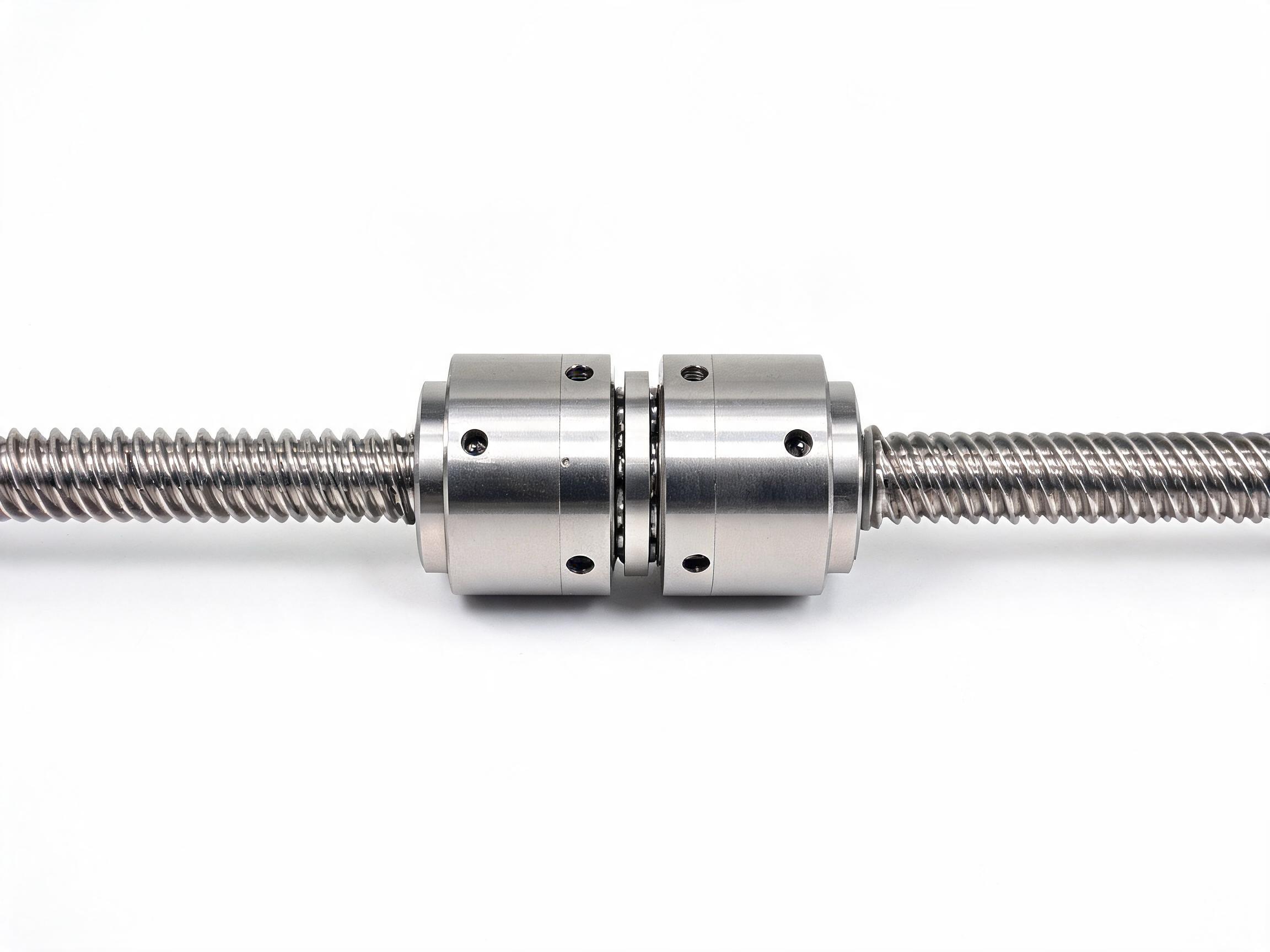
Preload removes the internal clearance by loading the balls against the groove in both directions. A single nut can be preloaded to a limited degree by using oversized balls or a shifted-lead geometry, but the load range over which that preload survives is narrow. A double nut with a spacer between the two nuts applies a controlled axial force that keeps both nuts engaged on opposite flanks, so clearance is taken up regardless of which direction the axis is moving.
Measuring backlash with a dial indicator
This is a non-destructive check that can be done on an assembled machine. It does not require removing the screw.
- Isolate the axis. Disconnect or disable the drive so the screw cannot be commanded, and lock out the machine. Position the table at the point in the stroke where you expect to work most.
- Mount the indicator. Set a dial indicator with a magnetic base on a rigid part of the machine frame, with the plunger contacting the table or nut housing parallel to the axis of travel. Every micrometre of play must register on the dial.
- Zero the indicator. Bring the table into contact in one direction only, so the nut is loaded against one flank. Set the dial to zero.
- Reverse gently by hand. Apply a light force in the opposite direction — enough to overcome friction, not enough to bend the screw. Read the movement at the moment the table starts to move. That is the backlash.
- Repeat at several positions. Check near both ends of the stroke and at the middle. A reading that is constant along the length points at the nut clearance. A reading that changes with position points at alignment or screw straightness.
On unused single-nut screws, expect the indicator to show the inherent 0.005–0.02 mm axial play. That is the baseline. A preloaded double-nut design is specified to hold axial backlash below 0.003 mm, and that is the figure to compare against when the application cannot tolerate reversal error.
When a preloaded double nut is the fix
Replacing the nut is the correct move when the indicated backlash is caused by ball and groove clearance that cannot be adjusted out, or when the application's reversal accuracy requirement is tighter than what any single nut can hold. Typical cases are contouring and interpolation paths, measurement axes, and any axis that oscillates around a setpoint.
The DFU series double-nut zero-backlash ball screw uses a spacer between the two nuts to set preload, holding axial backlash under 0.003 mm. It is available with shaft diameters from 16 mm to 40 mm and in C7 rolled or C5 ground accuracy grades. As a reference point for load capacity, the DFU2005 carries a dynamic load rating of 10.2 kN — 1.5 times the single-nut equivalent.
If the requirement is less stringent and the priority is lead accuracy on a general positioning axis, a rolled assembly can be the more economical route. The SFU series rolled ball screw assembly is offered in C7 with a lead accuracy of ±0.05 mm per 300 mm; the SFU1605 has a dynamic load rating of 6.8 kN. Both routes are valid — the choice follows from the reversal accuracy the axis actually needs, not from the screw being larger or smaller.
Choosing between the two before you order
- If reversal error is the problem and the axis allows essentially none, specify a preloaded double nut and confirm the backlash figure in the drawing.
- If the axis runs largely in one direction, or the controller already compensates and the part is acceptable, a single nut with start-of-life play of 0.005–0.02 mm may be sufficient.
- Before any nut change, re-measure after correcting bearing preload and alignment — it is common for the measured error to drop substantially once the outer interfaces are right.
For an application where you are unsure which specification fits, the useful information to bring to a supplier is the required bi-directional positioning accuracy, the stroke length, the moving mass, and the highest load the axis sees. From those, the preload class and the nut format can be matched rather than guessed.
FAQ
Is ball screw backlash the same as lost motion?
Backlash is the axial play present in the assembly. Lost motion is what you observe at the load when the axis reverses. On a machine, extra lost motion can also come from bearings, couplings, and belt or gear stages, so the two are related but not identical.
How much backlash is normal on a single ball screw nut?
A single-nut ball screw has inherent axial play in the range of 0.005–0.02 mm when it is new. That figure is a design characteristic rather than wear. A preloaded double-nut design, by comparison, is specified to hold axial backlash under 0.003 mm.
Can controller backlash compensation replace a preloaded nut?
Compensation can improve positioning accuracy at reversal, but it applies a fixed correction that does not follow wear, and it does not change the mechanical response at the reversal point. Where the process is sensitive to that response, mechanical preload is the more direct solution.
Does backlash always mean the nut needs replacing?
No. Bearing preload, locknut tightness, and mounting alignment should be checked and corrected first. If the measured play remains after those are correct, the nut clearance is the remaining cause.