
A cost-driver breakdown for procurement engineers: how manufacturing route, precision grade, diameter and lead, length, end machining, nut configuration, MOQ tier and documentation change a ball screw quotation before you request one.
A ball screw quotation is not a single number pulled from a catalogue. It is the sum of decisions you make before the inquiry is sent: which manufacturing route, which precision grade, what diameter and lead, how long the shaft runs, how the ends are machined, how the nut is configured, how many pieces you commit to, and what paperwork travels with the shipment. Understanding these levers lets you compare quotations on equal terms instead of comparing totals that describe different products.
This site does not publish prices. What it can do is explain what drives them, so your first request arrives with the right parameters and the quote that comes back can be checked line by line. Quotations are confirmed within one business day of a complete inquiry.
Key takeaways
- Manufacturing route is the largest structural variable: rolled C7 versus ground C5.
- Precision grade, diameter and lead, and overall length change cost independently.
- End machining and nut configuration are specification items, not free options.
- MOQ tier and documentation requirements affect how an order is quoted.
- A complete inquiry is what makes a quote comparable and fast to confirm.
- Manufacturing route: rolling versus grinding
- Precision grade and what it buys
- Diameter, lead and length
- End machining
- Nut configuration and preload
- MOQ tier
- Documentation and inspection
- How to write a quote-ready inquiry
Manufacturing route: rolling versus grinding
This is the first fork in any ball screw cost discussion. Rolling forms the ball track without removing material. Grinding starts from a hardened shaft and removes material to correct distortion introduced by heat treatment. The two routes produce different accuracy classes at different cost levels, and the mechanism explains why.
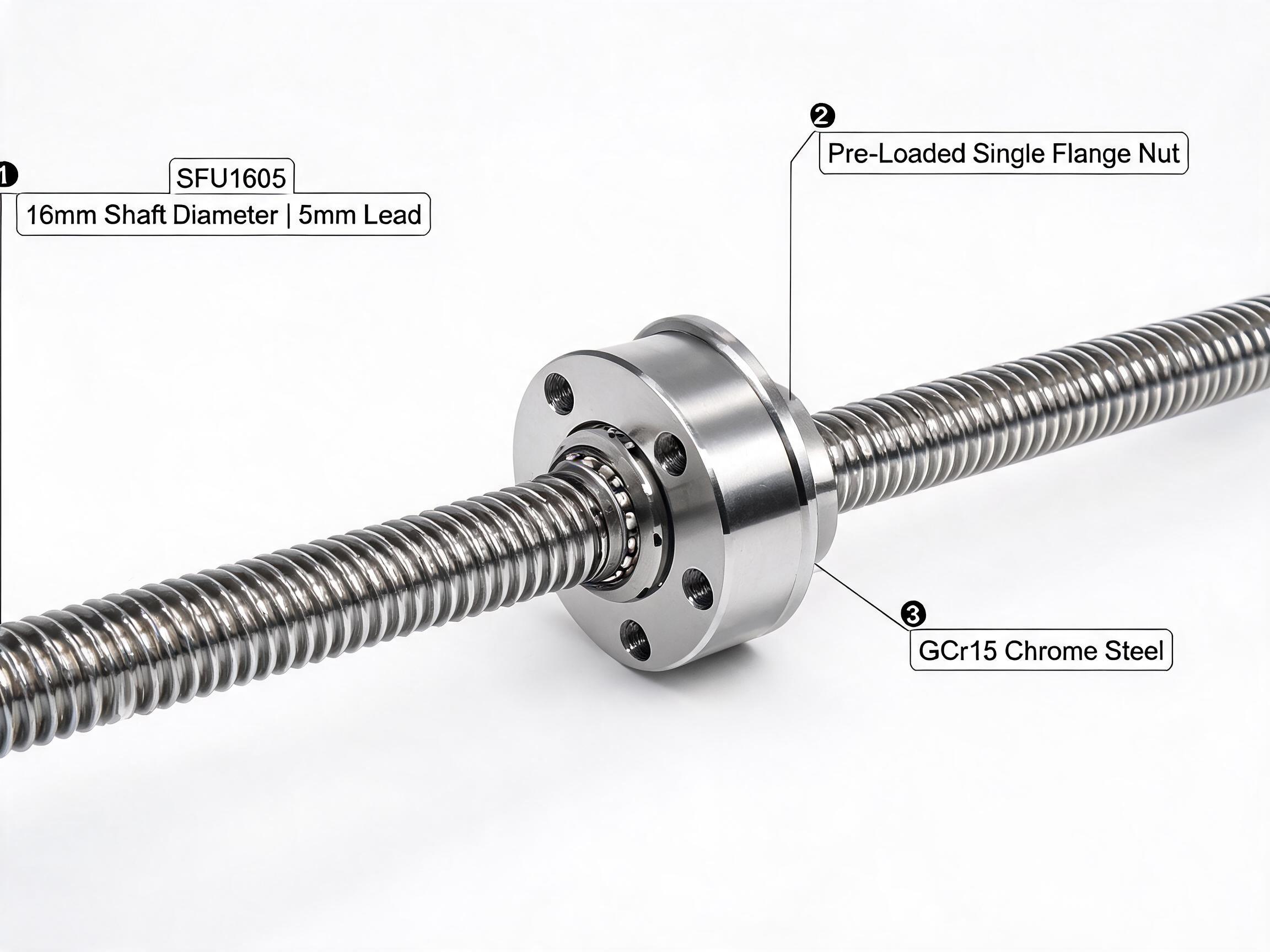
A rolled screw such as the SFU series rolled ball screw assembly is specified as C7 per ISO 3408 with lead accuracy of ±0.05 mm/300 mm. It is made from GCr15 chrome steel hardened to HRC 58–62, and the SFU1605 carries a dynamic load rating of 6.8 kN. Standard lengths run from 300 to 1500 mm.
A ground screw such as the SFE series ground ball screw assembly is specified as C5 with lead accuracy of ±0.008 mm/300 mm. The SFE2005 carries a dynamic load rating of 12.7 kN and axial rigidity up to 280 N/µm. Standard lengths run from 200 to 1200 mm.
The lead-accuracy figures show the practical gap: roughly one order of magnitude in accumulated error per 300 mm of travel. When your application tolerates the C7 figure, the rolled route is the lower-cost path. When position repeatability drives the design, the ground route is the one that meets it. The decision should come from the machine's error budget, not from a preference for tighter numbers.
Precision grade and what it buys
Grade is not a label applied after the fact; it reflects the process, the inspection, and the reject rate that process implies. C7 rolled and C5 ground are the two grades in this catalogue, and each sits on a defined route. A request that specifies "high precision" without a grade and a standard leaves the supplier to choose, and two quotations may then describe two different products.
State the grade and the standard together — for example, C7 per ISO 3408 — so the quotation can be accepted or rejected against a fixed criterion rather than a vague expectation.
Diameter, lead and length
Diameter and lead are usually quoted together because they define the nut and the ball circuit. The SFU1605 designation encodes a 16 mm nominal diameter and a 5 mm lead. Both dimensions are part of the SKU definition: the MOQ of 50 pieces for the SFU series is counted per SKU, where the SKU is the combination of length and diameter. Changing either dimension moves you to a different SKU and a different quotation basis.
Length is a separate driver. A shaft is machined, hardened and straightened over its full run, so a longer screw carries more process time and more handling risk than a short one. The listed standard ranges — 300–1500 mm for SFU, 200–1200 mm for SFE — are the lengths that follow the standard process. Lengths outside those ranges need to be discussed as a custom item, with tooling and inspection implications confirmed with the supplier.
End machining
Bare shaft stock and a ready-to-mount screw are different products. Bearing journals, threads, keyways, flats and chamfers all require additional operations after the screw body is finished, and those operations are quoted per drawing. This is one of the most common gaps between an inquiry and a usable quote: a buyer sends a diameter and a length, receives a number for stock, and later discovers the machined ends were never priced.
Include a dimensioned end-machining drawing with the inquiry. Lead times also shift accordingly: standard lengths of the SFU series ship in 7–15 business days, while custom end machining runs 15–25 business days.
Nut configuration and preload
The nut is quoted alongside the screw, and its configuration changes both performance and cost. A single nut is the baseline. A preloaded double nut removes axial play, and the method of preload matters.
The DFU series double-nut zero-backlash ball screw uses spacer preload to hold axial play below 0.003 mm. Its dynamic load rating is 1.5 times that of a single nut — the DFU2005 is rated 10.2 kN. Shafts range from 16 to 40 mm and are available in C7 rolled or C5 ground. MOQ is 20 pieces per configuration.
The SFE ground series reaches axial play below 0.005 mm with a pre-loaded double nut. Note that "zero backlash" and "low backlash" are not interchangeable: the two figures above differ, and the right one depends on what your positioning loop can tolerate.
| Series | Route and grade | Lead accuracy | Axial play | Dynamic load | Standard length | MOQ basis |
|---|---|---|---|---|---|---|
| SFU (SFU1605) | Rolled, C7 per ISO 3408 | ±0.05 mm/300 mm | per the datasheet | 6.8 kN | 300–1500 mm | 50 pcs per SKU (length + diameter) |
| SFE (SFE2005) | Ground, C5 | ±0.008 mm/300 mm | <0.005 mm with pre-loaded double nut | 12.7 kN | 200–1200 mm | 10 pcs per configuration |
| DFU (DFU2005) | Rolled C7 or ground C5 | per the datasheet | <0.003 mm with spacer preload | 10.2 kN (1.5x single nut) | per the datasheet | 20 pcs per configuration |
MOQ tier
MOQ is quoted per configuration, and the basis differs by series. SFU counts a SKU as a length-plus-diameter pair at 50 pieces. SFE is 10 pieces per configuration. DFU is 20 pieces per configuration. If your requirement sits below the tier for the product you want, the practical choice is to move to a series whose MOQ basis fits your volume, or to plan a stocked quantity that does — the two paths lead to different quotations and should be raised in the inquiry rather than after it.
Documentation and inspection
Material certificates and inspection reports are available on request for the ground series. Specify them at the inquiry stage so inspection time is factored into the quoted lead time. This is not a cost line you can add later without changing the schedule: ground series lead time is typically 20–35 business days, and paperwork prepared alongside production keeps that figure intact.
Decide which documents you actually need — a material certificate, a dimensional inspection report, or both — and name them in the first message.
How to write a quote-ready inquiry
A complete inquiry lets a supplier confirm a quotation within one business day. Include the following:
- Series and model, or the duty the screw must meet
- Manufacturing route and precision grade with the standard reference
- Nominal diameter, lead and overall length
- A dimensioned end-machining drawing
- Nut configuration: single, preloaded double nut, and the preload method
- Quantity, and whether it sits at or above the MOQ tier for that configuration
- Documentation required, named explicitly
- Delivery destination and any required delivery date
When you receive quotations, compare them field by field against that list. Two numbers only become comparable once the grade, route, nut, machining and documentation match. A quotation that omits end machining or names a different grade is describing a different product, whatever the total says.
Where to go next
If you are still choosing between the rolled and ground routes, the lead-accuracy and load figures above are the deciding inputs. If the configuration is settled, the next step is a complete inquiry — and a quotation confirmed within one business day.