
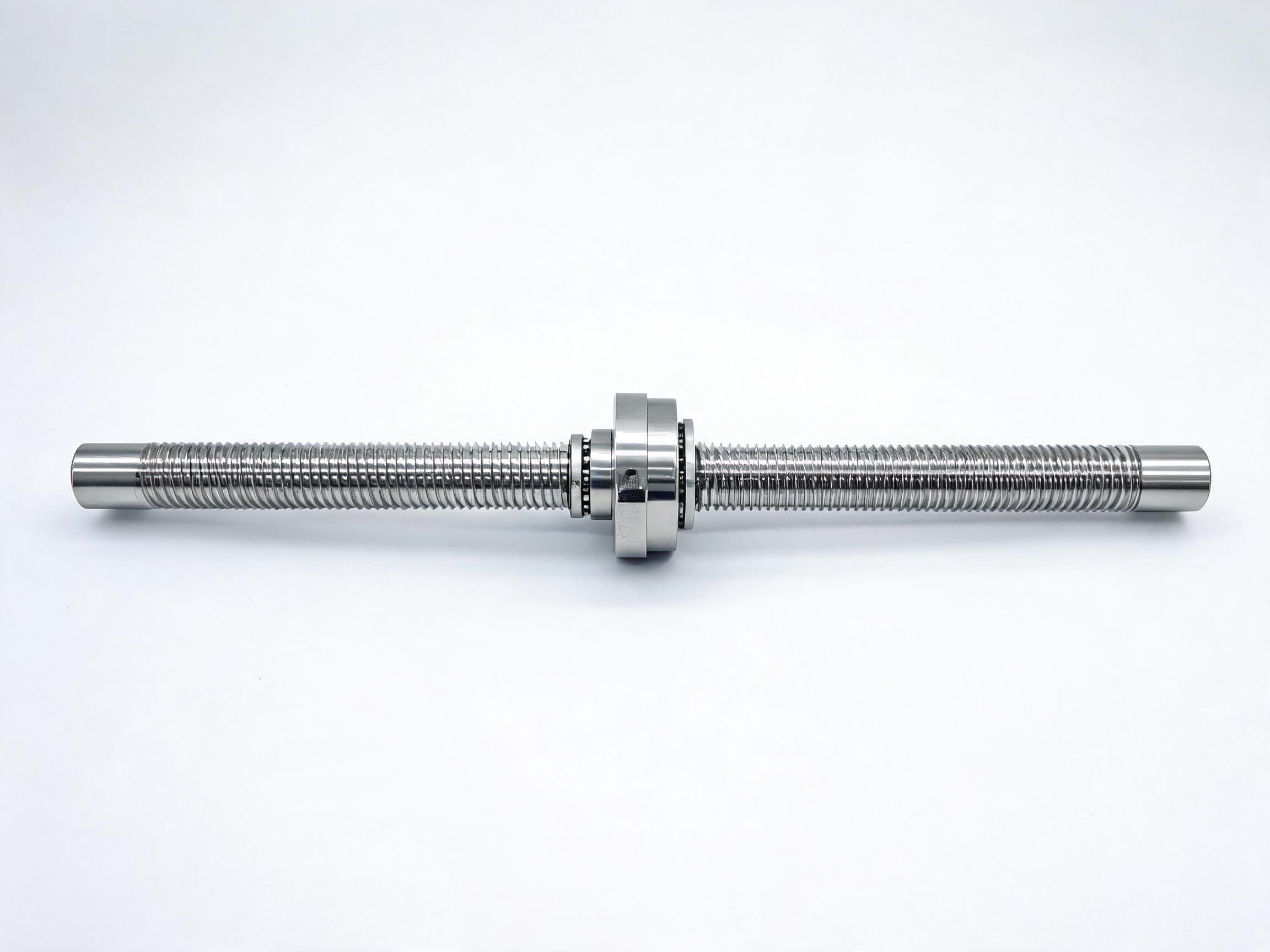
A specification guide for machine builders and maintenance engineers working in dusty or contaminated conditions: what contamination damages on a ball screw, which protection layer suits which condition, where each layer stops working, and the failure signs that tell you protection is already breached.
Most ball screw failures in dusty plants are not load failures. They are contamination failures, and they announce themselves long before the axis stops holding position. This guide explains what dust attacks inside a screw assembly, then walks through the four protection layers and the conditions each one actually handles.
- Contamination damages the ball track and the recirculation path first, which raises running torque before position error appears.
- Nut-end seals, wipers, bellows and full-length covers each suit a different contamination type, and each has a clear failure boundary.
- Sealing choice changes running torque and the lubrication interval, so it belongs in the purchase specification, not in a later retrofit.
- Torque rise, lubricant colour and wiper wear are the earliest signals that protection is already breached.
What dust actually damages on a ball screw
A ball screw transmits motion through balls rolling in a ground or rolled track, returned to the start of the circuit through a recirculation path inside the nut. Both features are dimensional. The track profile carries the load; the return path lets every ball complete the loop without jamming. Dust, chips and dried coolant interfere with both.
The mechanism is straightforward. A particle small enough to enter the gap between the nut and the shaft gets rolled over by the ball load. Hard particles dent the track. Once a dent sits in the raceway, every ball passing that point produces a small impact, and the impact raises friction. Soft contamination such as wood dust or dried coolant mist mixes with grease and forms a paste that drags in the return path. The nut does not seize immediately. It gets harder to turn.
That is why contamination shows up as torque rise before it shows as position error. A C7 rolled assembly such as the SFU1605 reference, with 16 mm shaft, 5 mm lead and lead accuracy of plus or minus 0.05 mm per 300 mm, keeps repeating until friction is high enough to produce stick-slip, lost steps on a stepper, or following error on a servo, because the drive compensates for a considerable part of the added friction along the way. By the time position error appears, the track is already marked.
Maintenance engineers should therefore watch torque and lubricant condition, not just part dimensions. The torque signal is earlier and cheaper.
The four protection layers and what each one handles
Protection is not one part. It is a stack, and each layer in the stack blocks a different size and type of contaminant. The table below matches layers to conditions.
| Layer | Contamination type it suits | Where it stops working |
|---|---|---|
| Nut-end seals | Fine airborne dust, light mist, low-speed dry particles | Large chips, high-velocity spray, direct washdown pressure |
| Wipers (shaft-side scrapers) | Sticky chips, wood dust, swarf that would otherwise adhere | Particles harder than the wiper edge, or when the wiper lip wears and stops contacting the shaft |
| Bellows / way covers | Coolant mist, chip spray, general machining debris over an exposed stroke | Abrasive dust that settles on the bellows folds, and long strokes where the compressed stack is too tall |
| Full-length covers | Washdown, heavy chip load, abrasive dust on long axes | Where the cover cannot be sealed at the ends, or where it traps debris and prevents inspection |
Nut-end seals
These sit at each end of the nut body and wipe the shaft as it enters and leaves. They are the first line and the cheapest one. A proper seal set keeps fine dust out of the return path during normal travel. What they cannot do is survive a stream of chips hitting the nut face directly, and they cannot stop a washdown jet from driving fluid past the lip at pressure.
Wipers
A wiper is a firmer scraper on the shaft side, intended to remove material that has already settled on the shaft before it reaches the seal. This matters on woodworking and cast iron dust, where particles stick to a lightly oiled shaft. Wipers work only while the lip maintains contact. Once the edge wears or picks up embedded hard particles, it stops scraping and starts passing material.
Bellows and way covers
A bellows encloses the screw between the nut and the bearing housing, so the whole exposed stroke is protected rather than just the nut face. This is the right choice for coolant mist and chip spray on a horizontal machining centre. Two limits are real. First, a bellows fold collects abrasive dust on its upper surface, and that dust gets carried back and forth. Second, the compressed stack length is fixed by the folded height, so a bellows may not fit a short axis without reducing stroke.
Full-length covers
Where the axis is long and the environment is heavy, a rigid or telescoping cover that runs the full travel is the practical choice. It shields the screw completely. The constraint is end sealing: if the cover ends are open, contamination enters there, and if debris is allowed to accumulate under the cover, the screw sits in a trap with no way to inspect it.
Matching protection to the real condition
Four conditions cover most dusty axes. Each has a decision branch.
Dry chips and wood dust
Particles are hard, dry and accumulate on oiled surfaces. Use nut-end seals plus wipers as the baseline, and add a bellows where the axis is long enough to accept one. The decision point is shaft length: below roughly the point where the compressed bellows would eat usable stroke, wipers and seals are the practical answer. On wood dust specifically, confirm that the wiper material is compatible with the resin and adhesive content of the dust rather than treating it as inert.
Coolant mist
Mist settles as a film and carries fine metal particles with it. Seals alone pass mist over long running periods. This is the condition where a bellows earns its cost, because it keeps the mist off the shaft surface entirely rather than wiping it at the nut face. Confirm with the supplier that the bellows material suits the coolant chemistry in use, since water-miscible and neat oils place different demands on the cover.
Washdown
Pressure and volume are the issue, not particle size. A washdown jet drives fluid past any lip seal driven only by contact pressure. Full-length covers plus a shield over the nut region are the realistic combination. If the axis is washed down regularly, the lubrication schedule must be reassessed as well, because washdown removes grease and oil films faster than dry running does.
Abrasive dust
Foundry, grinding and ceramic dust is hard and does not break down. A single particle in the track stays there and keeps damaging the raceway. Full-length covers with sealed ends are the default, and the covers should be arranged so debris can be cleared rather than trapped.
Vertical axes add a second problem to the same dust. When the axis stands upright, gravity drains the grease or oil film from the nut and the upper track instead of letting it sit in the contact zone, so the surfaces that need the film most are the ones that lose it between re-greasing intervals. On a vertical screw that already carries abrasive dust, plan the protection and the re-lubrication interval together: a full cover with sealed ends keeps the particles out, and the re-greasing interval has to be set short enough that the drained film is restored before the track runs dry. The exact interval depends on the lubricant, the load and the environment, so it is set with the supplier against the datasheet rather than copied from a generic schedule.
Why sealing choice changes running torque and lubrication interval
Every seal and wiper adds drag. A tighter seal excludes more contamination and costs more torque. On a lightly loaded axis the extra drag is often acceptable; on a small-motor axis it may not be. The specification decision is to state the running torque budget with the seal configuration, so both are specified together rather than discovered at commissioning.
Lubrication is the second coupling point. Protected screws hold lubricant longer; unprotected screws lose it to contamination and cleaning. Both directions of change must be reflected in the maintenance schedule. The SFU Series rolled assembly carries a lubrication port on the nut body for grease or oil maintenance, which makes re-greasing practical, but the interval itself depends on the environment and on the seal configuration fitted. For a comparison point on how sealing is described on a related product, the HGH Series carriage block record states a combined end seal and side seal strip described as IP40 equivalent, with a lubrication port on the carriage top face that accepts a standard grease nipple or central lube line. That wording is useful when reading seal specifications across suppliers, because it states the sealing function and the lubrication access in the same description.
Before ordering, confirm four things with the supplier:
- The seal and wiper configuration supplied as standard on the specific model, and what the options add.
- The running torque implication of that configuration, or how it is presented in the datasheet.
- The lubrication point arrangement and the recommended interval basis for the environment.
- Whether the protection layer is supplied with the screw assembly or must be sourced separately, including mounting interfaces.
For preloaded assemblies, the preload itself is part of the torque picture. The DFU Series double nut achieves axial backlash below 0.003 mm with spacer preload, offered in P0 light, P1 medium and P2 heavy preload classes over shaft diameters 16 to 40 mm, in GCr15 chrome steel at HRC 58-62. A heavier preload class raises baseline drag, so the seal torque margin is smaller and should be checked before adding a tight seal set. The SFE Series ground assembly, 20 mm shaft and 5 mm lead, C5 per ISO 3408 with lead accuracy plus or minus 0.008 mm per 300 mm and axial play below 0.005 mm with a pre-loaded double nut, is specified where accuracy demands are tighter; the protection choice for it follows the same contamination logic.
The product pages for the SFU Series rolled ball screw assembly, the DFU Series double nut and the HGH Series carriage block list the standard configuration for each range; the seal arrangement for a given model is confirmed against the datasheet for that model.
Failure signs that protection is already breached
Protection rarely fails all at once. These are the signals to watch, roughly in the order they appear.
- Torque rise. A slow increase in drive current or hand-feel resistance on the same axis, with load unchanged, points to contamination in the track or return path.
- Lubricant colour and texture. Grease that turns grey, gritty or paste-like contains metal or abrasive particles. That material is already circulating.
- Wiper edge wear. A wiper that no longer contacts the shaft along its full length has stopped scraping. Look for a visible gap or a polished band on the shaft where it should be wiped.
- Debris under the cover. If material is found inside a bellows or under a full-length cover, the end seals or the cover mounting have failed and the screw has been running unprotected for some period.
- Audible change. A new rattle or clicking at a specific point in the stroke suggests a damaged ball or a dented section of track.
- Position error at reversal. Lost motion appearing on a preloaded assembly that previously held position is a late sign. Check the preload class and the nut condition together, since contamination damage and preload loss produce similar symptoms.
Two of these, torque and lubricant condition, can be checked without dismantling the axis and are the basis of a workable inspection routine. Compare the reading against the same axis recorded at commissioning, because an absolute torque number means little without that baseline.
FAQ: retrofitting protection to an existing screw
Can a seal or wiper be added to a ball screw that was supplied without one?
It depends on the nut body design. Some nut bodies have a machined seat for an end seal and a retaining feature for a wiper; others do not. Check the nut drawing for the specific model before planning a retrofit, and confirm with the supplier whether the seal kit is available as a separate item for that model.
Can a bellows be fitted without changing the stroke?
Only if the axis has spare travel equal to the compressed length of the bellows stack. Measure the available gap between the nut and the bearing housing at the end of stroke, then compare it with the folded height of the bellows being considered. If the gap is smaller, either the stroke reduces or the bellows is not the right layer for that axis.
Will adding seals change the torque enough to affect the drive?
It can, particularly on small-motor axes or heavy preload classes. The practical check is to measure running torque before and after fitting, at the same speed and temperature. If the increase is significant relative to the available torque margin, consider a lighter seal configuration or verify the motor sizing.
How do I know whether the existing protection is still working?
Inspect the wiper contact line on the shaft for a continuous wiped band, check the lubricant at the nut port for grit or discolouration, and compare drive current on a known cycle with the value recorded at commissioning. If all three are unchanged, the protection is likely intact. If any has drifted, the seal set is the first item to examine before the screw itself is condemned.
Send the operating condition (contaminant type, stroke, speed and lubrication method) with the model reference and the seal configuration and lubrication schedule can be confirmed against the datasheet for that model.