
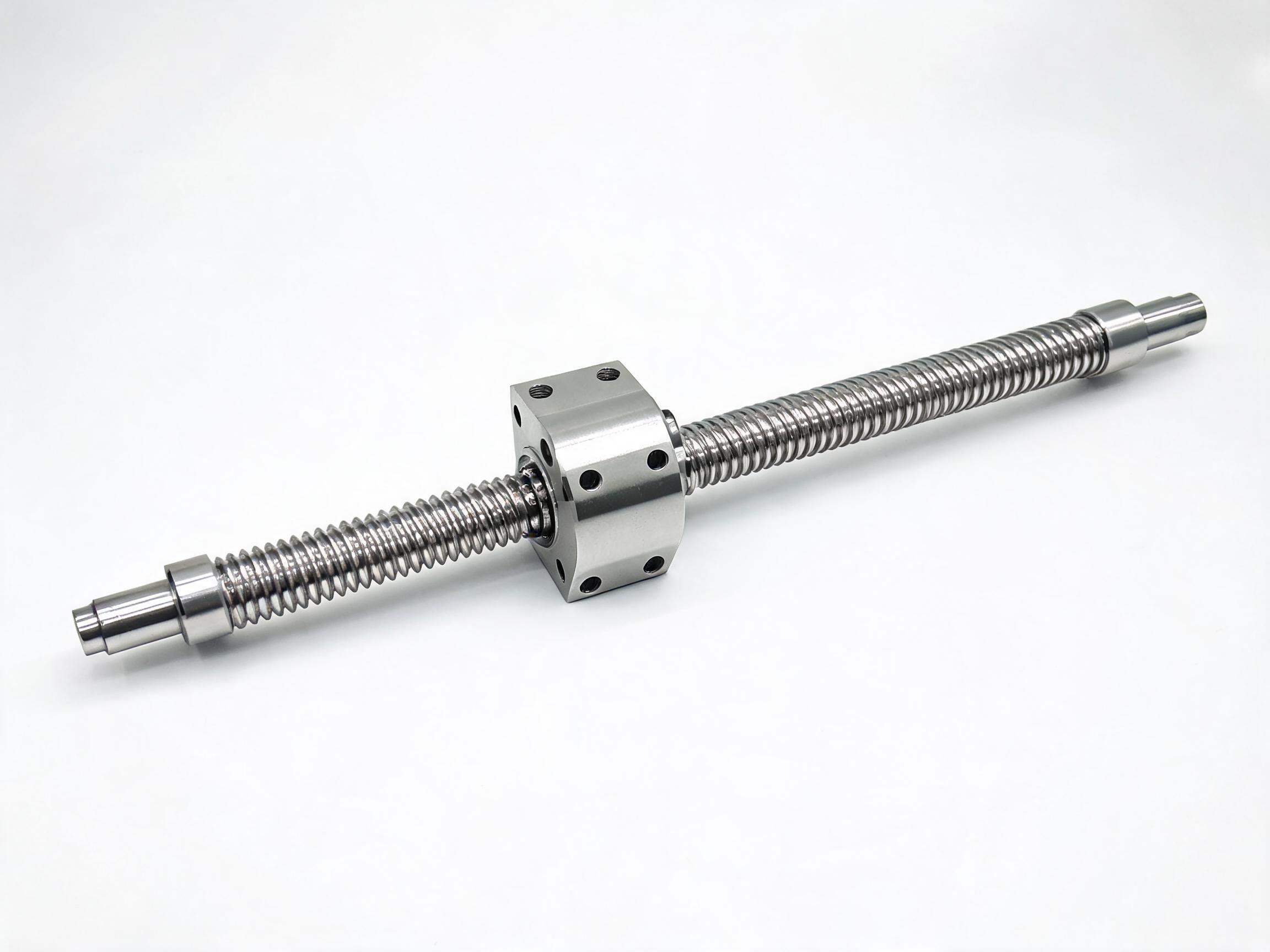
Lead time for ball screws is not a single number. It depends on precision grade, shaft length, end machining, and order quantity. This article explains how each factor adds time and provides a practical checklist to plan your orders, based on quoted ranges from Xiamen Dongfeng Bearing.
When you are planning a machine build, ball screw lead time directly affects your production schedule. It is not a fixed number. The same supplier can quote 7–15 business days for one order and 25–35 days for another, depending on the specifications you request.
This article explains what determines ball screw lead time, using actual quoted ranges from Xiamen Dongfeng Bearing, and gives you a checklist to plan your orders more accurately.
Contents
- Precision grade: why ground C5 takes longer than rolled C7
- Shaft length and diameter: longer screws add production and shipping time
- Custom end machining: the biggest single time adder
- Order quantity and MOQ: how batch size affects scheduling
- Comparing lead times across series
- Order planning checklist
- Frequently asked questions
Precision grade: why ground C5 takes longer than rolled C7
Rolled ball screws, such as the SFU series, are formed by rolling a hardened blank between dies. This process is fast and suits C7 accuracy (±0.05 mm per 300 mm). For the SFU series rolled ball screw assembly, standard lengths of 300–1000 mm typically ship within 7–15 business days. The SFU1605 (16 mm, C7) is a common example with a MOQ of 50 pcs per SKU.
Ground ball screws, such as the SFE series, are machined by grinding the thread after hardening. Grinding removes material in multiple passes to achieve higher accuracy, typically C5 (±0.008 mm per 300 mm) or better. The additional grinding steps and the need to maintain tight tolerances over the full length increase production time. For the SFE series ground ball screw assembly, the quoted lead time is 20–35 business days, with a MOQ of 10.
The same difference appears in the DFU double-nut series. C7 versions of the DFU double-nut zero-backlash ball screw are quoted at 15–20 business days, while C5 versions take 25–35 business days. The double-nut design achieves axial backlash under 0.003 mm, which requires precise matching of the two nuts; higher grades add more lapping and inspection time.
Shaft length and diameter: longer screws add production and shipping time
Shaft length affects lead time in two ways. First, longer screws are harder to machine to consistent accuracy. Second, they require different handling and packaging.
For the SFU3205 heavy-duty rolled ball screw (32 mm, 22.5 kN dynamic / 34.8 kN static), standard lengths of 500–2000 mm are quoted at 15–20 business days. Lengths from 2500–4000 mm take 20–30 business days. The additional 5–10 days come from the need for more careful straightening and from the switch to wooden crates for shafts 2000 mm and above.
Diameter also matters. Larger diameters require more material removal and heavier handling. For the SFE series, specific length and diameter combinations may have different allowances; refer to the datasheet for exact limits.
| Series | Size / Type | Standard Length Range | Lead Time (standard lengths) |
|---|---|---|---|
| SFU rolled | e.g., SFU1605 (16 mm, C7) | 300–1000 mm | 7–15 business days |
| SFU3205 heavy-duty rolled | 32 mm, 22.5 kN dynamic | 500–2000 mm | 15–20 business days |
| SFU3205 heavy-duty rolled | 32 mm, 22.5 kN dynamic | 2500–4000 mm | 20–30 business days |
| SFE ground | C5, ±0.008 mm/300 mm | refer to datasheet | 20–35 business days |
| DFU double-nut (C7) | double-nut, backlash <0.003 mm | refer to datasheet | 15–20 business days |
| DFU double-nut (C5) | double-nut, backlash <0.003 mm | refer to datasheet | 25–35 business days |
Custom end machining: the biggest single time adder
If you need machined ends—such as journal diameters, keyways, threads, or bearing seats—the screw must be set up on a lathe or grinder after thread production. This adds a separate operation and often requires custom fixtures.
For the SFU series, custom end machining adds to the lead time: 15–25 business days instead of the 7–15 for standard lengths. For the SFU3205 heavy-duty series, custom end machining takes 25–35 business days (compared to 15–20 business days for standard lengths of 500–2000 mm; longer standard lengths of 2500–4000 mm already take 20–30 business days). The MOQ for custom end machining on the SFU3205 is 20 pcs, lower than the 30 pcs MOQ for standard length configurations.
Providing a detailed drawing with tolerances and surface finish requirements helps avoid back-and-forth clarification, which can delay the start of production.
Order quantity and MOQ: how batch size affects scheduling
Each series has a minimum order quantity (MOQ) per SKU or length configuration. Orders below MOQ may not be accepted or may be grouped with other production runs, potentially extending lead time. The quoted lead times assume you meet the MOQ.
- SFU1605: MOQ 50 pcs per SKU.
- SFU3205: MOQ 30 pcs per length configuration; MOQ 20 for custom end machining.
- SFE ground: MOQ 10.
- DFU double-nut: MOQ 20.
For larger quantities, production may be scheduled in batches. It is worth discussing your expected annual usage with the supplier to see if a blanket order or scheduled releases can secure better lead times.
Comparing lead times across series
The table below summarizes the typical lead times for standard and custom configurations. These are quoted ranges; actual lead time will be confirmed at the time of order.
| Series | Standard Lengths | Custom End Machining |
|---|---|---|
| SFU1605 (C7) | 7–15 business days | 15–25 business days |
| SFU3205 (C7 heavy-duty) | 15–20 business days (500–2000 mm); 20–30 business days (2500–4000 mm) | 25–35 business days |
| SFE (C5 ground) | 20–35 business days | refer to datasheet |
| DFU (C7 double-nut) | 15–20 business days | refer to datasheet |
| DFU (C5 double-nut) | 25–35 business days | refer to datasheet |
Order planning checklist
Use this checklist to plan your ball screw orders and avoid surprises.
- Confirm length and quantity early. Decide on the exact shaft length and order quantity per SKU. Remember the MOQ for each series and configuration. For lengths 2000 mm and above, plan for wooden crate packaging.
- Decide on end machining per drawing. If you need custom ends, prepare a detailed drawing with dimensions, tolerances, and surface finish. Confirm the lead time adder (e.g., 15–25 business days for SFU, 25–35 for SFU3205) and the custom MOQ.
- Plan sea freight. For shipments to Europe, allow 28–35 days; to the USA, 20–28 days. Add this to the production lead time. For urgent needs, discuss air freight options with the supplier.
- Check precision grade requirements. Higher precision grades add production time — for example, the DFU double-nut series is quoted at 15–20 business days in C7 versus 25–35 in C5. Ensure the grade you select is necessary for your application.
- Place orders with buffer. Given the ranges above, add a buffer to the quoted lead time to account for scheduling and transport variability.
- Request a written quotation. Confirm the lead time, MOQ, and shipping terms in writing before committing to a purchase order.
Frequently asked questions
Can I get a shorter lead time by paying expedite fees?
Expedite options depend on current production load. Discuss with the supplier; refer to the datasheet for standard lead times.
Do all series require the same MOQ for custom end machining?
No. SFU1605 requires MOQ 50 pcs per SKU; SFU3205 has a standard MOQ of 30 pcs per length configuration and a custom end machining MOQ of 20 pcs. A separate custom-end-machining MOQ is not published for every series — confirm it with the supplier before ordering.
How does the DFU double-nut series compare in lead time?
C7 versions take 15–20 business days; C5 versions take 25–35 business days. The double-nut design achieves backlash under 0.003 mm.
Xiamen Dongfeng Bearing exports to over 50 countries. For specific lead time on your configuration, contact our sales team with your requirements.