
A longer screw and a shorter screw of the same diameter behave differently: whip risk rises with unsupported length. This guide explains the length-diameter-end support relationship for ball screws, why end machining must be fixed at quotation, and what data to send to get a reliable quote.
Ball Screw Length, Whip and End Support: What to Decide Before You Order
Two ball screws with the same shaft diameter and the same lead do not behave the same way if one is 400 mm long and the other is 1500 mm. The longer screw has more unsupported mass turning at speed, and the way you mount each end changes how much of that length stays unsupported. That is the practical reason a supplier asks for your stroke, your mounting method and your speed before quoting a screw, and it is the reason end machining has to be settled on the drawing, not after the order.
This article deals with the length-and-support problem only. It does not re-explain what a ball screw is, how lead differs from pitch, or how preload classes are chosen. It covers what changes with length, what whip means, how end support and end machining enter the quotation, and the data a supplier needs to run the check.
Key takeaways
- Same diameter, different length: the longer screw is the one at risk, because whip depends on unsupported length, diameter and end support together.
- Whip is not a number you can read off a single spec. Have the supplier run the check against your real stroke and speed.
- End machining (for example a shaft end for BX25/BF25 support blocks) is a quotation-time decision, tied to the bearing blocks you plan to use.
- Standard length ranges differ by series. A custom length can be ordered, but it adds a spec change, not just a cut.
Why the same diameter is not one screw but several
When engineers search for how to select a ball screw, they often start from diameter. Diameter matters, but it is only one of three parameters that decide whether a screw suits a given travel. The other two are accuracy class and nut configuration, and then length turns them into a real application.
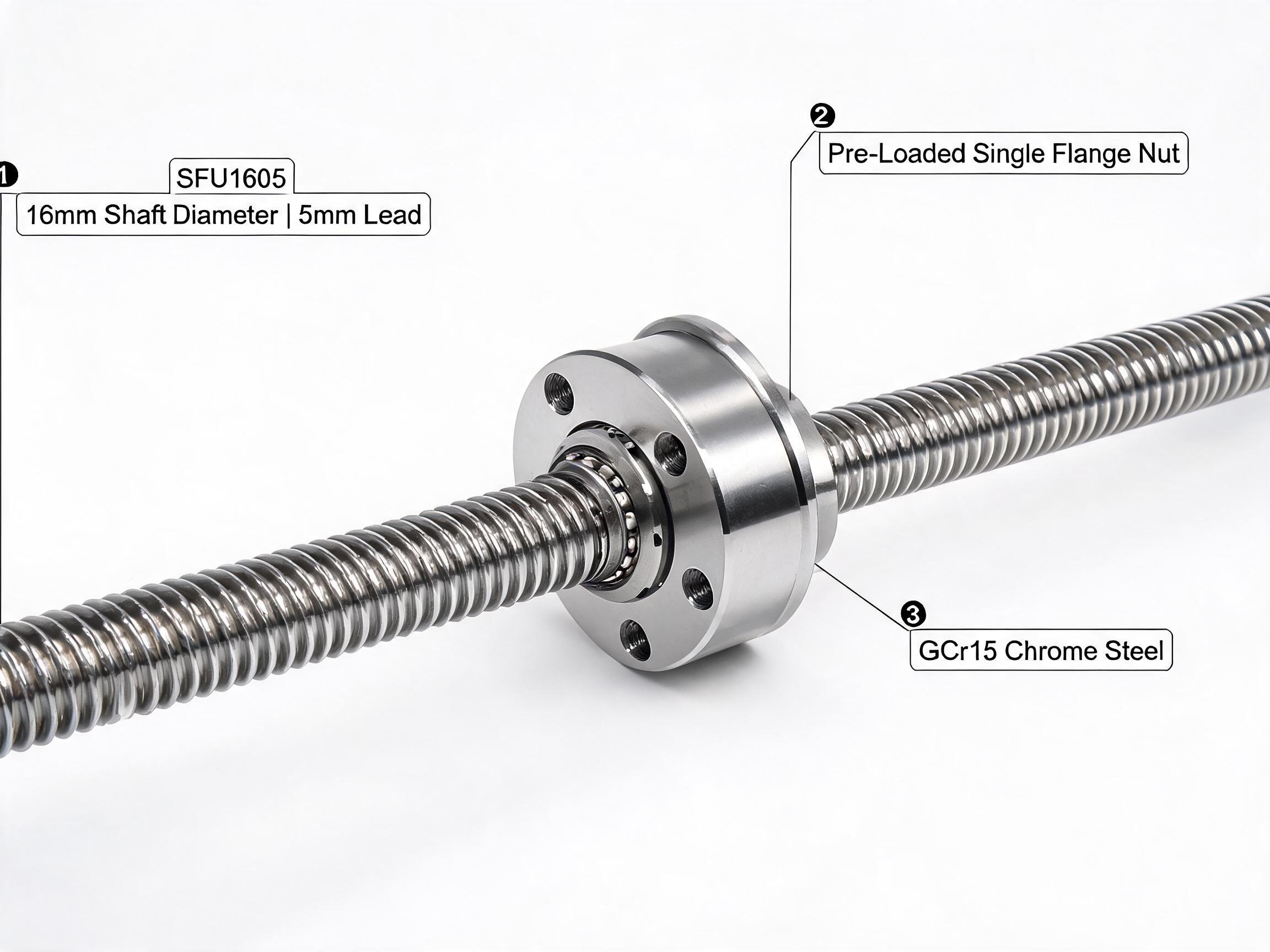
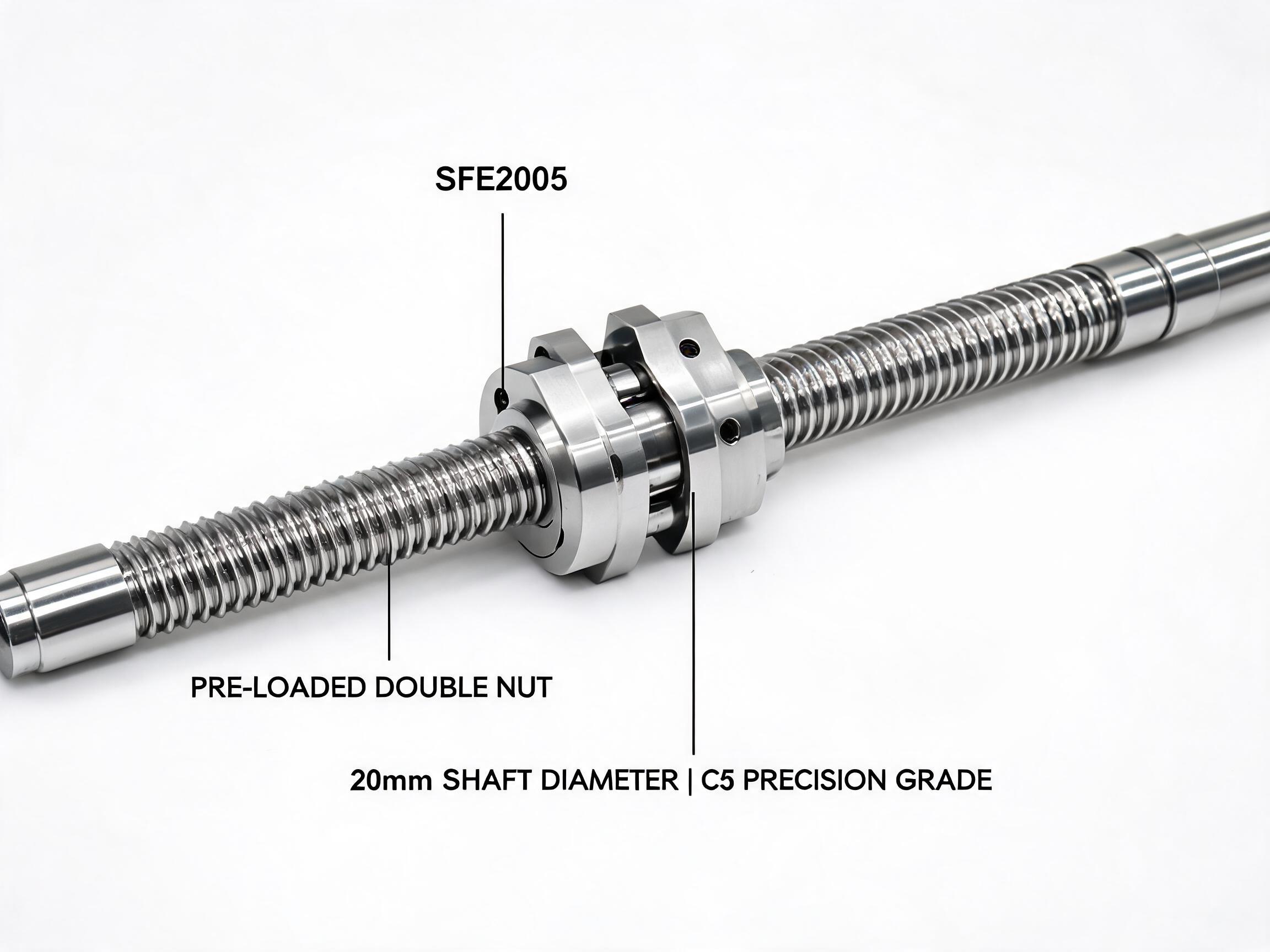
Take two products from the same manufacturer's range. The SFU series rolled assembly is a C7 screw to ISO 3408, 16 mm shaft, 5 mm lead, with a travel error of plus or minus 0.05 mm per 300 mm and a single nut rated 6.8 kN dynamic. The SFE series ground assembly is a C5 screw to ISO 3408, 20 mm shaft, 5 mm lead, with a travel error of plus or minus 0.008 mm per 300 mm and a double nut rated 12.7 kN dynamic. Same 5 mm lead, different shaft, different accuracy class, different nut arrangement, different dynamic load and different axial rigidity, which reaches up to 280 N per micrometre on the ground double-nut version. A buyer who specifies only "20 mm ball screw" has not specified a screw yet.
Length widens that gap further. A screw ordered at 300 mm and the same screw ordered at 1600 mm share a drawing number in the catalogue, but they are different problems on the machine. The supplier still runs the same checks, but the answer changes because unsupported length changed.
The whip problem, explained without inventing numbers
Whip is the lateral vibration of a rotating screw. Every screw has a critical speed range at which this vibration becomes severe, and the critical speed is fixed by three things acting together:
- Unsupported length. The longer the span between supports, the lower the speed at which whip appears.
- Shaft diameter. A larger shaft resists the same vibration over a longer span than a thin one.
- End support. How the screw is held at each end changes the effective unsupported span and how much the screw can deflect.
This is why a 16 mm screw and a 40 mm screw are not interchangeable at the same travel and the same speed. The relationship is qualitative until the numbers are put in: you cannot tell from a datasheet alone whether a given screw will whip at your stroke. The check has to be run against the real unsupported length, the real shaft, the real end support and the real operating speed. Ask the supplier to run it and give you the result, rather than estimating it from a rule of thumb.
One practical consequence: when a design calls for a long travel and a fast move, reducing the unsupported length or increasing the shaft diameter is usually more effective than changing the accuracy class. Whip is a length and support problem before it is a precision problem.
End support and end machining
End support is not a detail added after the screw is chosen; it is part of what makes the screw usable at a given length. A fixed bearing block at one end and a supported block at the other is a common arrangement, and the distance between those two supports is what the whip check uses as the unsupported span.
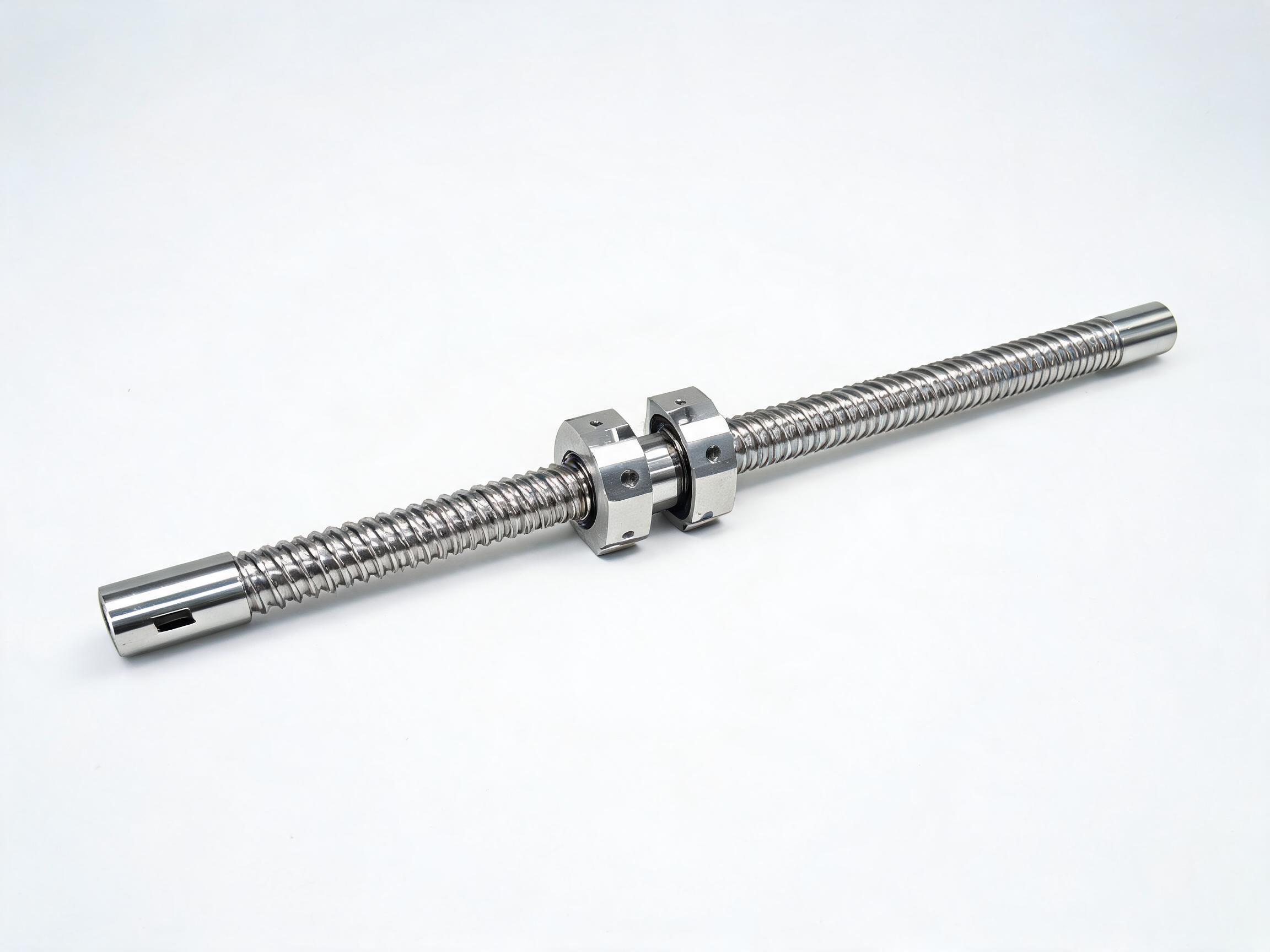
The screw shaft has to be machined to accept those blocks. On the SFU2510 screw, for example, the drawing shows a machined shaft end intended for BX25/BF25 support blocks. That machining is part of the screw specification. If you change the support block type, the shaft end changes with it, and that is a decision that has to be made when the quotation is prepared, not at assembly. The manufacturer also supplies shaft support seats, fixed and supported bearing blocks, alongside its screw assemblies, so the screw end and the block can be specified together.
Practical points to settle before ordering:
- Which end is fixed and which is supported, and what block series each end uses.
- Whether the shaft end is machined for the standard block for that series, or for a different block you already have.
- Whether the screw length you need falls inside the standard range for the series, or has to be made to a custom length.
Standard length ranges and what a custom length changes
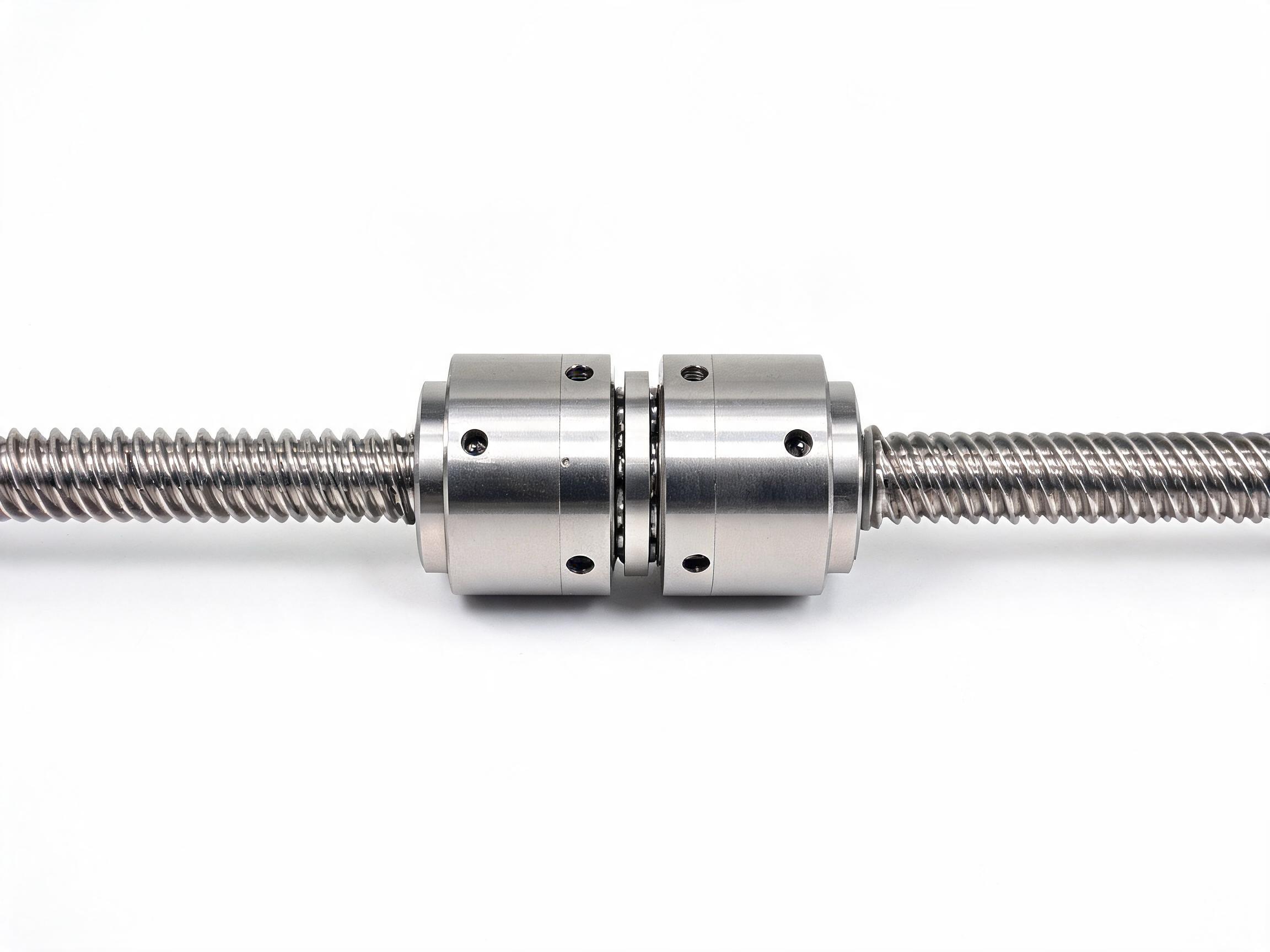
The standard ranges differ by series. The SFU rolled series is quoted at standard lengths of 300 to 1500 mm. The SFE ground series is quoted at 200 to 1200 mm. The DFU double nut zero-backlash series, which is offered in shaft sizes 16 to 40 mm, leads of 5, 10 and 20 mm, in C7 and C5 with preload classes P0, P1 and P2, is quoted at lengths of 300 to 2000 mm.
Those ranges tell you two things. First, a longer screw is available in some series and not in others; the ground series tops out earlier than the rolled and double-nut series. Second, a length inside the standard range is a catalogue item, while a length outside it is a custom item. A custom length is not simply a standard screw cut shorter. It changes the shaft drawing, the machining at the ends, and often which end support is appropriate, which is why the length and the end machining should be confirmed together.
The data to send before ordering
The supplier's checks and the quotation are only as good as the inputs. Before requesting a quote for a screw of a given travel, prepare the following:
| Item | What to provide |
|---|---|
| Travel / stroke | The working stroke required, and the overall screw length if already fixed by the machine envelope. |
| Mounting arrangement | Type and position of each end support, and the unsupported span if known. |
| Operating speed | The speed at which the screw will turn in normal operation. |
| Shaft and lead | Diameter and lead, or the load and accuracy requirement if you want a recommendation. |
| Accuracy and preload | Required accuracy class (for example C7 or C5) and preload class if the application needs it. |
| End machining | The support block series the shaft end must fit, or your existing block drawing. |
| Nut configuration | Single nut or double nut, and any backlash target. |
With those inputs, the supplier can run the whip check against the real stroke and speed and confirm whether the chosen diameter and end support are suitable. Without them, any answer is an assumption. This is the part of selection that cannot be replaced by browsing a catalogue: the catalogue gives the series, but the check is application-specific.
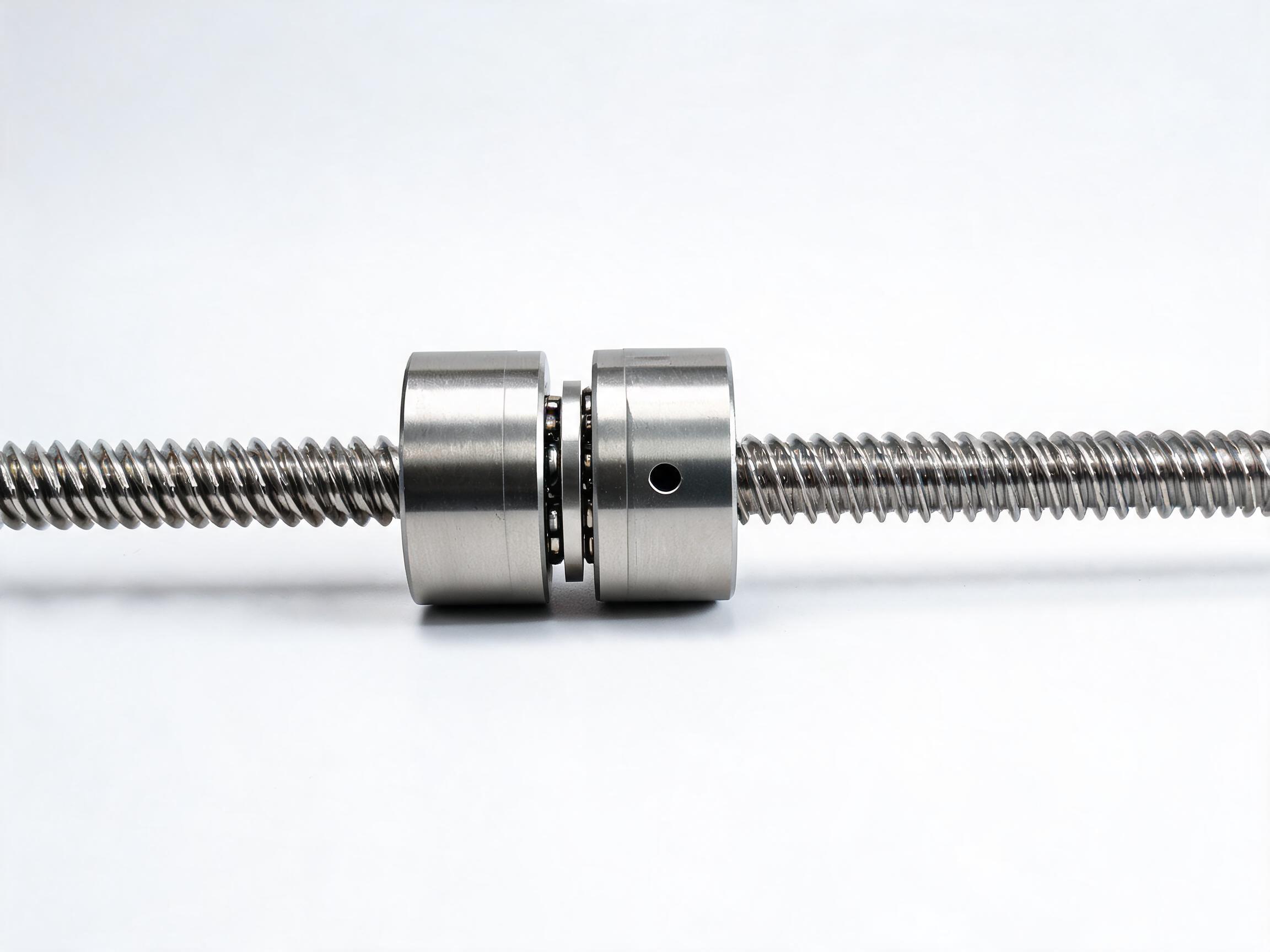
If you need a starting point, the SFU rolled assembly, the SFE ground assembly and the DFU double nut zero-backlash assembly cover C7 and C5, single and double nut, and lengths from 200 mm to 2000 mm across the three series. Use the table above to match your requirement to the series, then send the data for the check.
Short FAQ
How do I choose a ball screw for a given travel?
Fix four things first: the stroke, the end support arrangement, the operating speed and the accuracy class. Diameter and lead follow from those. Then have the supplier check the selected diameter against the real unsupported length and speed before the order, because that check decides whether the screw is suitable.
How do I select ball screw diameter?
Diameter is not chosen in isolation. It has to be large enough to keep whip under control over the unsupported span you plan, and to carry the load. A longer travel generally pushes you toward a larger diameter or a shorter unsupported span, or both. Confirm both with the supplier rather than picking the diameter first.
What is ball screw whip?
Whip is lateral vibration of a rotating screw at speed. It depends on the unsupported length, the shaft diameter and the end support. A longer screw with the same diameter whips more easily than a short one. The exact limit for your application is an engineering check, not a catalogue figure.
What is the difference between a ball screw and a lead screw?
They are different mechanisms and are not covered in detail here. This article is about selecting a ball screw of a given length and support arrangement; the comparison between ball screws and lead screws is a separate topic.
Xiamen Dongfeng Bearing Mechanical & Electrical Co., Ltd. has manufactured linear motion bearings and linear guideways since 2014 and exports on EXW, FOB, DAP and DDP terms. To have a screw length checked against your stroke and speed, send the data table above with your enquiry. You can start from the SFU series rolled ball screw assembly, the SFE series ground ball screw assembly or the DFU series double nut zero-backlash ball screw.