
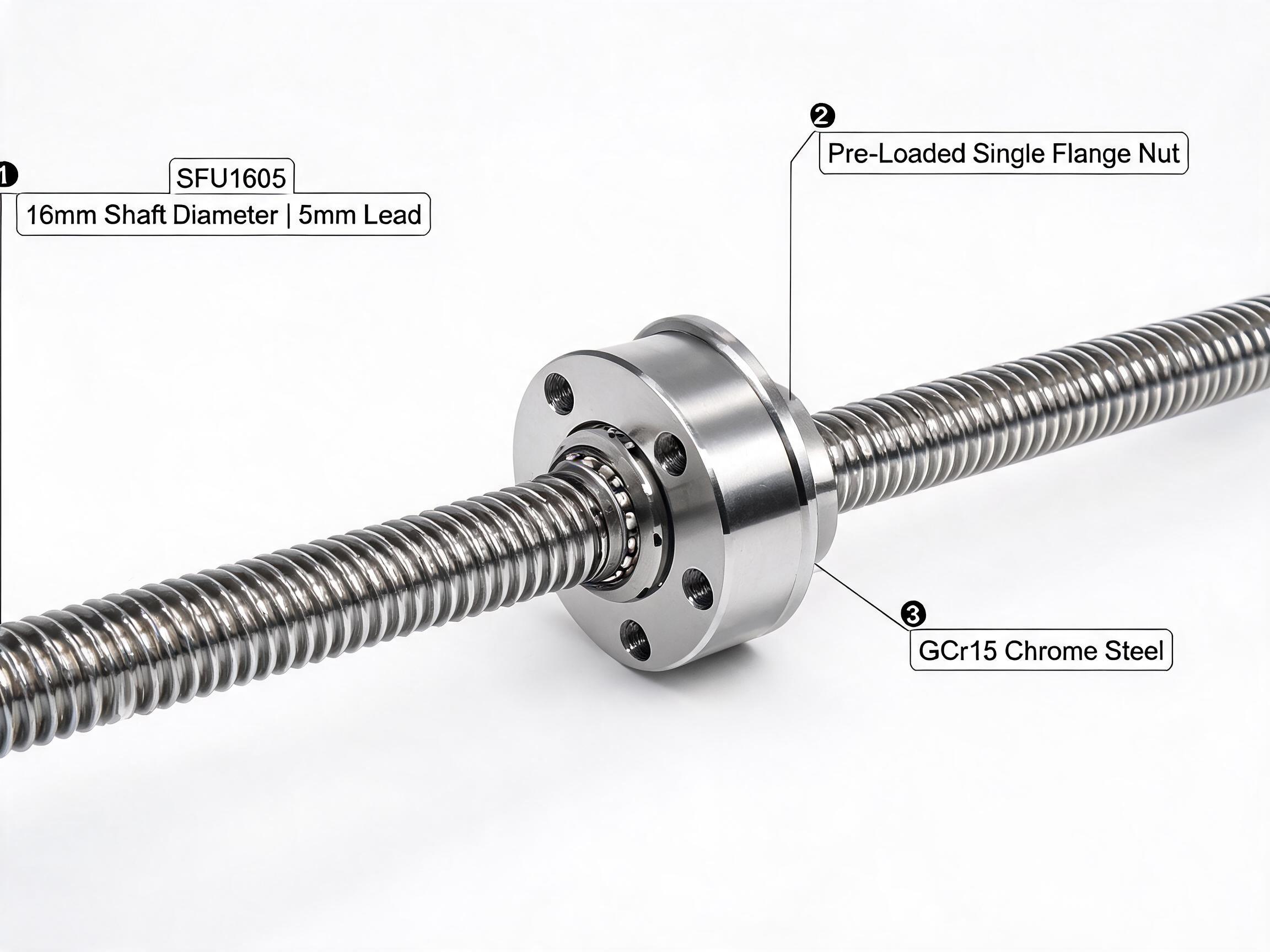
A practical guide to mapping axis load to a real ball screw size: how dynamic load rating, static load margin and end-support rigidity work together, with cross-series figures from SFU1605, SFU2510, SFU3205, DFU2005 and SFE2005 to show where each size fits.
Ball Screw Selection
Most axis sizing errors are not arithmetic errors. They happen because a buyer compares one number, the dynamic load rating, against the axis load and stops there. The rating that clears the load is necessary, but the static margin and the end-support arrangement decide whether the chosen shaft diameter and bearing pair will actually carry that load over the stroke you need. This article maps axis load to series size using the ratings published for the SFU, DFU and SFE families, so the choice is made on three numbers instead of one.
Key takeaways
- Dynamic load rating sets the size floor; static load rating sets the margin at peak and impact loads.
- End-support rigidity and shaft diameter scale together, which is why BK/BF size must match the screw, not just the load.
- Series (rolled SFU, double-nut DFU, ground SFE) changes what you get at a given size, not the size itself.
- Length range is a size constraint: a load that fits SFU1605 on paper may not fit if the stroke requires a longer shaft than that size offers.
Read the three numbers in order
A ball screw load capacity question usually arrives as one figure: the maximum axis force, perhaps the thrust at acceleration, perhaps the push at a jam condition. The sizing method is to run that figure against three published values, each doing a different job.
- Dynamic load rating is the reference value for the moving duty of the screw. It is the number you compare with the working load to pick a size band.
- Static load rating governs the load the screw sees without rotation, or at a peak that is not part of the running duty. Static ratings are published for some sizes only; where a table is blank, refer to the datasheet.
- Axial rigidity is how much the screw assembly deflects per unit of axial force. At the same load, a screw with lower rigidity moves more under thrust, which shows up as positioning error and as extra load on the support bearings.
The order matters because the three values scale together but not linearly. Going from SFU1605 to SFU2510 more than doubles the dynamic rating, while the shaft goes from 16 mm to 25 mm and the lead from 5 mm to 10 mm. Lead change alters the torque and speed relationship at the same time, so a bigger screw is not simply a stronger version of the smaller one. The comparison below keeps each published value in its own column so the trade-offs are visible.
Cross-series ratings compared
| Model | Type / accuracy | Shaft dia. | Lead | Dynamic load | Static load | Length | Support |
|---|---|---|---|---|---|---|---|
| SFU1605 | Rolled, C7 / ISO 3408 | 16 mm | 5 mm | 6.8 kN (single nut) | refer to the datasheet | refer to the datasheet | refer to the datasheet |
| SFU2510 | Rolled | 25 mm | 10 mm | 17.2 kN | 26.5 kN | 300–3000 mm | BK25 / BF25 |
| SFU3205 | Rolled | 32 mm | 5 mm | 22.5 kN | 34.8 kN | 500–4000 mm | BK32 / BF32 |
| DFU2005 | Double nut, zero backlash | 20 mm | 5 mm | 10.2 kN (double nut) | refer to the datasheet | refer to the datasheet | refer to the datasheet |
| SFE2005 | Ground, C5 | 20 mm | 5 mm | 12.7 kN (double nut) | refer to the datasheet | refer to the datasheet | refer to the datasheet |
Values as published for the listed configurations. Diameter alone does not set capacity: SFU3205 carries a higher rating than SFU2510 while using a smaller lead, which changes the nut geometry inside the same shaft envelope. Nut configuration is stated only where the record states it: SFU1605 is a single-nut rating, DFU2005 and SFE2005 are double-nut ratings. Where a row does not name the nut configuration, that value is the rating published for the size, and the nut configuration should be confirmed against the datasheet before any two figures are treated as directly comparable.
Two comparisons in this table are worth keeping in mind during sizing. First, SFU3205 at 32 mm shaft offers 22.5 kN dynamic against 17.2 kN for SFU2510, roughly 31 percent more on the published ratings, and its axial stiffness is stated in its record as about 2.5 times that of SFU2510. Second, the DFU2005 double nut at 10.2 kN carries about 1.5 times the load of a single nut at that size, with axial play held below 0.003 mm. Those two facts point at different selection levers: more shaft diameter for raw capacity and stiffness, or a double nut for capacity and play control at a smaller envelope.
End support: the second half of the answer
The published load rating describes the screw and nut. The axis that surrounds it adds a second constraint, because the shaft has to be held at both ends with bearings matched to its diameter. The support designation in the catalog is not decorative: SFU2510 pairs with BK25/BF25, and SFU3205 with BK32/BF32. A 32 mm screw cannot be run in 25 mm housings simply because the load fits the larger screw. That is why the support size belongs in the sizing decision, not in the drawing stage after the screw is ordered.
Support rigidity also feeds back into load capacity in practice. A screw that deflects under thrust pushes some of that thrust into the bearings and the nut, and a soft fixed end lets the shaft move where the design assumed it would not. When you compare two sizes and the larger one carries higher ratings, part of what you are buying is that stiffer shaft-and-support combination. In the SFU3205 case the catalog states roughly 2.5 times the stiffness of SFU2510; that figure is the reason a machine may move up a size even when the dynamic rating alone would have passed at 25 mm.
Check the support arrangement against the axis direction of load before fixing the size. A thrust load in tension behaves differently at the support than the same load in compression, and the bearing pair selected at each end must suit the load direction and the fixing method you intend. The published BK/BF pairings tell you the diameter class; the arrangement detail and allowable support load require confirmation against the specific bearing datasheet.
Mapping your axis load to a size
Sizing starts with the working force, not the motor torque or the speed. Take the maximum thrust the axis must produce during normal running, then add the peak that occurs during acceleration or a stall condition if the machine can reach it. Compare that figure with the published dynamic rating and keep a margin you can defend; the size that simply equals the load leaves nothing for the conditions the rating does not capture for your machine.
Worked through the catalog figures, a running thrust of around 5 kN sits inside SFU1605's 6.8 kN single-nut rating, but with a small margin. A thrust of 10 kN takes SFU1605 out of contention and puts SFU2510 at 17.2 kN in range with substantial headroom, while DFU2005 at 10.2 kN double nut reaches the load directly and offers zero-backlash positioning at the same time. Around 20 kN, SFU3205 at 22.5 kN is the size that covers the duty with the stiffness figure to go with it.
These are comparisons against published ratings, not a recommendation for a specific machine. The conversion from axis force to screw load depends on the drive arrangement, friction and the direction of gravity, and a vertical axis loading the screw in compression can need a different check than a horizontal one. Use the figures to narrow the candidate size, then verify the result against your axis geometry and the relevant datasheet values.
Choosing the series at the same size
Once the size band is fixed, the series decision is about accuracy and backlash rather than load alone. The SFU rolled series covers the C7 / ISO 3408 accuracy class at SFU1605 and the larger rolled sizes; the SFU2510 with flange nut is the natural step up in that family when the rated load climbs. Where the axis needs zero backlash, the DFU double-nut series puts a 20 mm shaft at 10.2 kN with axial play below 0.003 mm; where the application needs ground accuracy, the SFE2005 at C5 offers 12.7 kN on a double nut with 280 N/µm axial rigidity.
That 280 N/µm figure for SFE2005 is a useful cross-check on the size decision. Axial rigidity at this level tells you how the screw behaves under the load you are applying, and it is the number that separates a ground screw from a rolled screw at the same nominal size when positioning accuracy is the real requirement. A rolled screw with a higher dynamic rating but lower rigidity may still be the wrong answer for an axis that has to hold position under thrust.
| If the requirement is… | Series that fits | Published basis |
|---|---|---|
| General transfer axis, standard accuracy, load up to about 5 kN | SFU1605 (C7 / ISO 3408) | 6.8 kN dynamic, single nut |
| Higher thrust with rolled accuracy, stroke up to 3000 mm | SFU2510 | 17.2 kN dynamic, 26.5 kN static, BK25/BF25 |
| Heaviest listed thrust and long stroke, stiffness critical | SFU3205 | 22.5 kN dynamic, 34.8 kN static, about 2.5 times SFU2510 stiffness |
| Zero backlash at a 20 mm envelope | DFU2005 double nut | 10.2 kN, axial play below 0.003 mm |
| Ground accuracy, load around 12 kN at 20 mm | SFE2005 (C5) | 12.7 kN double nut, 280 N/µm axial rigidity |
What to put on a requirement sheet
The fastest way to get a usable size back from a supplier is to state the axis load, stroke and accuracy class together, along with the support arrangement you intend. That is the information the three-number method needs. Sizes that only fit on the dynamic rating will surface immediately if the stroke forces a longer screw than the size allows, since the length ranges differ: SFU2510 covers 300–3000 mm, SFU3205 500–4000 mm, and the shorter sizes reference their own datasheet limits rather than a shared range.
- Maximum running thrust and any peak thrust, in kN, with the direction of load.
- Required stroke and the overall screw length that follows from it.
- Accuracy class and backlash requirement.
- Fixed and supported end arrangement, with the BK/BF size you expect to use.
- Nut configuration, single or double, so the rating you compare is quoted on the same basis.
- Quantity, so the MOQ (SFU 50, SFU3205 30, DFU 20) can be checked against the order at the same time.
Keep the requested dynamic rating, static margin and support pairing separate on the sheet. If the proposal comes back with a size that clears the load but changes the support size, the change is visible and can be reviewed against the axis design before the screw is ordered. Where the static rating or the support load limit is not published for the size you need, ask for it from the datasheet rather than assuming the figure scales from a neighbouring size.