
Ball screw preload removes axial play and raises rigidity, but it also adds drag torque and heat. This guide explains what preload does, how spacer double-nut preload works, and how P0/P1/P2 classes map to real machine requirements. It also compares ground C5 and rolled C7 options so machine builders can match stiffness and speed without overspending.
Key Takeaways
- Preload removes axial play and raises rigidity, but adds drag torque and heat.
- P0, P1, and P2 are light, medium, and heavy preload classes.
- Spacer double-nut preload produces axial backlash below 0.003 mm.
- Ground C5 screws and rolled C7 screws serve different speed and stiffness targets.
What ball screw preload actually does
Preload is an internal axial force applied between the ball nut and the screw. It is not a setting you can see on a drawing; it is a manufacturing condition that changes how the nut behaves under load. The practical effects are straightforward: it removes axial play, raises axial rigidity, and introduces drag torque and heat.
When a ball screw has no preload, there is a small clearance between the balls and raceways. Under reversing loads, the nut can move axially before the balls contact the opposite raceway. This lost motion shows up as backlash at the tool tip or worktable. Preload closes that gap by forcing the balls into contact with both raceways at all times. The result is near-zero axial play and a stiffer load path.
The trade-off is friction. A preloaded nut has more contact stress and more rolling resistance than a zero-preload nut. That extra drag torque generates heat, especially at high speed. The heat changes the screw temperature and causes thermal growth, which can shift the axis position. So preload is always a balance: enough to hold the axis stable under cutting forces, but not so much that drag torque and heat become the limiting factor.
This is why the question "what is ball screw preload" usually leads to a second question: "how much do I need?" The answer depends on the load direction, the required positioning accuracy, the speed profile, and the duty cycle. A heavy-cutting machining center and a high-speed pick-and-place axis will not use the same preload class.
Spacer double-nut method: how it creates preload
There are several ways to preload a ball nut, including oversized balls and offset lead. For high-stiffness machine tool axes, the spacer double-nut method is common because it gives a controlled, stable preload with a clear mechanical origin.
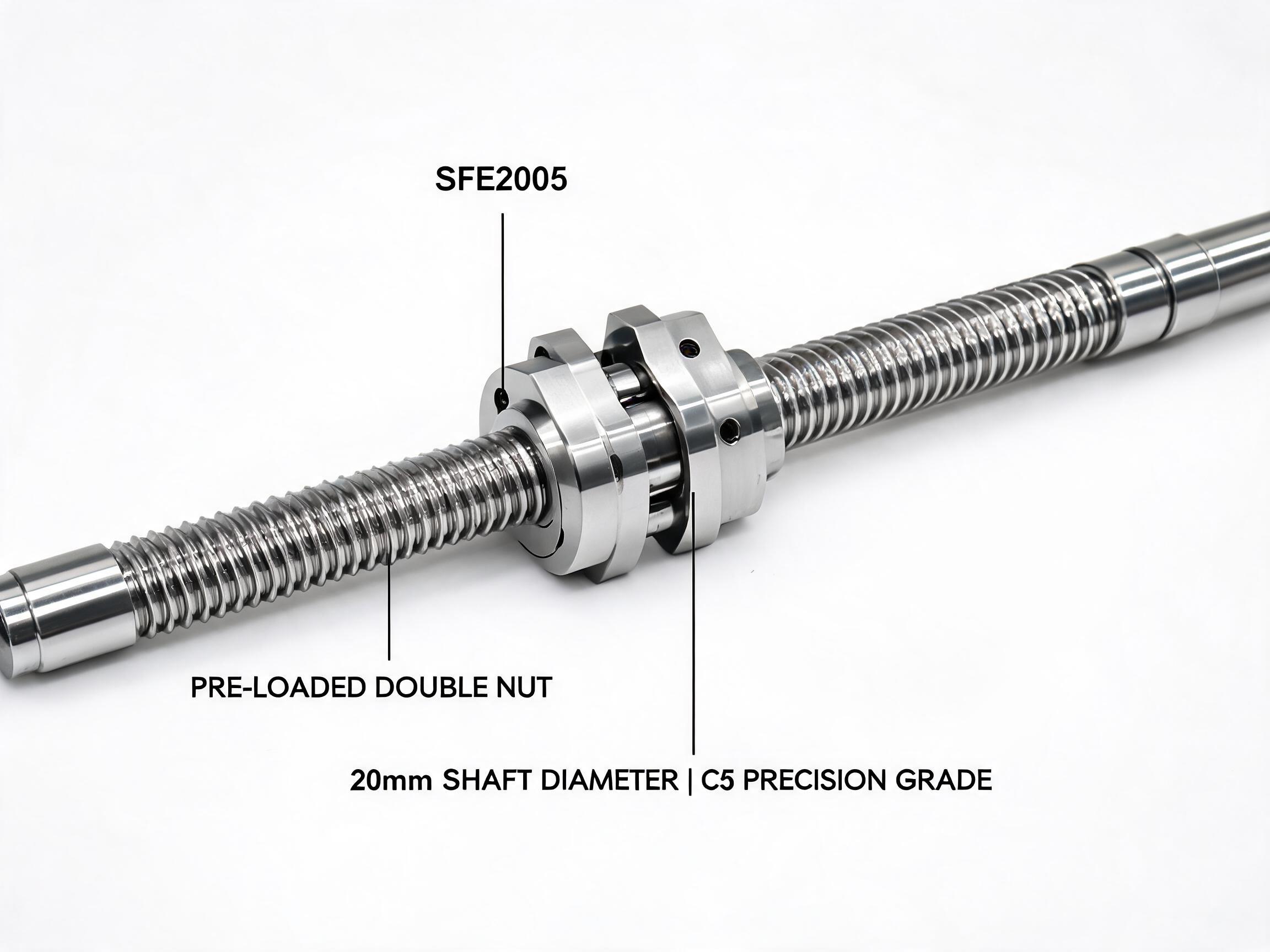
In a double-nut design, two nut halves are mounted on the same screw. A precision-ground spacer sits between them. The spacer is slightly thicker than the free gap between the nuts, so when the nuts are clamped together, the spacer forces them apart. Each nut half is pushed into contact with opposite sides of the ball track. The balls are preloaded in both directions, and the axial play is eliminated.
The amount of preload is set by the difference between the spacer thickness and the natural gap. Because the spacer is a separate part, it can be ground to a specific value. This makes the preload repeatable across a production batch.
For the DFU series double-nut zero-backlash ball screw, the spacer double-nut design produces axial backlash below 0.003 mm. That is a direct statement of what the preload achieves: a very small axial clearance under reversing conditions. For a machine builder, this matters when the axis must hold position during a direction change, such as in contour milling or in a measuring cycle.
The double-nut design also provides a stiffness advantage. The DFU2005 double-nut screw has a dynamic load rating of 10.2 kN, which is 1.5 times the rating of a comparable single-nut version. The higher dynamic rating comes from sharing the load across two nut halves and from the preload keeping both halves engaged. In a vertical axis or a high-thrust application, this margin can extend service life or allow a smaller screw size for the same load.
P0, P1, P2: matching preload to the cut
Preload classes are a way to specify the amount of preload without naming a torque value. The common classification is P0, P1, and P2, corresponding to light, medium, and heavy preload.
| Preload class | Level | Typical behavior | Best suited to |
|---|---|---|---|
| P0 | Light | Lowest drag torque, lowest heat generation | High-speed axes, light cutting, pick-and-place, transport axes |
| P1 | Medium | Moderate drag torque, good rigidity | General machining, milling, drilling, moderate thrust |
| P2 | Heavy | Highest rigidity, highest drag torque and heat | Heavy cutting, high-thrust axes, vibration-sensitive processes |
The class choice is not about "better" or "worse." It is about which failure mode you are trying to avoid. If the axis runs at high speed for long periods, P0 keeps drag torque low and limits heat. If the axis takes heavy interrupted cuts, P2 keeps the tool from deflecting under reversing load. P1 covers the middle ground where both speed and cutting force matter.
One common mistake is to specify P2 everywhere because it sounds strongest. In practice, a P2 preload on a high-speed axis can raise operating temperature enough to require more cooling or a larger motor. The extra rigidity is real, but it may not be usable if the axis cannot reach its commanded speed without thermal growth. Conversely, a P0 preload on a heavy-cutting axis may leave enough axial compliance to cause chatter or poor surface finish.
The right way to choose is to start from the worst-case axial load and the required positioning accuracy, then check the resulting drag torque against the speed and duty cycle. If the drag torque is too high for the thermal budget, step down one class and see if the rigidity is still sufficient. If the axis still deflects under load, step up.
Ground C5 vs rolled C7: choosing the base screw
Preload class is only half of the specification. The base screw's manufacturing method and accuracy grade determine what the preload can achieve in practice.
Ground screws are machined and ground after heat treatment. The grinding process removes material to create the final raceway geometry, which gives tight lead accuracy and smooth surface finish. Rolled screws are formed by rolling the thread, which is faster and lower cost but leaves a different surface and geometry.
The SFE series ground ball screw assembly is an example of a ground C5 screw. Its lead accuracy is ±0.008 mm per 300 mm, and its axial play is below 0.005 mm. The axial rigidity can reach up to 280 N/µm. The dynamic load rating is 12.7 kN. These are the numbers a machine builder uses to check whether the screw can hold the required position under load.
Compared with a rolled C7 screw, a ground C5 screw has lower friction heat at high feed. The ground raceway geometry reduces rolling resistance, so the screw can run at higher speed without the same temperature rise. This matters for high-speed machining centers and for axes with long travel where thermal growth accumulates.
Rolled C7 screws are still a valid choice for many applications. They are often used for positioning tasks where the load is moderate and the speed is not extreme. The lower cost can make them attractive for large machines with many axes. But if the axis needs high rigidity, tight lead accuracy, or low heat at high feed, the ground C5 screw is the better starting point.
The combination of preload class and screw grade determines the final axis behavior. A rolled C7 screw with heavy preload may still have more axial compliance than a ground C5 screw with medium preload, because the raceway geometry limits how tightly the balls can be loaded. For a machine builder, it is worth evaluating the pair together rather than treating preload and accuracy grade as independent choices.
Selection summary for machine builders
Use the following steps to narrow the specification:
- Define the worst-case axial load. Include cutting force, acceleration force, and any external thrust. This sets the minimum dynamic load rating.
- Define the required positioning accuracy. If the axis must hold position during reversing cuts, axial play and rigidity matter more than lead accuracy alone.
- Check the speed and duty cycle. High speed and long duty cycles favor lower preload and ground geometry to limit heat.
- Pick a preload class. Start with P1 for general machining, P0 for high-speed light-load axes, P2 for heavy cutting or high-thrust axes.
- Pick a screw grade. Ground C5 for high rigidity and low friction heat; rolled C7 for moderate load and cost-sensitive axes.
- Verify the drag torque. Confirm that the motor and cooling system can handle the added friction without exceeding the thermal budget.
For a double-nut zero-backlash design, the DFU series double-nut zero-backlash ball screw uses a spacer to achieve axial backlash below 0.003 mm and a dynamic load rating up to 1.5 times a single-nut equivalent. For a ground screw with tight lead accuracy and high rigidity, the SFE series ground ball screw assembly offers C5 accuracy, axial play below 0.005 mm, and axial rigidity up to 280 N/µm.
FAQ
What is ball screw preload in simple terms?
It is an internal force that keeps the balls in contact with both raceways, removing axial play and making the nut stiffer under load. It also adds friction, so it is a trade-off.
How do I know which preload class to choose?
Start from the axial load and the required accuracy. Use P0 for high-speed light-load axes, P1 for general machining, and P2 for heavy cutting or high-thrust axes. Then check drag torque against the thermal budget.
Can I use a rolled C7 screw with heavy preload?
It is possible, but the rolled raceway geometry may limit the achievable rigidity compared with a ground screw. If high stiffness is the priority, a ground C5 screw is usually the better match.
Does preload affect the life of the ball screw?
Preload changes the load distribution inside the nut. A properly selected preload can improve life by keeping the load shared across more balls. Excessive preload increases contact stress and drag torque, which can reduce life and raise operating temperature.
If you are specifying an axis and want to confirm the preload class and screw grade for your load and speed profile, send the details to our engineering team. We can help you match the right ball screw assembly to your application.