A practical guide for overseas buyers comparing ball screw quotes and suppliers on more than price: what a complete RFQ must state, which documents to request before committing, how rolled and ground screws differ in cost and accuracy, and how to put two quotes on the same basis.
Sourcing guide
Two ball screw quotes can look comparable on the invoice and describe different products. The difference sits in what each RFQ asked for, which documents came back with the price, and whether rolled and ground options were priced against the same duty. This guide sets out how to compare quotes and suppliers on that basis.
Key takeaways
- A quote is only comparable when both suppliers priced the same specification, the same packaging and the same Incoterms.
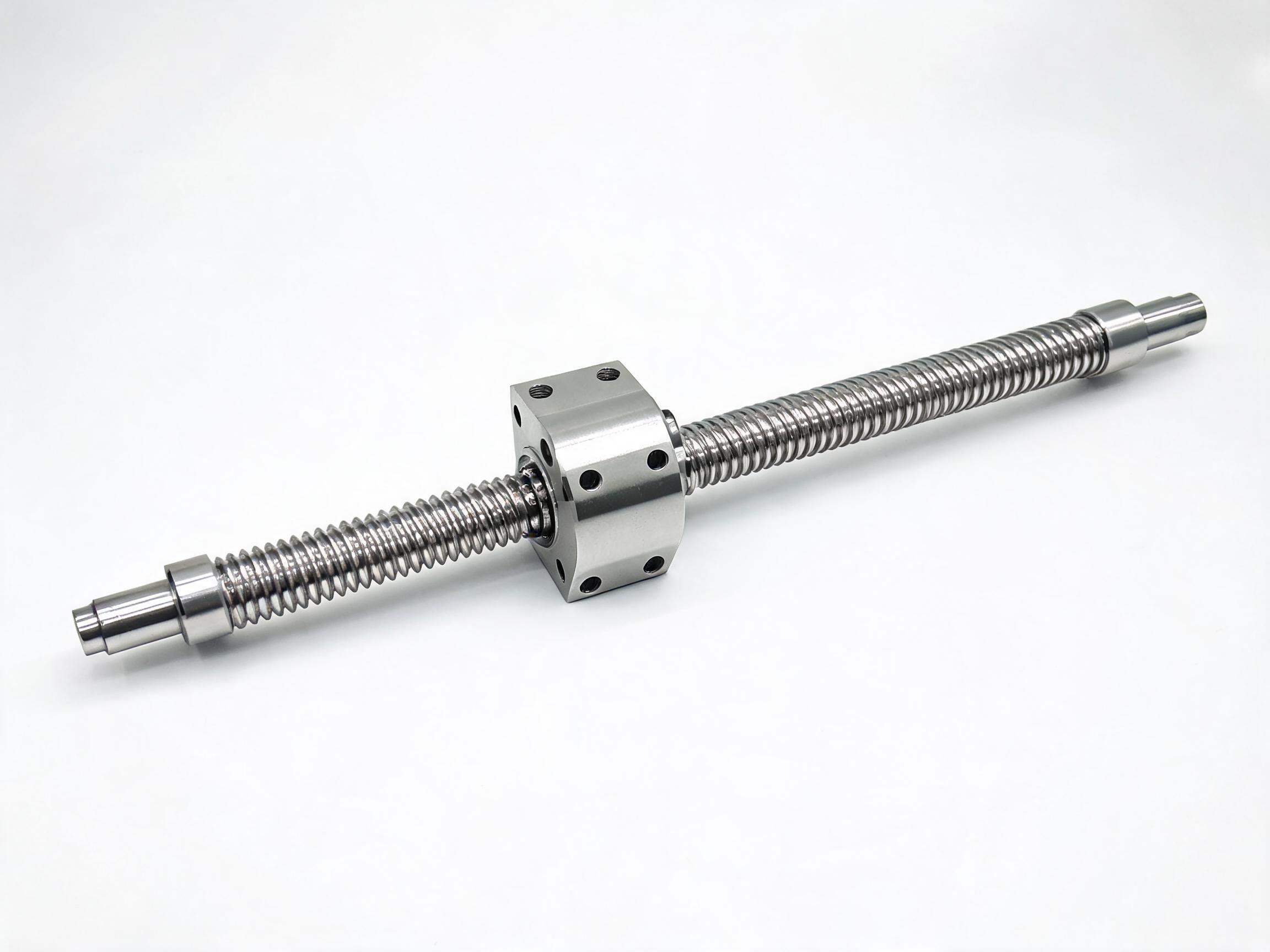
- Diameter and lead alone do not define a ball screw; total length, threaded length, end journals, nut type and flange are part of the product.
- Rolled and ground screws should be compared as separate options against the accuracy the application needs, not blended into one lowest price.
- Ask for drawings, inspection documents, and material and heat-treatment statements before ordering, not after.
In this article
What a complete ball screw RFQ must state
Most quoting problems start before the supplier replies. If the RFQ leaves a dimension open, each supplier fills it with whatever is convenient for its stock or its process, and the prices that come back describe different parts. A ball screw is a machined assembly, not a catalogue item with a single number. State the following in the request itself.
Motion specification
- Nominal diameter and lead, with the direction of the thread if it is not standard.
- Total length and threaded length, measured between defined reference points.
- Number of starts, where the screw is multi-start.
End journal and mounting details
- Journal diameters and lengths at both ends, including any stepped or tapered sections.
- Bearing support arrangement at each end, and whether the screw is intended for a fixed, supported or free end.
- Keyways, flats, threads and locking features on the journals.
- Any coupling or motor interface that fixes the journal geometry.
Nut and flange
- Nut type and whether a single nut or a double nut is required.
- Flange type, mounting hole pattern and hole size.
- Any preload or backlash requirement, stated as the intended condition rather than a general wish.
Duty and acceptance
- Accuracy grade required for the application, stated explicitly.
- Expected axial load, speed and duty cycle, including whether the load is mainly static or reversing.
- Mounting orientation and any environmental conditions that affect the choice, such as exposure to coolant or dust.
- Quantity, packing requirement and destination, which affect how the price is built.
A drawing attached to the RFQ is usually clearer than a text list of dimensions. If the drawing leaves material or heat treatment open, mark those as items to be proposed separately, so alternatives are visible rather than buried in the price.
Documents to request before committing
Price alone does not show what will be shipped. Request the documents before ordering, and read them against the RFQ.
- Dimensional drawing of the offered screw and nut, with tolerances and reference points. Check that the drawing matches the RFQ, not a similar catalogue size.
- Inspection report for the offered product or grade, showing which characteristics were measured and under what conditions.
- Material and heat-treatment statement, identifying the screw and nut material and the treatment applied.
- Accuracy grade statement, written into the quotation, not left to a catalogue page for a different size.
- Packing and marking description, so the goods arrive protected and identifiable.
These documents define what the supplier is offering. They do not, by themselves, prove future performance in your machine, so keep the acceptance criteria in your own specification and check the offered documents against it.
Rolled vs ground: comparing like for like
Rolled and ground ball screws are made by different processes, and their cost and accuracy profiles differ. The practical comparison is not which is cheaper, but which process meets the accuracy and duty the application actually needs.
| Comparison point | Rolled screw | Ground screw |
|---|---|---|
| Typical position in the range | General positioning duties | Duties needing tighter accuracy and finish |
| Cost profile | Lower cost per unit at comparable size | Higher cost per unit, reflecting additional machining |
| Lead time profile | Often built to closer standard series | More process steps before shipment |
| What to compare | Accuracy grade quoted, end journal tolerances, nut backlash | Same, plus the grinding specification and inspection record |
| Best use of the quote | As a baseline for the duty | As the option priced to the required grade |
When two suppliers quote different processes, ask each to price both rolled and ground options against the same drawing. That gives a cost comparison on one basis and makes the accuracy difference a stated choice rather than an assumption. The DF Linear catalogue separates these categories, for example the SFU Series rolled ball screw assembly and the SFE Series ground ball screw assembly, which makes it easier to request the right option in an RFQ.
Nut configuration also changes the comparison. A DFU Series double nut zero-backlash ball screw addresses backlash through its nut arrangement; if one quote uses a single nut and another a double nut, the prices are not for the same function.
Signals of a reliable supplier
Reliability in ball screw sourcing shows up in the paperwork before it shows up in the shipment. Look for these signals in the reply to your RFQ.
- Consistent drawings across revisions. The drawing number and revision in the quote should match the drawing you are asked to approve, and changes should be marked rather than silently redrawn.
- Clear grade statements. Every accuracy claim is attached to a specific size and process, not stated for the product family as a whole.
- A defined sample policy. The supplier can say what a sample will be, how it will be documented and what the buyer is expected to check.
- Transparent MOQ and lead time. Both are stated per item and per quantity, with any condition attached to them, so the same basis can be compared across suppliers.
- Answers to technical questions. A supplier that can explain its end journal tolerances and nut options is easier to hold to a specification later.
None of these signals proves that the next order will go smoothly. They do show whether the supplier can describe its product precisely, which is the basis for any acceptance discussion.
How to compare two quotes fairly
Before comparing totals, check that both quotes rest on the same basis.
- Same specification. Confirm that both suppliers priced the same drawing, including journals, nut and flange, and the same accuracy grade.
- Same process. If one quote is rolled and the other ground, compare each process separately, or ask both for both.
- Same quantity and unit. Check whether the unit price applies to the quantity you intend to order, and whether it includes the nut.
- Same packaging. Compare whether protective packing, marking and palletisation are included or listed as extras.
- Same Incoterms. EXW, FOB and CIF prices are not comparable until freight, insurance and destination charges are aligned.
- Same document set. A quote that includes drawings, inspection records and material statements is not the same offer as one that does not.
- Same validity and payment terms. Note the quote validity period and any condition that could change the price before the order is placed.
Only after these are aligned is the difference in price a difference in price. Where a supplier cannot supply a document or confirm a basis, treat that as an open item to resolve before ordering rather than as an assumed inclusion.
FAQ
Can I send only a diameter and lead to get a comparable quote?
No. Diameter and lead fix the screw's motion, but the journals, nut, flange and total length determine how it mounts and what it costs. A quote based on those two values will not match one based on a drawing.
Should I ask for both rolled and ground prices?
Yes, when the application's accuracy requirement is not yet fixed in the RFQ. Pricing both options on the same drawing shows the cost of the accuracy margin and lets you choose deliberately rather than by default.
What if a supplier's quote includes a drawing that differs from my RFQ?
Treat it as a variation to be resolved, not as equivalent. Ask which dimensions changed and why, and have the supplier re-issue the drawing against the original request before you compare the price.
When should I request inspection and material documents?
Request them before ordering. They describe the product being offered; requesting them after the order makes any discrepancy a delivery dispute rather than a selection decision.
This article gives general sourcing guidance for comparing ball screw quotes. Specific tolerances, grades, prices and delivery terms should be confirmed in each supplier's written quotation and approved drawings for your application.