
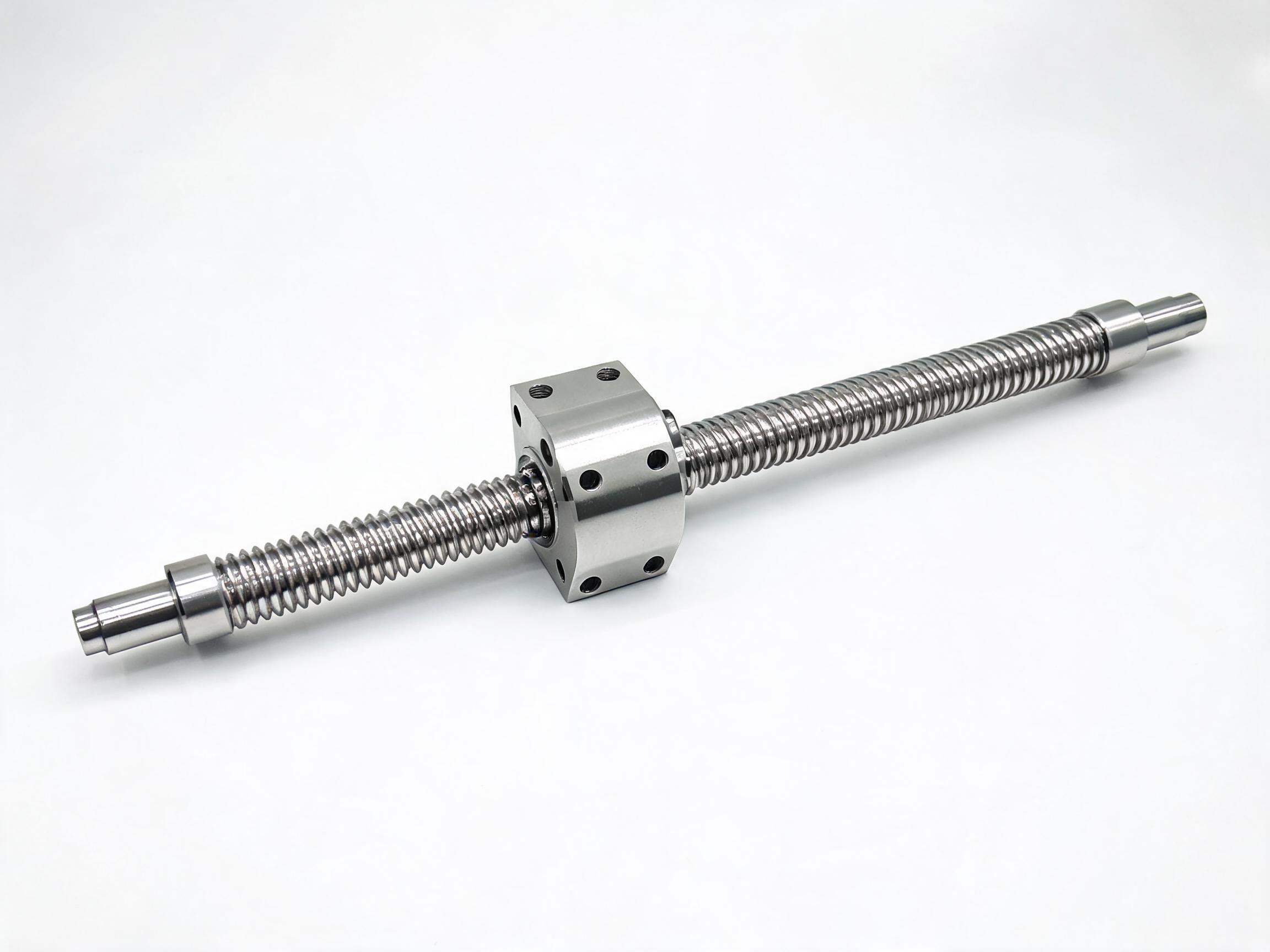
Buyers in coastal plants, washdown areas and chemical vapor environments ask what surface treatment a ball screw can take. This article explains what a treatment can and cannot change on a hardened GCr15 screw, how to read the environment, and the exact questions to put to a supplier before ordering.
A ball screw in a coastal plant, a washdown zone or a line exposed to chemical vapor faces a question that has nothing to do with load capacity: can the surface be treated against corrosion without damaging the hardened raceway or the ball recirculation that makes the screw work? The short answer is that some protection is possible, but the treatment has to be specified around the screw's function, not layered on top of it.
- On a GCr15 (52100 equivalent) chrome steel shaft, the raceway is induction-hardened to HRC 58–62 in the base metal. Any added coating is thin relative to that functional case.
- A surface treatment sits on top of the working surface. Whether it changes nut fit or drag torque must be confirmed with the datasheet or supplier for each configuration.
- The nut body is alloy steel supplied with surface treatment for corrosion resistance; the shaft and nut may not carry the same treatment.
- Assemblies leave with anti-corrosion oil, moisture-barrier film and foam-lined cartons — shipping protection is a separate matter from in-service corrosion.
- What a surface treatment can and cannot change
- Why the environment decides the question
- Questions to put to the supplier
- Matching treatments to corrosive duty
- Documentation and packing protection
What a surface treatment can and cannot change
The shaft of a standard ball screw assembly is GCr15 chrome steel, through-hardened with an induction-hardened raceway at HRC 58–62. That hardness lives in the base metal, below the surface. This is the reference point for every corrosion discussion: the treatment you add is a thin layer, and the load-bearing case underneath is what carries the balls.
A surface treatment can change how the exposed steel reacts to moisture, salt and chemical vapor. It cannot replace the hardened raceway, and it cannot be counted on to survive contact with the balls in the same way the base metal does. Where the treatment sits relative to the rolling contact is the critical detail, and it is often the detail buyers and suppliers talk past each other on.
Three things follow from that geometry:
- The raceway is a functional surface, not a decorative one. Anything applied there interacts with ball contact.
- Adding a layer adds dimension. Even a thin treatment can shift how the nut fits and how much drag torque the assembly produces.
- The external surfaces — shaft outside the raceway, nut body, end machining — are where corrosion protection is usually most useful and least disruptive.
Whether a coating changes nut fit or drag torque is not something to infer from a photograph or a general statement. It must be confirmed with the datasheet or the supplier, specific to the configuration you are buying — screw diameter, lead, nut type and preload. A double-nut zero-backlash design, for example, is sensitive to anything that alters the fit between nut and shaft, so the question matters more there than on a simple single-nut assembly.
Why the environment decides the question
Buyers rarely ask “what coating do you offer.” They describe a place. The place determines what the treatment has to resist, and how often the screw is exposed versus protected.
A coastal plant means airborne salt and humidity that settle on exposed surfaces between cycles. A washdown area means direct water contact, often with cleaning agents, and repeated wet-dry cycling. Chemical vapor means a specific aggressive atmosphere that depends on the process — and the exact chemistry matters, because a treatment chosen for one vapor may be the wrong choice for another. None of these are interchangeable, and a generic “corrosion resistant” label does not describe any of them.
One further distinction helps: continuous exposure versus occasional exposure. A screw that runs dry most of the time and sees salt air only when the machine is idle faces a different demand than one that is wet or vapor-exposed throughout operation. The supplier cannot choose correctly without knowing which situation applies.
Questions to put to the supplier
The productive conversation is not “do you have coatings?” It is a set of specific questions about what the treatment touches and what it costs in function. These are the questions worth asking before you compare quotes.
| Your environment | What to ask the supplier |
|---|---|
| Coastal plant, salt air, intermittent exposure | Which surfaces of the shaft and nut can be treated, and is the raceway excluded or included? What protection applies to end machining and the nut body? |
| Washdown area, direct water and cleaning agents | Does the proposed treatment tolerate repeated wet-dry cycles and the specific cleaning chemistry in use? Is the nut body treatment the same as the shaft treatment? |
| Chemical vapor, process-specific atmosphere | What is the treatment designed to resist, stated as a material and process rather than a general claim? Which vapors or chemicals were considered? |
| Any corrosive duty | Does the treatment change nut fit or drag torque for this specific configuration? Can the datasheet confirm it, and can you supply dimensional inspection for the treated assembly? |
| Preloaded or zero-backlash assembly | Does the treatment affect preload or backlash adjustment? How is this verified before shipment? |
Notice that none of these ask the supplier to name a product. They ask what the treatment does to the part. A supplier who can answer at the level of surfaces and function is giving you something you can check; a supplier who answers with a coating name and a durability promise is giving you a claim you cannot verify against your own environment.
Matching treatments to corrosive duty
Specific coating types are options to confirm with the supplier for your environment, not a fixed catalog you can pick from this page. The framework below is what to establish in each case, whatever treatment is proposed.
Establish the coverage boundary
Ask which surfaces the treatment covers: the shaft outside the raceway, the raceway itself, the nut body, the end journals. On a standard assembly the nut body is alloy steel supplied with surface treatment for corrosion resistance, while the shaft carries its hardened GCr15 raceway. These are different parts and may not receive the same treatment, so the answer has to be given per surface, not per assembly.
Establish the functional cost
For each treated surface, ask what happens to fit and drag torque. If the treatment touches the raceway, the answer needs to come from the supplier and the datasheet for that configuration. If it does not, the functional risk is lower, but the exposure profile changes — a screw protected on external surfaces only still has a raceway to think about.
Establish the acceptance method
Ask how a treated assembly is inspected before it ships. Dimensional inspection reports are available on request, and material certificates with GCr15 heat-number traceability can be requested as well. These help you confirm that what arrived matches what was specified — they do not by themselves prove corrosion performance in your plant, which is why the environment questions above matter.
For product context, the rolled SFU series rolled ball screw assembly and the ground SFE series ground ball screw assembly are the natural starting points for general motion duty, while the DFU series double-nut zero-backlash ball screw is the configuration where fit and preload questions deserve the most attention before any surface treatment is agreed.
Documentation and packing protection
There are two kinds of corrosion protection in a ball screw order, and they are often confused. In-service protection is the surface treatment on the part. Shipping protection is what keeps the part intact between the factory and your line — and it does not substitute for a treatment decision.
On the shipping side, assemblies are anti-corrosion oiled, wrapped in moisture-barrier film and packed in foam-lined individual cartons. For a coastal destination or a long sea route, that packing matters, but it is protection for transit, not a treatment of the working surfaces. Once the screw is installed and running, the environment takes over again.
On the documentation side, ask for what you will actually use to accept the goods: dimensional inspection reports for the assembly as supplied, and material certificates showing GCr15 heat-number traceability where material identity matters to your quality system. Both are available on request and are worth naming in your purchase specification rather than leaving to chance.
The practical conclusion is straightforward. In a corrosive or humid environment, a surface treatment can help protect the parts of a ball screw that do not carry rolling contact, and it can be specified without compromising the hardened raceway if the coverage boundary is defined and the fit and torque effect are confirmed. Choose the treatment by first describing your environment precisely, then asking the supplier what the treatment touches and how that is verified — not by asking for a coating name.
All hardness, material and packing details above describe standard catalog records for the assemblies referenced. Surface treatment options, their coverage and their effect on fit and drag torque must be confirmed with the supplier and datasheet for each configuration and environment.