
A practical diagnostic path for rough running, noise, vibration, lost backlash, positioning drift, and rising drive torque on ball screw axes. For each symptom: what to check first, what the finding points to, and when adjustment is enough versus when the shaft needs replacing.
A ball screw rarely fails without warning. Rough running, a new noise, growing backlash, or a motor that pulls more current than it used to are all measurable signals that appear before positioning accuracy collapses. This guide walks through five common symptoms in the order you should investigate them, so you rule out lubrication and preload before spending money on a new shaft.
- Check lubrication and mounting condition before anything else; many symptoms are service issues, not wear.
- Backlash that grows over time usually points to preload loss, not a bent shaft.
- Positioning drift with a clean, lubricated screw points toward the drive train or encoder, not the nut.
- Rising torque with a clean screw is a mechanical alignment or end-bearing problem in most cases.
- Replace the shaft when inspection shows measurable wear, corrosion pitting, or damage on the raceway.
Start with two baseline checks
Before you assign a symptom to a cause, confirm two things on every axis.
- Lubrication state. A nut with a lubrication port (oil or grease) needs the correct lubricant present. Look for dry or blackened film, and confirm the port has been serviced at the interval in your machine manual.
- Mounting and end bearings. Check axial play at the bearing housing, fastening torque on the nut housing, and whether the shaft turns freely by hand over the full stroke with the drive decoupled.
If either check fails, fix it and re-test before continuing. A surprising share of “failing screw” reports turn out to be a dry nut or a loose bearing block.
Symptom 1: Rough running or unusual noise
Roughness or noise is the least specific symptom, so work in this order.
First: lubricant film and contamination
Run the axis slowly with the drive disabled and listen along the stroke. Noise that changes with position usually tracks lubricant starvation or debris on the raceway. Wipe the exposed shaft, re-lubricate through the nut body port, and run a few slow cycles. If the sound clears, the cause was service, not damage.
Second: nut load and alignment
If the noise persists, check that the nut flange is seated flat against its housing and that the shaft is parallel to the guide rail along the full travel. Misalignment loads one side of the raceway and produces a rhythmic sound that follows the ball recirculation cycle.
Third: raceway inspection
Only after the first two checks do you inspect the raceway. Look for spalling, pitting, or a matte wear band. If the damage is visible, lubrication will not recover it.
For reference, a rolled SFU1605 assembly is quoted at 55 dB on our test bench at 600 RPM. Use that figure only to judge whether your measured noise is abnormal for that specific configuration and condition, not as a specification for every ball screw.
Symptom 2: Vibration at higher traverse speeds
Vibration that appears only above a certain speed usually involves the shaft's rotating mass, support stiffness, or critical speed rather than the nut.
- Inspect the shaft's straightness between supports using a dial indicator with the drive decoupled.
- Check the bearing preload at both ends of the shaft. A loose support lets the shaft orbit.
- Confirm your running speed against the critical speed limit for your shaft diameter and support span. The limit depends on end-fixity and span; confirm with the datasheet for your specific configuration.
Long SFU1605 shafts between 300 and 1500 mm standard length behave differently at speed than short ones. If your application runs close to the critical speed, changing the support arrangement or shaft diameter addresses the cause; a new nut of the same size will not.
Symptom 3: Backlash increasing over time
Growing backlash on a single-nut assembly is usually preload loss or wear, and the two look similar until you measure. This is where a structured sequence saves money.
Measure before deciding
Lock the shaft, apply a small axial load in each direction at the nut, and record the movement with a dial indicator. Then check whether the play is in the nut or in the bearing mount; if the nut housing moves, the problem is mounting, not screw wear.
When adjustment or a preload design is enough
If the play is confined to the nut and the raceway is clean, the preload has relaxed with service life. A double-nut, shim-preloaded design such as the DFU series double-nut zero-backlash ball screw holds axial clearance under 0.003 mm and is a useful reference when you select a replacement. If you are only confirming that the old nut has relaxed, that comparison is the decision point.
When the shaft needs replacement
Replace the assembly when the measured play is accompanied by a visible wear band on the raceway, or when backlash continues to grow after re-preload. Wear on the balls and grooves cannot be adjusted away.
Symptom 4: Positioning drift
Drift means the commanded position and the achieved position diverge, and it is not always a screw problem.
- Check repeatability first. Command the same position several times and record the return error. A random scatter suggests the encoder, coupling, or drive tuning.
- Check the coupling. Slippage between motor and shaft produces drift that correlates with load direction.
- Check thermal growth. If drift grows with running time and recovers after cooling, expansion is moving the reference. Confirm the compensation settings in your control before touching the mechanics.
- Check lead accuracy against your requirement. SFU1605 is a C7 (ISO 3408) rolled screw with lead accuracy of ±0.05 mm/300 mm. If your tolerance demand is tighter than the grade can deliver, the drift is a selection issue. The SFE series ground ball screw assembly is a C5 ground option at ±0.008 mm/300 mm when a tighter grade is required.
Symptom 5: Drive torque climbing
Rising torque is a load-path symptom. Isolate it in this order.
- Disconnect the coupling and turn the shaft by hand. If it is still stiff, the resistance is in the screw, nut, or bearings.
- If the shaft turns freely alone but stiffens when coupled, the alignment between motor and screw is the likely source.
- Check the nut's lubricant again; a dry nut raises friction before it makes noise.
- Compare motor current at the same speed and load to a recorded baseline. Without a baseline, note the present value and track it as your reference.
Do not set a torque or temperature threshold from a generic table. Confirm the acceptable limit with the datasheet for your drive and bearing configuration.
Quick reference: symptom to first check
| Symptom | Check first | Check second | Typical action |
|---|---|---|---|
| Rough running, noise | Lubricant film | Nut seating and alignment | Re-lubricate, realign |
| Vibration at speed | Support preload | Shaft straightness, critical speed | Fix support or change span |
| Backlash growth | Measure play at nut vs mount | Raceway wear inspection | Re-preload or replace |
| Positioning drift | Repeatability and coupling | Thermal growth, lead accuracy grade | Fix drive or change grade |
| Rising torque | Free rotation of shaft alone | Alignment, lubrication, current baseline | Realign or service |
When to stop adjusting and replace
Adjustment, lubrication, and re-preload are appropriate while the raceway is intact and the measured play is confined to the nut. Replace the assembly when any of the following applies:
- The raceway shows pitting, spalling, or a visible wear band.
- The shaft shows corrosion damage on the running surface.
- Play remains after correct re-preload, or returns within a short service interval.
- Noise or vibration comes from the shaft itself rather than the nut.
Selecting the replacement
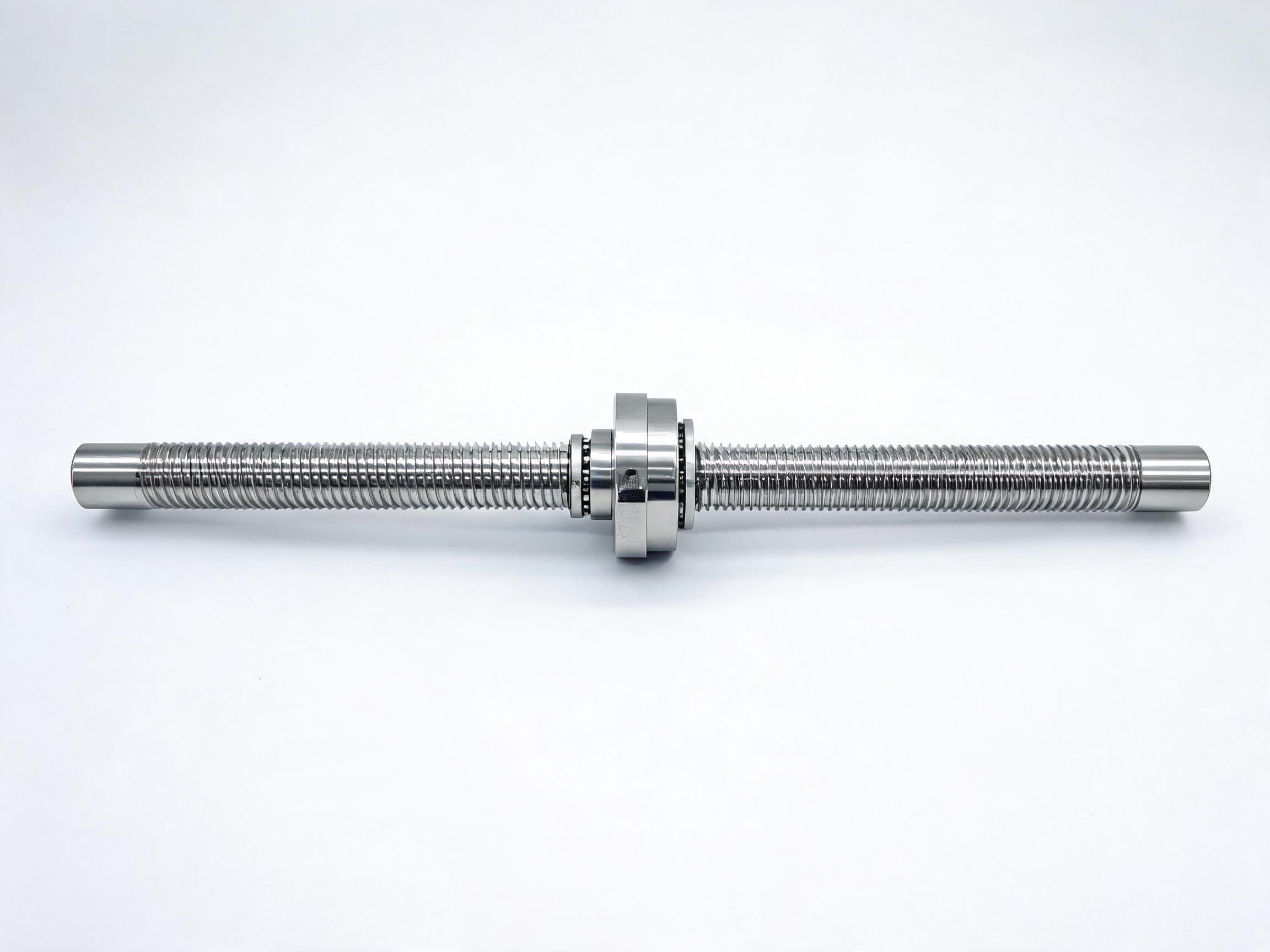
Match the new assembly to what the axis actually needs, not to what was there before. The SFU series rolled ball screw assembly is built on GCr15 (52100 equivalent) chrome steel with an induction-hardened shaft at HRC 58–62. SFU1605 has a 16 mm shaft diameter and 5 mm lead, a single-nut preload, a dynamic load rating of 6.8 kN, a four-hole M4 flange, and is supplied in standard lengths from 300 to 1500 mm with an M4 bolt pattern that fits BK12/BF12 bearing housings. The nut body includes a lubrication port for grease or oil.
If backlash is the reason for the replacement, compare against a double-nut preloaded design. If lead accuracy is the reason, confirm the grade your application needs. Where an axis needs a specification not covered above, confirm with the datasheet before ordering.
Frequently asked questions
Can I re-preload a worn single-nut screw?
If the raceway is intact and the play is small, the nut can be re-preloaded following the manufacturer's procedure. If play returns quickly or the raceway is worn, the balls and grooves have lost material and adjustment will not hold.
Does noise always mean the screw is worn?
No. Dry lubricant film and misalignment produce noise on healthy screws. Clear the first two checks before inspecting the raceway.
How do I know whether drift is mechanical or control-related?
Run a repeatability test at one position. Random scatter points to the encoder, coupling, or drive, while drift that tracks load direction or running time points to the mechanics or thermal growth.
What if my measured play is small but backlash still bothers the axis?
Check the drive train and the nut housing connection before the screw itself. Play outside the nut produces the same symptom.
Diagnostic steps here describe a general inspection sequence. For torque, temperature, and wear limits specific to your machine, confirm with the datasheet and your maintenance manual. Operations that change preload or disassemble the nut should follow the manufacturer's procedure.