
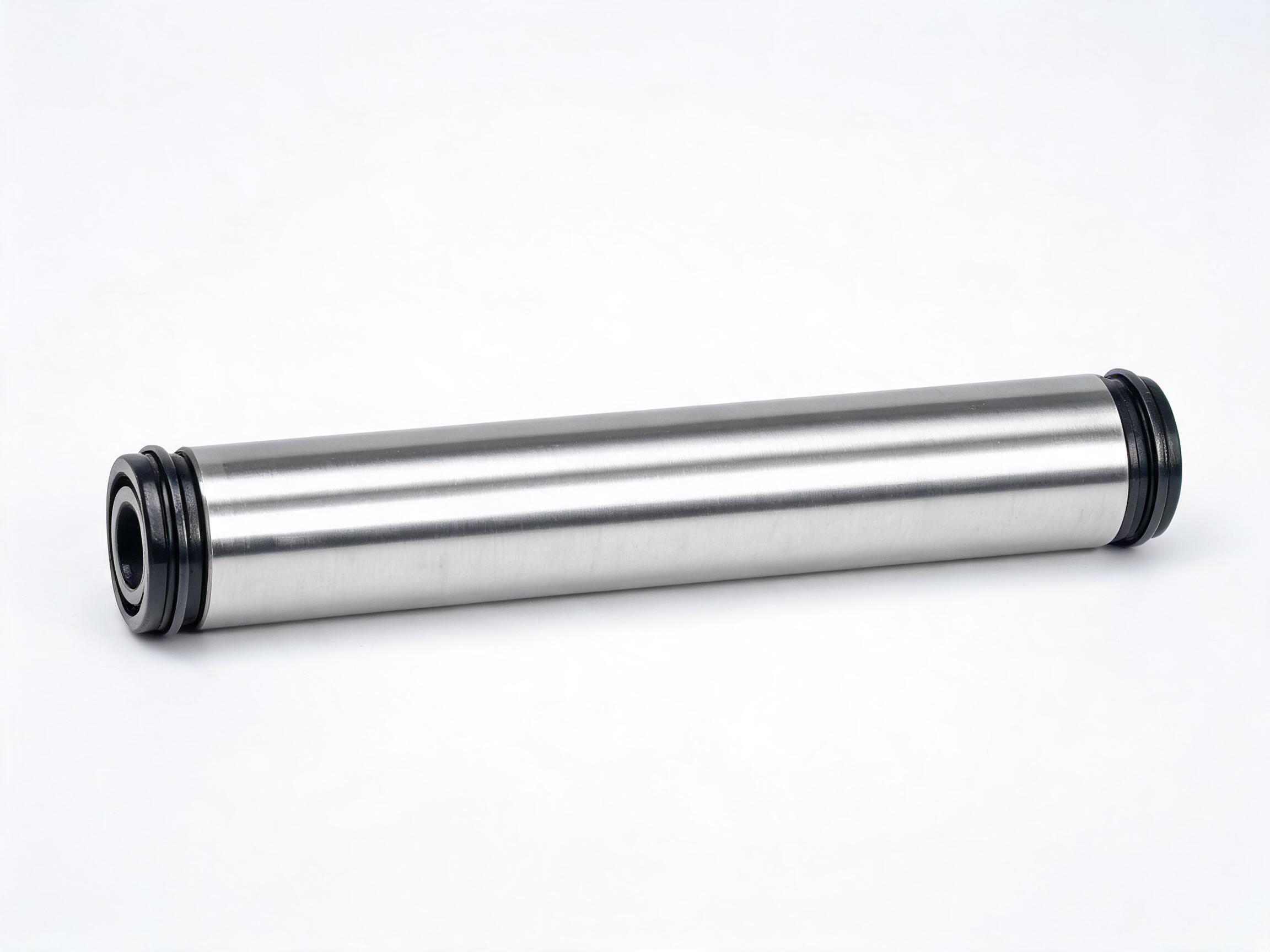
A decision guide for buyers weighing UU sealed linear bushings against open or lightly sealed types. Covers dust and debris exposure, NBR and FKM seal temperature limits, supported shafts, load and travel-life trade-offs, re-lubrication, and how to write the specification so the quote comes back right.
Linear motion selection
A sealed bushing costs more than an open one and adds drag on every stroke. It earns that premium in exactly one place: keeping abrasive dust out of the ball circuit. This guide sets out the conditions where UU sealing pays for itself, the temperature ceiling of each seal material, and the load and travel-life trade-offs you accept when you specify it.
Key takeaways
- Specify UU sealing when dust, grit or machining swarf reaches the shaft surface and the bushing runs unmaintained for long intervals.
- NBR seals cover -30°C to +110°C; an FKM option extends the seal to 200°C. The seal, not the bearing steel, sets your ambient limit.
- Supported (slotted) shafts on LME metric flange bearings change the sealing question, because the shaft groove cuts through the seal contact band.
- Extended-length sealed bodies recover load capacity that a plain sealed bushing gives up: LMUU16 is rated 1580 N dynamic with 40% more balls than the standard sleeve.
On this page
- What a UU seal actually does
- Dust and debris: when the open type stops being viable
- Temperature limits of NBR and FKM
- Supported versus unsupported shafts
- Load and travel-life trade-offs
- Specifying the requirement
- FAQ
What a UU seal actually does
UU designates a linear bushing sealed at both ends. In the LMUU series the seal is a double-lip NBR rubber ring with labyrinth grooves, fitted at each end of the sleeve. The lips wipe the shaft as it passes; the labyrinth adds a tortuous path behind the lip, so particles that get past the first contact face lose momentum before reaching the ball track.
In the supplier's own test record, dust ingress in a sealed unit measured 95% lower than the open type. That figure comes from an 8-hour talcum powder exposure run following ISO 20643. It is the supplier's test record, not third-party certification, and it describes one powder under one duration — a useful indicator of how much the seal blocks, not a guarantee of service life in your machine.
Two lips rather than one matters where the shaft is wiped dry: the first lip takes the abrasion, the second keeps the barrier intact after the first begins to wear.
Dust and debris: when the open type stops being viable
An open linear bushing is the cheapest and lowest-drag option, and it remains the right choice inside a clean, enclosed machine with a lubricated shaft. The case for sealed types is built on exposure, not preference.
Specify sealed when any of the following is true:
- Cutting dust, casting sand, or carbon black reaches the shaft. Abrasive particles entering the ball circuit are the dominant mode of premature linear bearing failure.
- The axis runs vertically or at an angle, so gravity carries contaminants toward the bushing rather than away from it.
- The machine is re-lubricated on a long interval, or not at all between maintenance windows.
- The application is a door, guard, or adjustment axis on a machine tool or packaging line where the shaft is intermittently exposed.
The reverse also holds. In a sealed gearbox with an oil bath or a clean-room axis already inside a protective enclosure, an open bush with a good lubrication film will outlast a sealed one on drag and on cost, and the seal gives you nothing to recover.
Temperature limits of NBR and FKM
The steel and the retainer are not the constraint. Standard LMUU bodies use chrome steel GCr15 with a PA66-GF retainer, and the seal material sets the ambient ceiling.
| Seal material | Service temperature | Typical fit |
|---|---|---|
| NBR (standard in LMUU / LMK) | -30°C to +110°C | General machinery, packaging, automation, most indoor axes |
| FKM (option) | up to 200°C | Near heat sources: ovens, dryer tunnels, hot-process equipment |
Above 110°C the NBR lip hardens and loses its wiping contact, so protection degrades quietly before the bearing itself shows any sign of trouble. If the axis sits near a heat tunnel, specify FKM at the enquiry stage rather than after the seal has failed.
Seal friction is not stated in the available product records. Confirm with the datasheet before sizing a low-power drive where drag counts; do not assume the open-type figure applies.
Supported versus unsupported shafts
This is where many specifications go wrong. A supported shaft carries a ground longitudinal groove; the mating bushing is a slotted type that keys into the groove to prevent rotation. The LME metric flange series covers open (slotted) types for supported shafts in 8–60 mm shaft sizes.
On a supported shaft, a full circumferential seal cannot maintain a clean contact band: the groove interrupts the lips at the same point on every stroke, and the groove itself carries contaminants along the axis. If your design uses a supported shaft, seal the system elsewhere — a shaft cover, a bellows, or a positive air purge around the bearing housing — rather than relying on the bushing's UU seal alone. If you need a sealed bushing, the shaft must be unsupported (plain, round, continuous) across the full stroke.
Load and travel-life trade-offs
Sealing is not cost-free. The lips add drag and consume some sleeve length. Both can be answered by sizing up within the sealed range rather than accepting a derated open-type equivalent.
Extended-length LMUU: recovering capacity
The LMUU sealed extended-length series runs 6–60 mm bores. Compared with a standard LM16UU measuring 24 mm, the LMUU16 sleeve is 35 mm long and carries 40% more balls. That gives a rated dynamic load of 1580 N and a static load of 2450 N. The extra length is what allows a sealed design to hold load capacity close to what buyers expect from an open bush of the same bore.
Double-length flange: travel life
The LMK double-length flange series covers 6–50 mm with UU double rubber seals. The LMK16UU is rated 2350 N dynamic and 3680 N static. In the supplier's own comparison against the single-circuit LMF16UU baseline, the double-length version is stated at +60% rated travel life. That is the supplier's comparison under its stated conditions — treat it as a design margin to verify against your own duty cycle, not as an independent life prediction.
| Item | LMUU16 (sealed, extended) | LMK16UU (double-length, sealed flange) |
|---|---|---|
| Dynamic load rating | 1580 N | 2350 N |
| Static load rating | 2450 N | 3680 N |
| Sleeve length | 35 mm (vs 24 mm standard LM16UU) | Double length |
| Ball complement | +40% vs standard sleeve | — |
| Travel life | — | +60% vs LMF16UU baseline (supplier record) |
| Sealing | Double-lip NBR with labyrinth grooves | UU double rubber seal |
Values as listed in the supplier's product records. Ratings are catalog figures, not independently verified results for your application.
The practical trade-off: a sealed extended or double-length bearing buys protection and load margin at the cost of envelope length and a higher unit price. Where the mounting space will not accept a longer sleeve, an open bush in a protected enclosure is the more honest answer than forcing a sealed part into a squeezed footprint.
Specifying the requirement
A short, explicit enquiry avoids the usual back-and-forth. State the following in your RFQ:
- Bore and housing standard. LMUU units fit JIS B 1185 LM housings; state the housing series you are mounting into.
- Shaft condition. Unsupported round shaft, or supported with a groove — this decides whether a sealed bushing is viable at all.
- Ambient temperature at the bearing. Below 110°C the NBR standard applies; above it, ask for FKM.
- Contaminant type and exposure. Fine dust, metal swarf and wet slurry all stress the lip differently.
- Load and stroke per cycle, so the right sleeve length can be selected against the duty.
- Quantity. Sealed LMUU carries a minimum order of 100 pieces, which suits spare-parts stocking as well as prototype lines.
The manufacturer holds ISO 9001:2015 certification at company level, alongside CE and an SGS factory audit. Those are management-system and factory-audit credentials covering the business — they do not certify the performance of every individual bearing model.
FAQ
Can I re-lubricate a UU sealed bushing?
The seal slows dust entering, it does not make lubrication permanent. Grease is retained longer in a sealed unit than in an open one, but the interval still depends on speed, load, and temperature. Re-lubricate through the housing path or by removing the end seal per the maintenance schedule; do not assume the seal removes the need entirely. Confirm the recommended interval with the datasheet for your duty.
NBR or FKM — how do I choose?
Choose by the steady-state temperature at the seal, not the peak the machine occasionally reaches. NBR covers -30°C to +110°C; FKM goes to 200°C. Below 110°C NBR is the standard and cheaper option. Above 110°C only FKM will hold wiping contact, so specify it at the enquiry stage.
Does the seal eliminate the need for a shaft cover?
No. The 95% dust reduction is relative to an open bushing under one powder test. Heavy grit, coolant spray, and washdown exposure still justify a physical barrier such as a bellows or shaft cover. Use sealing and containment together where the environment is aggressive.