
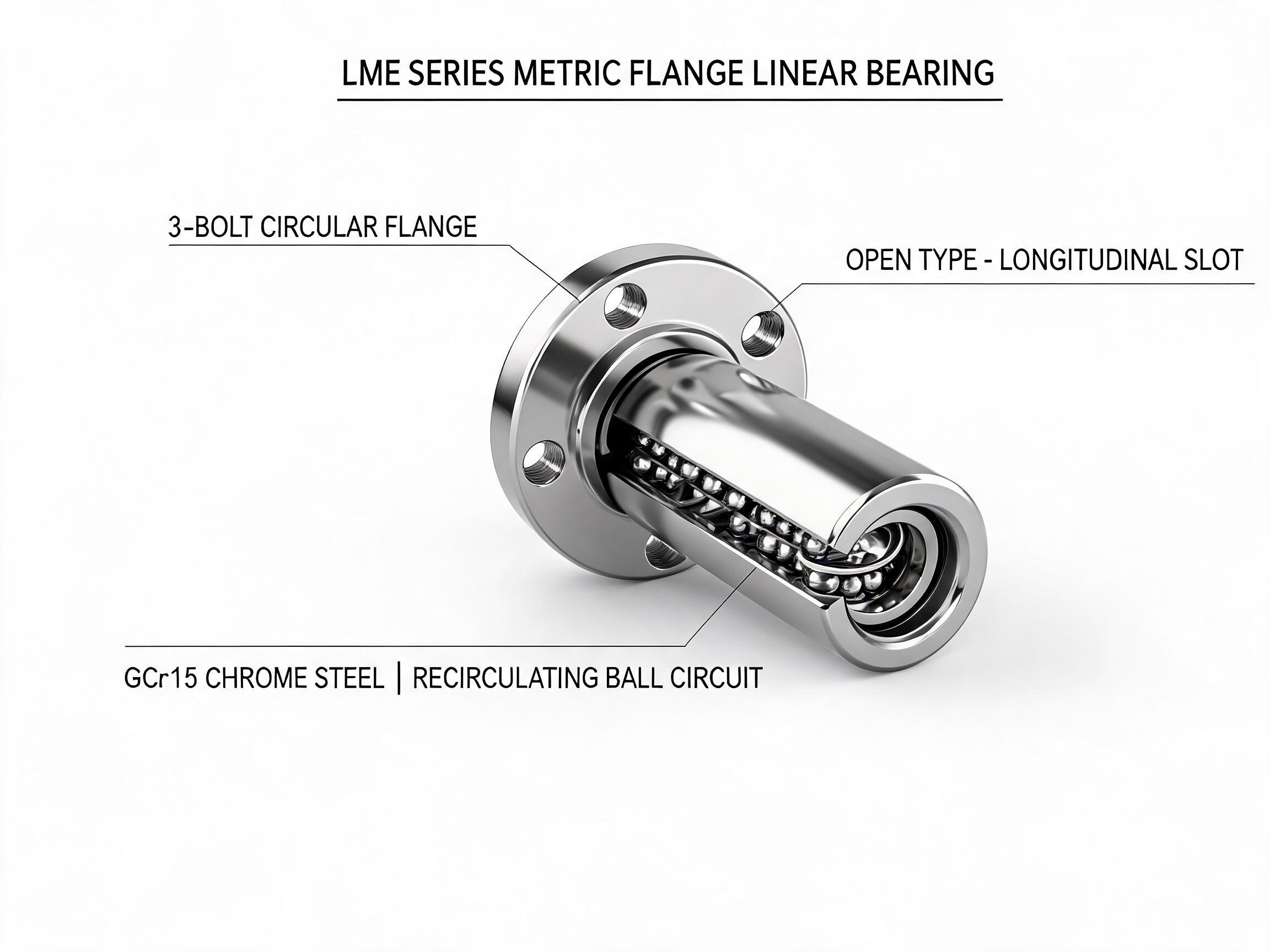
A sourcing guide for maintenance and procurement teams replacing SKF LMEF or INA KGNOZ flange linear bearings on European machines. Covers how the LME 3-bolt circular flange mounts from the housing face, what the OP open-type slot changes, and the four dimensions to verify against the housing drawing before ordering.
Replacement Sourcing Guide
When a flanged linear bearing fails on a European machine, the replacement decision is rarely about the bearing alone. It is about whether the new unit will sit on the existing housing plate, align with the shaft, and bolt down without reworking the machine. This guide is for maintenance engineers and sourcing buyers replacing SKF LMEF or INA KGNOZ flange bushings with an LME series equivalent, and it focuses on the checks that decide whether the swap works.
In this article
How the 3-bolt circular flange mounts from the housing face
An LME flange linear bearing is a circular flanged bushing with a 3-bolt pattern. The flange bolts to the front face of a standard LME housing plate. The bearing body passes through the bore of the housing plate, and the flange fastens against its machined front face, so the load path runs from the flange through the plate into the machine frame.
This face-mounting approach is what makes the LME series practical as a maintenance part. There is no press-fit tooling required, and no bore machining on the housing plate. The old bushing is unbolted and withdrawn, the replacement is inserted and bolted, and the machine is back in service. For a machine builder the difference is small; for a plant that has a line down, it is the difference between a repair measured in minutes and a repair measured in hours.
The envelope dimensions follow DIN ISO 10285 LME, and the series is dimensionally compatible with SKF LMEF and INA KGNOZ. That compatibility is the starting point, not the finish line. Two bushings can share a nominal series designation and still differ in the specific dimensions that locate them on a real housing plate, which is why the drawing check in the next sections matters.
Typical host machines include European CNC machining centers, woodworking machines, packaging lines and laser cutting heads. In each case the flange bearing is a wear or crash item, and the housing plate stays on the machine while the bearing is exchanged.
What the OP open-type slot changes
The LME series is available in two types, and the choice between them is the second decision after sizing.
- Closed type (UU). A full circular bore with double rubber seals. The shaft is supported around its full circumference, and the seals retain lubricant and exclude contaminants.
- Open type (OP). A longitudinal clearance slot runs along the bore. The slot provides anti-rotation in the housing and allows minor radial adjustment where the housing bore has some variation.
The OP slot is often misunderstood as an interchangeable variant. It is not. The slot changes how the bearing interacts with the housing and with the shaft support arrangement, so it needs to match what the machine was designed around.
When the original European build used an open-type flange bushing, the slot was specified for a reason: either the housing bore tolerances in that machine call for radial take-up, or the design relies on the slot for anti-rotation in a supported shaft configuration. Fitting a closed bearing into that position can remove the adjustment the design depended on. Fitting an OP bearing where the original was closed introduces a clearance path that was not part of the original arrangement. In both directions, the correct move is to read the original part designation and the housing drawing rather than to substitute by shaft size alone.
The OP slot also affects sealing. The closed UU version carries double rubber seals; the open version is an open bore by construction. Buyers replacing a sealed bushing in a dusty environment, such as a woodworking machine, should confirm whether the original position was sealed and whether the open slot is acceptable in that location.
The four dimensions to check against the housing drawing
Before placing an order, verify four dimensions of the proposed replacement against the housing drawing. Nominal series and shaft diameter are not enough on their own.
| Dimension | What it locates | Why it decides fit |
|---|---|---|
| Outer diameter | The bearing body in the housing bore | Sets the clearance or interference between the bushing body and the plate bore |
| Flange diameter | The flange against the housing face | Must clear surrounding structure and seat flat on the machined face |
| Bolt-circle | The 3-bolt pattern | Determines whether the existing bolt holes line up without redrilling |
| Length | The body length through the plate | Controls how far the bushing extends and how much shaft is engaged |
In practice, the bolt-circle and flange diameter are the two that most often expose a mismatch, because a bearing can share a shaft size and outer diameter while using a different flange pattern. Length matters on machines where the bearing sits close to a shaft end or a support block, and outer diameter matters wherever the housing bore has been repaired or has worn.
If the housing drawing is not available, measure the failed bearing itself: outer diameter of the body, flange diameter, bolt-circle across the bolt holes, and overall length including the flange. Record the original part designation as well, so the open or closed type and the seal arrangement are not lost in translation.
The LME series covers shaft diameters from 8 to 60 mm, so most flange positions on European machine tools fall within the range. Where the machine uses a size not covered by a standard item, the starting point is the drawing rather than a nearest-size guess.
Materials, precision grade and order quantities
The construction is straightforward and matches what machine maintenance teams expect from a European-standard bushing:
- GCr15 chrome steel outer ring and balls, induction hardened to HRC 60-64
- PA66-GF glass-fiber nylon retainer
- Standard precision grade Normal, with H5 available on request for LME8 to LME40
Precision grade is worth a moment of thought. Normal grade suits the typical replacement position where the original specification was standard. If the original drawing specifies a tighter tolerance band, record that before ordering; H5 is available on request across LME8 to LME40, and the request has to be on the purchase order rather than assumed.
The minimum order quantity is 100 pieces per size and type, and mixed sizes are accepted within an order. For a plant replacing one bearing on one machine, that quantity means buying against a maintenance stock plan rather than a single-unit purchase. Maintenance and MRO buyers typically combine sizes across the same machine family or across several lines in one order, which also keeps a spare on the shelf for the next failure.
The full dimensional and type range is listed on the LME series metric flange linear bearing product page, which is the reference for confirming a specific size against the drawing.
Buyer questions before ordering
Is an LME bearing a direct replacement for SKF LMEF or INA KGNOZ?
The LME series follows DIN ISO 10285 LME envelope dimensions and is dimensionally compatible with those series. Compatibility is stated at series level; the specific size still needs the four dimensions above checked against the housing drawing.
Can I replace a closed bearing with an open one?
Only where the housing design calls for it. The OP slot adds anti-rotation and minor radial adjustment, and removes the full-circumference bore of the closed type. Match the original type unless the machine designer confirms otherwise.
Do I need press tools to install it?
No. The flange bolts to the front face of the housing plate, so the bearing is inserted and bolted without press-fit tooling or bore machining.
What should be on the purchase order?
Shaft size, closed (UU) or open (OP) type, precision grade, quantity per size, and the four verified dimensions. Where H5 is needed, state it explicitly; it is a request option for LME8 to LME40.
For a replacement decision, the bearing is the easy part. The drawing check is the work that prevents a second failure and a second downtime event.