Open (OP) and closed (UU) linear ball bearing bushes share identical envelope dimensions under JIS B 1185 / ISO 10285, so the housing, not the shaft, decides which one you order. This guide covers when the OP longitudinal slot is required — split housings, supported shafts, bore-wear adjustment — when a closed UU with double seals is the better fit, and the dimensions to confirm before placing a PO.
Housing-fit selection guide
Open (OP) and closed (UU) linear ball bearing bushes in the same size class share identical outer dimensions under JIS B 1185 / ISO 10285. The shaft does not decide which one you order — the housing does. This guide covers when the OP longitudinal slot is required, when a closed UU with double seals is the better fit, and what to confirm before sending a purchase order.
Key takeaways
- Same envelope, same shaft fit: OP and UU differ by the longitudinal slot and seal arrangement, not by outer diameter.
- Choose OP when the housing is split, when the shaft is fully supported along its length, or when you need rotation locking and a small radial adjustment.
- Choose closed UU when the housing bore gives full circumferential support and the environment carries dust or chips.
- The OP slot is not a wear-compensation device. It absorbs minor bore variation and stops rotation; it does not restore a worn bore.
On this page
Why the two types look identical on a drawing
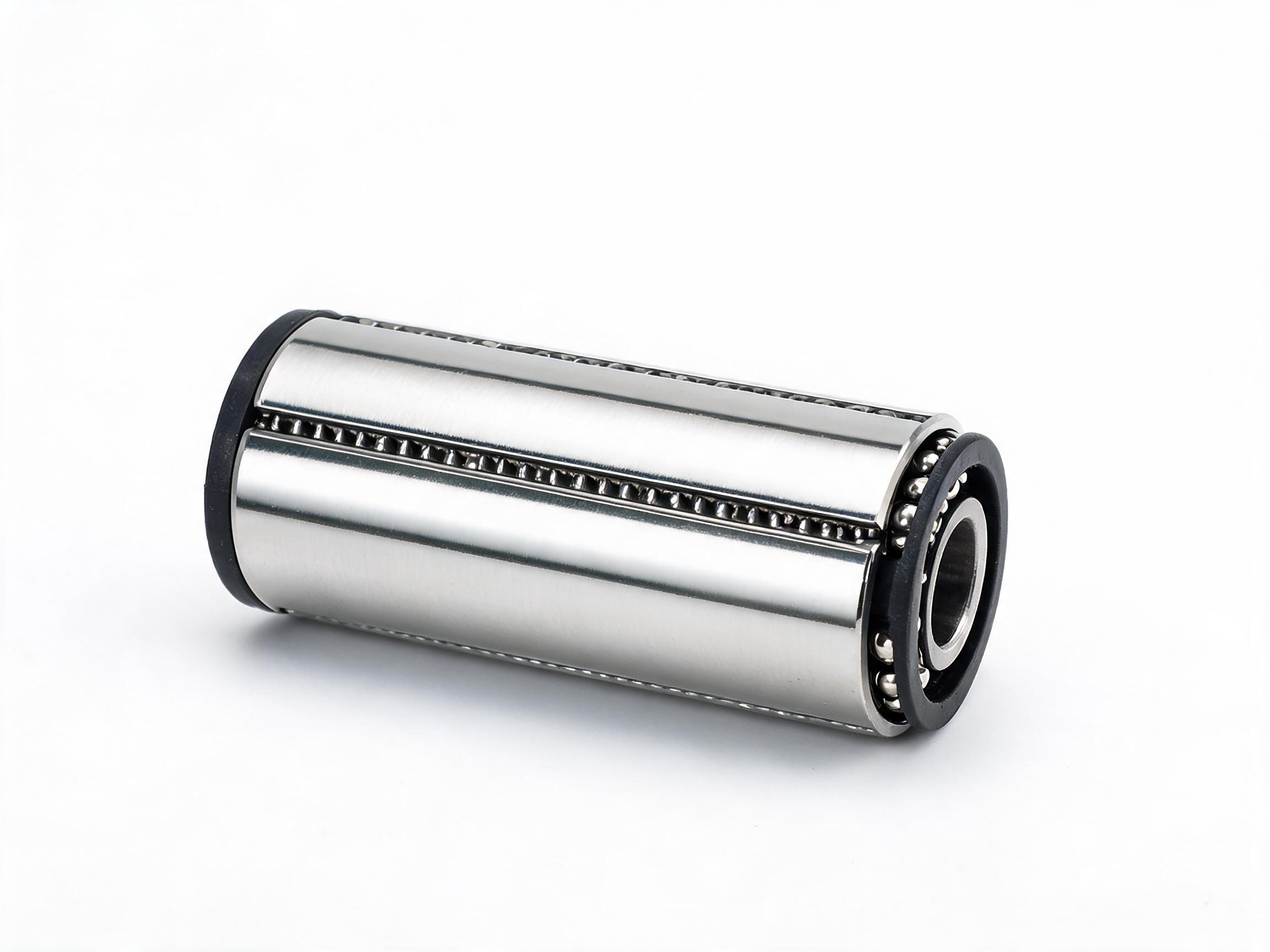
The LM Series Linear Ball Bearing Bush covers shaft diameters from 6 mm to 60 mm. Within that range, the closed (UU) version with double rubber seals and the open (OP) version with a longitudinal slot are made to the same outer dimensions per JIS B 1185 / ISO 10285.
That shared envelope matters at the drawing stage. If you have already machined a housing for an LM16 bore, an LM16UU and an LM16OP will both seat in it. The difference is the slot: material is removed from the outer sleeve so the bearing can compress slightly and fit over a shaft that is supported underneath, and the slot also prevents the bush from rotating inside the housing.
Both types use GCr15 chrome steel, hardened to HRC 60-64, with a PA66-GF retainer. Standard grade is normal; H5 is available on request. For reference on the lower end of the range, LM16UU carries a dynamic load rating of 980 N.
When the OP slot earns its place
The open linear bearing is not a general-purpose substitute for the closed type. It exists because some housing and shaft arrangements cannot accept a fully closed sleeve.
Split or clamped housings
Where the housing is split, clamped, or otherwise tightened around the bearing after assembly, a closed sleeve fights the clamping load. The OP slot lets the outer sleeve flex as the housing closes, so the bore does not distort the ball path. In these designs the slot is not optional — a closed UU pressed into a split housing can preload the balls unevenly.
Fully supported shafts
When the shaft is supported along its length rather than overhung, the bearing must slide over that support. An open bearing passes over the supported section; a closed one cannot. This is the classic case where the housing and the shaft support are designed together, and the OP slot is what makes the assembly possible at all.
Minor radial adjustment for bore variation
The slot gives a small amount of radial compliance. In housings where the bore varies slightly from part to part, or where an adjustable fit is wanted, the OP type takes up that variation. It is a practical tolerance buffer — not a large adjustment range, and not a replacement for a correctly sized bore.
Rotation locking
A longitudinal slot engaged with a mating keyway or pin prevents the bush from rotating in service. Where the load direction is fixed and you want the ball rows to stay in position, that is a legitimate reason to specify OP even if the housing is not split.
When closed UU is the right call
The closed version with double rubber seals is the default choice for the majority of plain linear motion assemblies, and the reasons are straightforward.
- Full circumferential support. Where the housing bore surrounds the bearing completely, the closed sleeve distributes load around the full ring. The OP slot removes a section of that ring, so a closed type is structurally the better fit in a closed housing.
- Double rubber seals. The UU designation means seals at both ends. In dusty, chipping, or coolant-exposed environments — woodworking, general machining, packaging lines — those seals keep contaminants off the ball tracks. An OP bearing exposes a slot that a plain seal cannot close in the same way.
- Standard availability. Closed types are the common stock item, which usually means shorter lead time and simpler replacement.
If your housing is a single-piece bore, the shaft is not supported under the bearing, and the environment carries dust, there is rarely a reason to specify OP. Ordering closed UU is the lower-risk decision.
Flange versions and rotation locking
Where the housing is a plate rather than a bored block, the LME Series Metric Flange Linear Bearing covers an 8-60 mm shaft range under the DIN ISO 10285 LME envelope and mounts through a 3-bolt circular flange.
On the flange variants, the OP slot serves a second purpose: it prevents rotation and allows minor radial adjustment in housings where the bore varies. That combination — 3-bolt mounting plus a slot that indexes against the housing — is useful on plate-mounted assemblies where you want the ball rows held in a fixed orientation.
Pre-order checklist: shaft, bore, support span
Most ordering errors on linear bushes come from three dimensions, and two of them are about the housing rather than the bearing. Confirm each before the PO goes out.
| Check | What to confirm | Why it matters for OP vs UU |
|---|---|---|
| Shaft diameter and tolerance | Nominal diameter, and shaft tolerance to h6 as the usual mating fit for linear bushings | The bearing bore is common to OP and UU in the same size, so a shaft that fits one fits the other. Shaft tolerance decides running fit, not slot type. |
| Housing bore | Measured bore diameter and roundness; whether the housing is split or single-piece | A split housing calls for OP so the sleeve can flex under clamping. A single-piece bore calls for closed UU. |
| Shaft support | Is the shaft supported along the stroke, or overhung? | A supported shaft requires OP to pass over the support. An overhung shaft does not. |
| Rotation constraint | Does the bush need to be held against rotation? | OP indexes against a keyway or pin. A closed bearing needs a separate anti-rotation feature. |
| Environment | Dust, chips, coolant, washdown | Closed UU with double seals is the contamination-resistant choice. |
| Grade and load | Normal or H5; required dynamic load rating for the size | Grade is ordered separately from slot type. H5 is available on request. |
Ordering details for the LM series from Xiamen Dongfeng Bearing: MOQ is 100 pcs per size. The company has been ISO 9001:2015 certified since its founding in 2014 and holds CE, with SGS audit. Specific life, speed, and clearance figures are not published here — verify those against your application with the supplier.
Questions buyers ask before ordering
Can I use an OP bearing in a closed housing if I add a key?
The OP type can be indexed against a keyway for anti-rotation, but the slot also removes part of the load-carrying ring. In a housing that fully surrounds the bearing, a closed UU is the better structural fit unless rotation locking is the priority. Confirm the trade-off with the supplier for your specific load direction.
Does the OP slot compensate for a worn housing bore?
No. The slot absorbs small bore variation and gives minor radial adjustment at assembly. It is not a wear-compensation feature, and it will not restore a bore that has already worn oversize. If the housing bore is out of tolerance, rework or replace the housing.
Are OP and UU interchangeable in the same bore?
In the same size class, yes for the outer envelope — both are made to JIS B 1185 / ISO 10285 with identical outer dimensions. Interchangeability of function is a different question: the slot affects load distribution and sealing, so the correct choice depends on the housing and environment, not on whether the part will physically fit.
What grade should I specify?
Normal grade is standard; H5 is available on request. Bring your shaft tolerance and load requirement to the quote so the right grade and size can be matched. If you are unsure whether your application needs H5, ask rather than assume.
What is the minimum order?
MOQ is 100 pcs per size. Mixing OP and UU within an order is a commercial question for the supplier — confirm when you request a quote.
Next step
The decision usually comes down to one question: does the housing close around the bearing completely, or does it clamp, split, or index? If it closes completely and the environment is dirty, order closed UU. If it splits, clamps, or the shaft is supported under the bearing, order OP and check the slot indexes the way you intend.
Send the shaft diameter, housing bore drawing, shaft support arrangement, and environment details with your inquiry. That is enough to confirm the type, grade, and size without a back-and-forth round.