A maintenance-focused comparison of press-fit linear ball bushings and bolt-on flanged linear bearings. Learn why flanged units avoid press tooling, how to verify shaft OD, housing bore, flange bolt pattern, and seal type before ordering, and where dimensional interchange still needs drawing confirmation.
A bearing swap on a running production line is judged by how fast the machine is back in cycle — not by how quickly the old part comes out. The difference between a press-fit bushing and a bolt-on flanged linear bearing is often the difference between a planned stop and an unplanned teardown. This article covers why flanged types change that equation, and the verification steps that must happen before the replacement is ordered.
- Press-fit linear ball bushings require disassembly, press tooling, and controlled insertion force to avoid housing or bushing damage.
- Bolt-on flanged linear bearings mount to a face plate with flange bolts, removing the press operation from the replacement procedure.
- "Flanged" is not a single fit. Shaft OD, housing bore, flange bolt pattern, and seal type must be verified against the drawing before ordering.
- Dimensional interchange between brands requires drawing-level confirmation — not a catalog size match alone.
Why press-fit bushings force a teardown
A standard linear ball bushing is retained by interference between its outer diameter and the housing bore. Removing it usually means extracting the shaft, releasing the housing from the machine frame or carriage, and driving the old bushing out with a press or an arbor. Installing the replacement means pressing it back in squarely, at controlled force, without cocking it in the bore.
That sequence has three consequences for maintenance planning:
- Tooling. A press or proper insertion sleeve is required. Improvised driving with a hammer risks brinelling the raceway or deforming the outer shell.
- Access. The housing often has to leave the machine, which means disconnecting the carriage, guarding, or drive elements around it.
- Fit risk. A housing bore that is worn, tapered, or out of round will not hold the new bushing to the specified interference. The old bushing may have been masking a bore problem.
None of this is a defect of the press-fit design — it is a deliberate retention method. It becomes a maintenance problem when the machine layout makes the press operation difficult to reach.
What changes with a bolt-on flanged unit
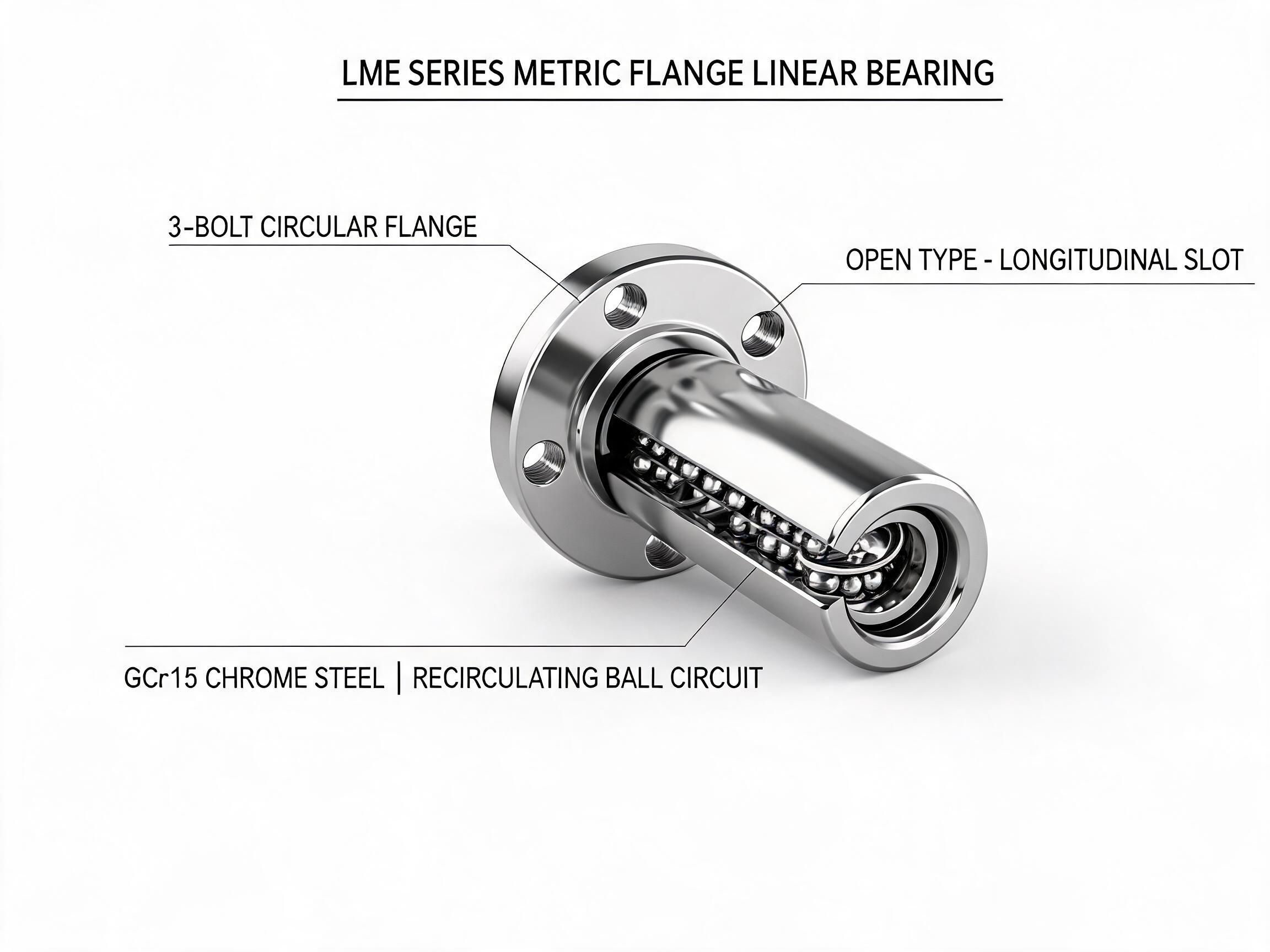
A flanged linear bearing moves retention from the outer diameter to the flange face. The bearing body still sits in the housing bore, but it is held in place by bolts through a circular (or square) flange into the face plate. In the LME Series metric flange linear bearing, the 3-bolt circular flange bolts to the face plate without press-fit tooling. That removes the press from the maintenance procedure, and with it the insertion-force risk and most of the housing-removal work.
The LME Series also carries an OP slot that allows minor radial adjustment in housings with bore variation and prevents rotation once the flange bolts are tightened. Bore variation is a realistic condition on older machinery — the slot gives a small correction range where a press-fit bushing would simply be loose.
For context on the non-flanged option, the LM Series linear ball bearing bush is available in UU closed and OP open versions that share identical outer dimensions under JIS B 1185 / ISO 10285. Shaft tolerance for correct clearance is h6. These are the bushings that typically install by press fit into a housing.
Comparison at a glance
| Consideration | Press-fit bushing (e.g., LM Series) | Bolt-on flanged unit (e.g., LME Series) |
|---|---|---|
| Retention method | Interference fit in housing bore | Flange bolts to face plate |
| Press tooling required | Yes — press or insertion sleeve | No press operation |
| Housing removal | Often required for access | Typically not required |
| Bore variation tolerance | Depends on interference; worn bore is a risk | OP slot allows minor radial adjustment |
| Rotation prevention | Via housing fit or open slot | Via OP slot and flange bolts |
| Shaft fit reference | h6 for correct clearance | Confirm against drawing |
| Envelope standard | JIS B 1185 / ISO 10285 | DIN ISO 10285; dimensional compatibility with SKF LMEF / INA KGNOZ per drawing verification |
Verification list before the replacement is ordered
The bolt-on design removes the press, but it does not remove the need to verify fit. A flanged unit that does not match the shaft, bore, bolt pattern, or seal will not install, or will install with the wrong clearance. Work through the following items against the machine drawing and the measured part.
- Shaft OD and tolerance. Measure the shaft at several points along the travel zone, not just at the bearing position. The LM Series specifies shaft tolerance h6 for correct clearance — confirm the actual shaft condition, including any wear or scoring, before selecting the replacement.
- Housing bore. Measure bore diameter, roundness, and taper. On a press-fit replacement, the bore determines retention. On a flanged unit, the bore still locates the bearing body and the OP slot can take up minor variation, but a badly worn bore still affects alignment.
- Flange bolt pattern. Confirm bolt count, bolt circle diameter, hole diameter, and flange outer diameter. The LME Series uses a 3-bolt circular flange; a machine designed around a 4-bolt pattern will not accept it without an adapter or plate modification.
- Flange thickness and mounting face. Check the face plate flatness and the available bolt length. The flange must seat fully against the face plate to hold the bearing square to the shaft.
- Seal type. Closed (UU) and open (OP) versions share outer dimensions but differ in function. Confirm whether the application needs a closed seal to retain lubricant and exclude contaminants, or an open slot for radial adjustment and rotation prevention.
- Check the drawing before ordering. Do not order from a catalog size alone. Compare the manufacturer drawing to the machine drawing — envelope standard, flange dimensions, bolt positions, and seal configuration.
Material and size range to check against the application
The LME Series is produced in GCr15 bearing steel, hardened to HRC 60-64, and covers a bore range of 8–60 mm. For maintenance planners, the practical checks are:
- Whether the required bore size falls inside the 8–60 mm range.
- Whether the shaft hardness and surface condition are suitable for the application's load and travel — the bearing raceway is GCr15 at HRC 60-64, but shaft condition still governs service life.
- Whether the environment calls for the closed or open configuration.
Common sizes are typically available with a lead time of 10–20 business days, and the minimum order quantity is 100 pcs. For maintenance stock planning, that MOQ is worth checking against the number of units on the machine and the spares policy. Samples of 10–20 pcs are available for qualified buyers, which is useful when a replacement decision depends on confirming fit before committing to a full order.
What flanged units do not solve
A bolt-on flange removes the press operation from the replacement. It does not remove alignment requirements. The shaft and housing bore still need to be aligned within the application's tolerance, and the flange face still needs to be square to the shaft axis. If the machine frame has shifted or the face plate is not flat, bolting on a new unit will not correct the underlying geometry.
It also does not replace a wear inspection. Shaft scoring, corrosion, and bore wear should be assessed while the old unit is out. A flanged bearing installed on a damaged shaft will wear faster than the part it replaced.
FAQ
Do flanged linear bearings need a press to install?
No. The LME Series mounts with flange bolts to a face plate. The bearing body locates in the housing bore, but retention comes from the flange bolts rather than interference fit, so no press tooling is required for the mounting operation.
Can I replace a press-fit bushing with a flanged unit directly?
Only if the housing and face plate support it. You need a mounting face for the flange, and the bolt pattern must match. In many machines, a flanged conversion also requires a new housing or an adapter plate.
Is the LME Series a drop-in replacement for SKF LMEF or INA KGNOZ?
It is stated as dimensionally compatible per drawing verification. That means the compatibility claim must be checked against the specific drawing — bolt pattern, seal type, and envelope — before ordering. Do not assume interchange from the size designation alone.
What shaft tolerance is required?
The LM Series specifies shaft tolerance h6 for correct clearance. Confirm the actual shaft condition, not just the nominal diameter, before selecting a replacement.
Do UU and OP versions have the same outer dimensions?
Yes — for the LM Series, UU closed and OP open versions share identical outer dimensions under JIS B 1185 / ISO 10285. The difference is the seal and slot configuration, not the envelope.
Next step
Before the next bearing swap, pull the machine drawing and the measured shaft and bore data. Confirm the flange bolt pattern and seal type, then verify the manufacturer drawing against the machine drawing. If the fit checks out, the LME Series flanged unit removes the press from the procedure. If the application still requires a press-fit bushing, the LM Series covers the UU and OP configurations with matched outer dimensions.
For qualified buyers, samples of 10–20 pcs are available to confirm fit before a full order. MOQ for the LME Series is 100 pcs, with common sizes typically shipping in 10–20 business days.