
A linear ball bearing is a recirculating ball bushing that runs on a hardened round shaft. This guide explains how round-shaft bushings compare with profile guideways, where each design wins, how sealed and extended-length variants help in dusty shops, and what to check when replacing a bearing. It covers LME flange bearings (8–60 mm shafts, DIN ISO 10285 envelope, 3-bolt circular flange), open type (OP) with a longitudinal slot, GCr15 chrome steel balls and outer ring at HRC 60–64, and PA66-GF retainers, as well as LMUU sealed extended series with double-lip NBR seals and a labyrinth groove.
Linear Motion Guide
What is a linear bearing? In the most common sense, it is a recirculating ball bushing that slides along a hardened and ground round shaft. The bushing carries load through balls that circulate inside a hardened outer ring, so the shaft and housing do not touch. This design is compact, low in friction, and easy to mount in a simple housing block. It is also the starting point for understanding a broader question: when should you use a round-shaft bushing, and when does a profile guideway do a better job?
This article answers that comparison for equipment builders. It focuses on the LME flange series and the LMUU sealed extended series, using published specifications and no claims beyond them. The goal is to help you read a drawing, match a replacement bearing, and decide whether your application is better served by a round shaft or a profile rail.
Key takeaways
- A linear ball bearing is a recirculating ball bushing running on a hardened round shaft; it needs a shaft and a housing, not a one-piece rail.
- LME flange bearings cover shaft diameters from 8 mm to 60 mm and follow the DIN ISO 10285 envelope with a 3-bolt circular flange.
- The open type (OP) has a longitudinal slot to clear supported shafts; closed (UU) and sealed versions are available for different environments.
- LMUU sealed extended bearings add a double-lip NBR seal plus a labyrinth groove and an extended sleeve with about 40% more balls than the standard version.
- Profile guideways are the better choice when the load includes a significant moment, when rail and carriage must come as one precision assembly, or when stiffness and repeatability are the main requirement.
- When replacing a bearing, match shaft diameter, housing bore, and flange mounting pattern before ordering.
On this page
What is a linear ball bearing?
A linear ball bearing, also called a linear ball bushing, is a cylindrical bearing that travels along a round shaft. Inside the outer ring, a set of balls recirculates through a return channel. As the bearing moves, the balls roll between the shaft and the ring, then loop back through the channel, so the motion repeats without the balls falling out. The outer ring and balls are typically made from GCr15 chrome steel, hardened to HRC 60–64. A retainer made of PA66-GF keeps the ball set in position and guides the return path.
Because the shaft carries the raceway, the running surface must be hardened and ground. This is different from a profile guideway, where the raceway is built into the rail itself. The practical consequence: a round-shaft bushing gives you more freedom in how you build the surrounding structure, but the shaft is a precision component in its own right and must be treated as such.
The LME series follows the DIN ISO 10285 envelope, which defines the boundary dimensions of the bearing: bore, outer diameter, and length. That means a correctly specified LME bearing can be swapped into a housing designed to that standard without changing the housing. The flange version adds a 3-bolt circular flange, so the bearing can be bolted directly to a face rather than pressed into a bore. Flange mounting simplifies assembly in applications where access to the back of the housing is limited.
Two configurations matter when reading a drawing. The closed type (often marked UU) has a full circular bore, and it is used on fully supported shafts. The open type (OP) has a longitudinal slot along its length, so it can pass over a shaft that is supported at intervals on continuous rail. If your shaft is only supported at the ends, the closed type is the usual choice. If the shaft runs continuously with support blocks along its length, the open type allows the bearing to travel past those supports.
Round-shaft bushings vs profile guides
Both designs move a load in a straight line, but they distribute force differently. A round-shaft bushing supports load mainly in the radial direction, acting more like a sliding joint. A profile guideway uses a rail with ground raceways and a carriage that wraps around it. The carriage can resist forces in multiple directions and can handle a moment, which a simple round bushing resists less effectively on its own.
| Decision factor | Round-shaft linear ball bushing | Profile guideway |
|---|---|---|
| Load direction | Primarily radial; moment capacity depends on shaft support and bearing spacing | Radial, reverse radial, and side loads in one carriage; moment capacity built into the interface |
| Mounting | Housing bore or flange; shaft supports are separate parts | One-piece rail and carriage; rail bolts directly to a machined surface |
| Self-alignment | Can accommodate some misalignment depending on housing design and shaft support stiffness | Limited self-alignment; alignment is set by the mounting surface |
| Typical cost structure | Lower component cost; shaft, supports, and housing add up in the final assembly | Higher rail and carriage cost; fewer separate alignment parts |
| Best for | Light to medium loads, simple linear motions, replacement-friendly assemblies | Precision positioning, cantilever or moment loads, compact one-piece axes |
If your load is carried between two parallel shafts, a round-shaft system can resist a moment because the two bushings act as a pair. That is a common and economical arrangement for gantry-style motion. If your axis is a single rail with an overhung load, a profile guideway is usually the more direct solution, because the carriage geometry is designed to take that moment without relying on a second shaft.
Cost deserves a careful reading. A round-shaft bushing is often the lower-cost bearing, but the complete axis includes the shaft, the shaft supports, and the housing. A profile guideway costs more per meter, but it arrives as a matched rail and carriage, which can reduce assembly and alignment time. The right comparison is the complete axis, not the bearing alone.
The LME flange series at a glance
The LME series metric flange linear bearing is a round-shaft bushing with a 3-bolt circular flange. It covers shaft diameters from 8 mm to 60 mm and follows the DIN ISO 10285 envelope. The outer ring and balls are GCr15 chrome steel, hardened to HRC 60–64. The retainer is PA66-GF. Both closed (UU) and open (OP) types are available.
The flange makes the bearing a bolt-on part. That matters when a housing would be difficult to machine or when the bearing needs to be replaced without pressing it out of a bore. The 3-bolt circular pattern is compact and self-centering around the shaft axis, so the bearing seats evenly against a flat mounting face.
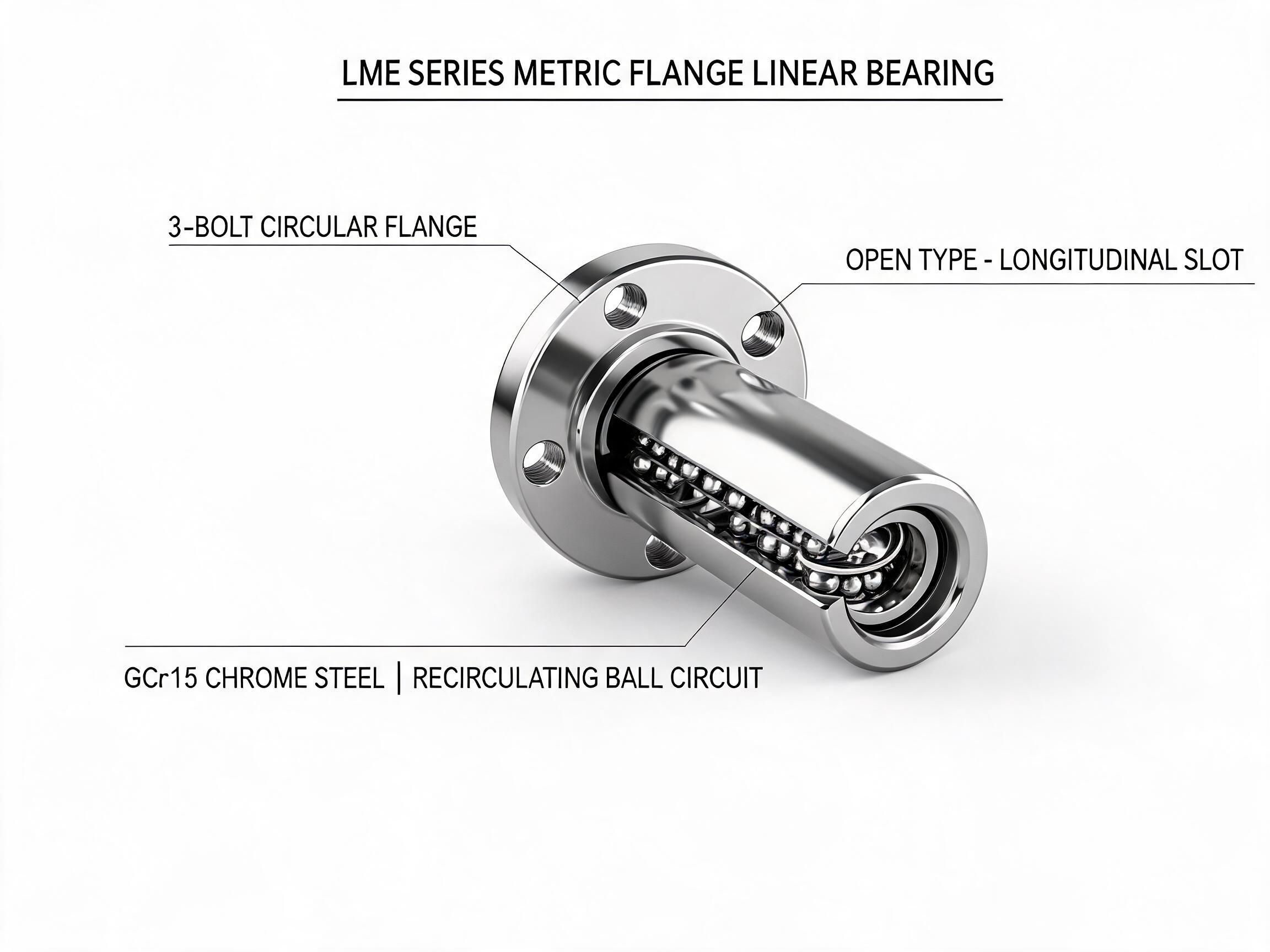
If you are designing a new axis around an LME flange bearing, confirm the shaft diameter and the housing face dimensions first. The DIN ISO 10285 envelope gives the boundary dimensions, but the flange bolt circle and pilot diameter are what locate the bearing in the assembly. Those three features—shaft diameter, housing bore or pilot, and bolt pattern—are the ones that decide whether the part fits.
Sealed and extended variants for dusty shops
In a clean test stand, an open bearing works fine. In a shop where dust, chips, or coolant mist are present, the ball path is the vulnerable point. Debris that reaches the balls and raceway can raise friction and shorten service life. That is the problem the LMUU series sealed extended-length linear bearing addresses.
The LMUU series uses a double-lip NBR seal plus a labyrinth groove. The combination reduces dust ingress by about 95% compared with an open type. The extended sleeve carries about 40% more balls than the standard length, which spreads the load over a longer contact area and increases the dynamic and static load ratings for the same shaft diameter. For example, the LM16UU is rated at 1,580 N dynamic and 2,450 N static, with a sleeve length of 35 mm.
- Seal material and temperature range
- Standard NBR seals operate from −30 °C to +110 °C. An FKM option is available for higher temperatures, up to 200 °C.
The extended length changes the housing dimensions. If you are replacing a standard-length bearing with an LMUU, check the housing bore depth and the available travel before ordering. The longer sleeve is an advantage in load capacity and dirt protection, but it needs space along the shaft.
One practical note on open (OP) versus sealed types: the open type has a longitudinal slot and is designed for supported shafts, but the slot is also a path for debris. In a dusty environment with a supported shaft, the sealed design and the shaft support arrangement need to be considered together. If the shaft is fully supported and the environment is dirty, discuss the sealing arrangement with the supplier before specifying the open type.
Replacement-fit checks
Linear bearings are often replaced during maintenance, and the replacement has to fit an existing housing. The following checks cover the points that most often cause a return or a delay.
| Check | What to measure or read | Why it matters |
|---|---|---|
| Shaft diameter | Nominal shaft size (8–60 mm in the LME series) and actual measured diameter | The bearing bore is matched to the nominal shaft; a worn or undersized shaft changes the fit and the running clearance |
| Housing bore or flange pilot | Bore diameter or pilot diameter on the mounting face | Determines whether the bearing seats concentrically with the shaft |
| Flange pattern | Bolt circle diameter, number of bolts, and thread size | A 3-bolt circular flange must match the existing tapped holes; a different pattern will not bolt on |
| Overall length and sleeve length | Bearing length, plus available travel and housing depth | Extended-length variants need more axial space than the standard version |
| Type (closed, open, sealed) | Drawing or existing part marking | An open (OP) bearing will not substitute for a closed (UU) bearing on an unsupported shaft |
A digital caliper and the original drawing are usually enough for the first four checks. If the original marking is worn off, the shaft diameter and the housing bore will narrow the options to a small set of candidate sizes. Confirm the type from the shaft support arrangement: end-supported shaft favors closed, continuously supported shaft may allow open.
FAQ
Is a linear ball bearing the same as a linear bushing?
The terms overlap. A linear ball bearing is a recirculating ball bushing; "linear bushing" can also refer to plain sliding bushings without balls. When the drawing or catalog says "linear ball bearing," it means the recirculating type described here.
Can I use a round-shaft bushing instead of a profile rail?
Yes, if the load is mainly radial and you can support the shaft properly. If the application has a significant moment load on a single rail, or if the axis must hold tight positioning accuracy, a profile guideway is the more suitable starting point.
What does the OP marking mean?
OP stands for open type. The outer ring has a longitudinal slot, so the bearing can pass over a shaft that is supported along its length. The closed type does not have this slot and is used on shafts supported at the ends.
When should I choose a sealed extended bearing?
Choose it when the environment contains dust or chips and when the housing can accept a longer sleeve. The double-lip NBR seal and labyrinth groove reduce dust ingress, and the extended sleeve adds ball capacity for higher load ratings.
What temperature do the seals handle?
Standard NBR seals are rated from −30 °C to +110 °C. For higher temperatures, an FKM option is available up to 200 °C.
The specifications above describe the LME and LMUU series as published. For a specific machine, confirm shaft hardness, housing tolerance, and environmental conditions with the supplier before ordering.