
A buyer's guide to the ball screw catalog: what each column means, how to shortlist a rolled or ground screw by duty, and which details need confirmation beyond the table before you place an order.
A ball screw catalog is a shortlisting tool, not a purchase order. The columns tell you which families and sizes are plausible for your stroke, load and accuracy target. They do not tell you how the screw ends will be machined, which support blocks will fit, or when the parts will actually ship. Read the table for candidates, then confirm the order outside it.
- What the main catalog columns mean and which ones decide the selection.
- How lead, diameter and accuracy grade map onto speed, load and travel error.
- What the catalog does not tell you, and what to put in the inquiry instead.
The columns that matter
Most ball screw catalogs follow a similar pattern: a series name, a size code, an accuracy grade, a load rating, a length range and a minimum order quantity. Some of these are selection filters; others are hints that a model exists. Treat the filters first.
Series and model name
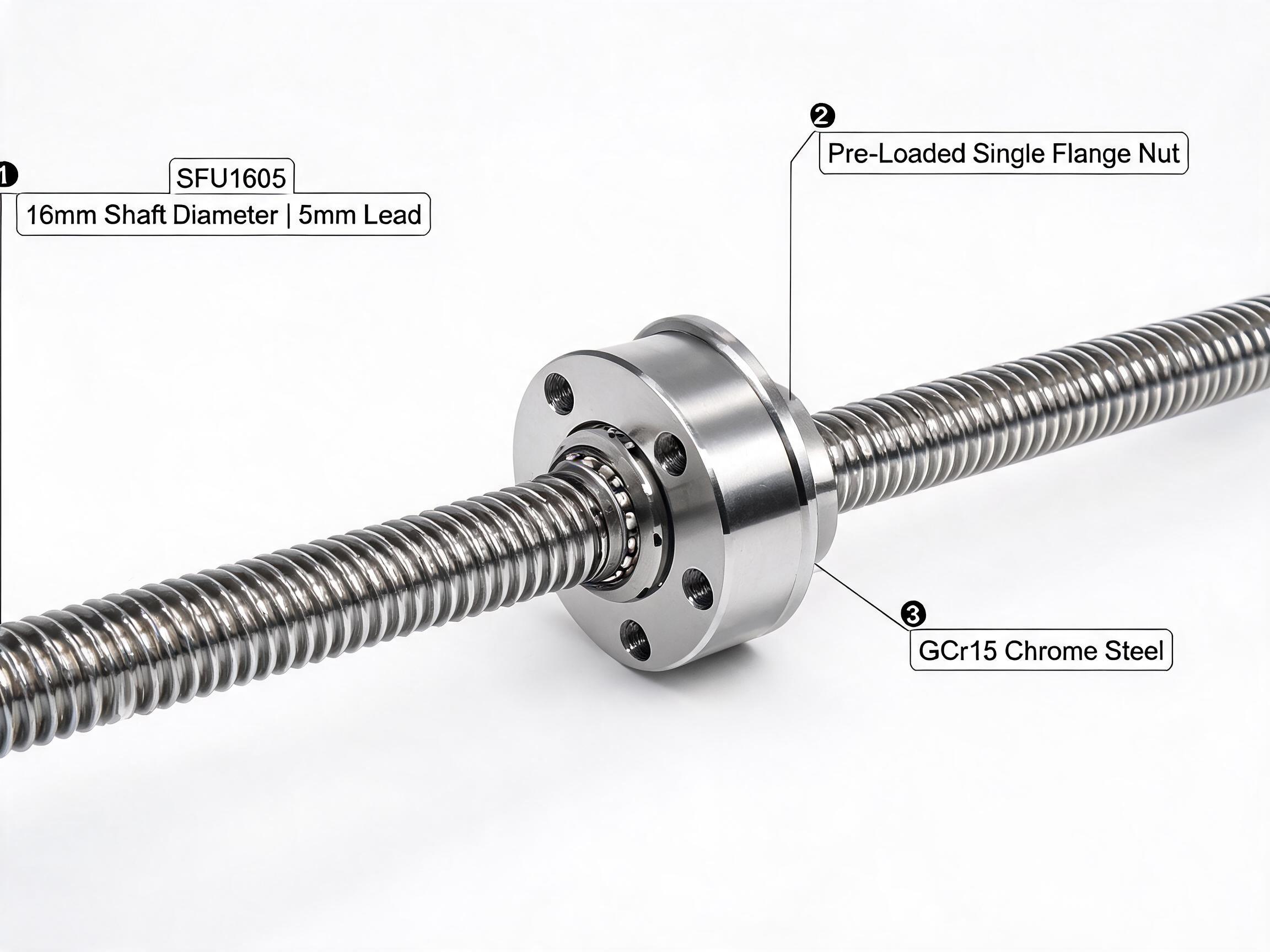
The series name usually tells you the manufacturing route and the nut type. Rolled series are formed rather than ground and are listed at a lower accuracy grade; ground series are listed at a higher one; double-nut series change how axial play is controlled — a spacer-preloaded second nut takes up the play, which is why they are the route to look at when backlash, not travel error, is your constraint. The model code usually combines shaft diameter and lead — SFU2510 is a 25 mm shaft with a 10 mm lead, and SFU3205 is a 32 mm shaft with a 5 mm lead. Reading the code against the diameter and lead columns keeps you from ordering a size you did not mean.
Shaft diameter and lead
These two numbers drive most of the mechanical outcome. Diameter affects stiffness and the load the screw can carry; lead affects how far the nut travels per revolution. Both together set the relationship between motor speed and linear speed, and both affect where the screw's critical speed and load limits fall. Do not read diameter alone as a strength rating or lead alone as a speed rating.
Accuracy grade
Accuracy grades describe permissible travel error over a defined length. The listing for the SFU series rolled ball screw assembly gives C7 per ISO 3408 with travel error of ±0.05 mm per 300 mm. The SFE ground series is listed at C5 with ±0.008 mm per 300 mm. These are the numbers to compare against your positioning requirement, and they are stated over 300 mm — the error limit is not a flat figure for the whole stroke.
Dynamic load
The dynamic load rating is the catalog's basis for comparing nut capacity between sizes. It is not a working load recommendation. The effective load on the screw depends on the application's force, direction, duty cycle and mounting; use the rating to sort candidates, then check the actual operating load against the supplier's technical documentation.
Standard length range
The length column tells you which strokes a listing covers, and it is stated per model, not per family. The SFU series rolled assembly is listed for lengths of 300–1500 mm; the SFE ground series for 200–1200 mm. SFU3205 is listed as its own heavy-duty entry with lengths up to 4000 mm — outside the standard SFU range — so for strokes beyond 1500 mm, check the specific heavy-duty model row rather than the standard series row. A stroke inside any listed range may still need confirming against critical speed and end-machining limits.
MOQ
Minimum order quantity is a commercial column, not a technical one, but it changes how you can trial a size. The SFU series is listed with MOQ 50; the SFE ground series with MOQ 10. Where a trial quantity matters, the MOQ column decides whether a short evaluation run is even on the table for that series.
| Series | Shaft / lead example | Accuracy | Dynamic load | Length range | MOQ |
|---|---|---|---|---|---|
| SFU rolled | 16 mm / 5 mm | C7, ±0.05 mm per 300 mm | 6.8 kN | 300–1500 mm | 50 |
| SFU2510 | 25 mm / 10 mm | C7 | 17.2 kN | confirm per datasheet | confirm per datasheet |
| SFU3205 (heavy-duty entry) | 32 mm / 5 mm | C7 | 22.5 kN (static 34.8 kN) | up to 4000 mm | confirm per datasheet |
| SFE ground | 20 mm / double nut | C5, ±0.008 mm per 300 mm | 12.7 kN | 200–1200 mm | 10 |
| DFU double nut | 16–40 mm shafts | C7 rolled or C5 ground | confirm per datasheet | confirm per datasheet | confirm per datasheet |
Shortlisting by duty
Sorting tens of catalog rows is faster if you translate the machine requirement into two or three numbers before you open the table.
Lead: speed versus resolution
A larger lead moves the nut further per motor revolution, which suits higher linear speed at a given motor rpm. A smaller lead gives finer resolution per revolution and generally favors higher force for the same motor torque. Neither is better in isolation. If the machine needs fast traverse and the positioning resolution is loose, a larger lead like the 10 mm on SFU2510 is the natural direction. If the machine moves slowly but needs fine increments, a smaller lead like the 5 mm on SFU3205 fits the duty. Check the trade-off against the motor and the required resolution before locking a lead.
Diameter and lead pair: load and critical speed
The pair decides more than either number alone. A larger shaft with a modest lead, such as 32 mm with 5 mm, is the pattern to look at when load capacity matters more than fast traverse. The dynamic ratings in the table show the step: 6.8 kN at 16 mm / 5 mm, 17.2 kN at 25 mm / 10 mm, 22.5 kN at 32 mm / 5 mm. A longer screw at high rotational speed brings critical speed into the decision, and the catalog column for length alone will not settle it. Confirm the allowable speed for your stroke and mounting per datasheet.
C7 versus C5: travel error over 300 mm
This is usually the clearest shortlist filter. If the application can accept ±0.05 mm per 300 mm, a C7 rolled series such as the SFU family is on the table. If it needs ±0.008 mm per 300 mm, the ground C5 range is the relevant starting point. Between them sit applications where either grade might work and the cost and lead-time difference should drive the choice — those are commercial decisions your inquiry has to surface, not catalog columns. Where axial play is the constraint rather than travel error, the DFU double-nut series lists a spacer-preloaded double nut with axial play below 0.003 mm, offered with 16–40 mm shafts in C7 rolled or C5 ground.
Beyond the catalog
The table answers "is this family plausible?" It does not answer "will this part fit my machine and arrive when I need it?" Those answers sit in drawings and confirmed terms.
End machining and journal drawings
Catalog rows list usable lengths, not end configurations. The shaft ends are cut, turned and threaded to suit the support bearings and coupling on your machine, and that geometry has to be agreed as a drawing before production. Send the required journal dimensions — end diameter and length, thread, keyway if any, and the datum for overall length — with the inquiry. Confirm what the supplier's drawing includes before you approve it, especially the relationship between the machined ends and the usable stroke.
Support blocks
Matching support blocks are available on request and confirmed per inquiry. There are no independent FK/FF/BK/BF product records to select from on the site, so do not assume a block part number from a generic catalog will match the screw you shortlisted. State the mounting and bearing arrangement you need, and let the confirmation come back with the screw and block as one checked set.
MOQ and lead time
The MOQ column is per series, not per order. Lead time is not derivable from the table at all: it depends on the size, the end-machining drawing, the quantity against MOQ and the current schedule. Ask for both in writing against the specific model and quantity you intend to order, and compare the answer with your build date rather than with the catalog.
Datasheet request for tolerance tables
Catalog summaries compress tolerance information. Request the datasheet for the exact model and ask for the tolerance table covering travel error, axial play and any preload class you are relying on. The headline figures in this article — C7 at ±0.05 mm per 300 mm and C5 at ±0.008 mm per 300 mm — are the comparison numbers; the full table is what your incoming inspection should be checked against, and the inspection method should be agreed as well.
Pre-order checklist
Use the catalog to get to one or two candidate models, then send an inquiry that covers the points below.
- Model, series and quantity, checked against shaft diameter, lead and accuracy grade.
- Required stroke, mounting orientation and any speed or load condition that affects critical speed.
- End-machining drawing with journal dimensions and datums, plus the drawing approval step.
- Support block requirement stated as an arrangement, not a guessed part number.
- MOQ and requested delivery date confirmed in writing.
- Datasheet request for the tolerance table and inspection basis.
The catalog gets you a shortlist in an afternoon. The order is confirmed in the drawing, the datasheet and the written terms — and those are the documents worth reading as carefully as the table.
Specifications quoted here are as listed in the referenced product records. Options, tolerances and commercial terms for a specific order are confirmed per inquiry and datasheet.