
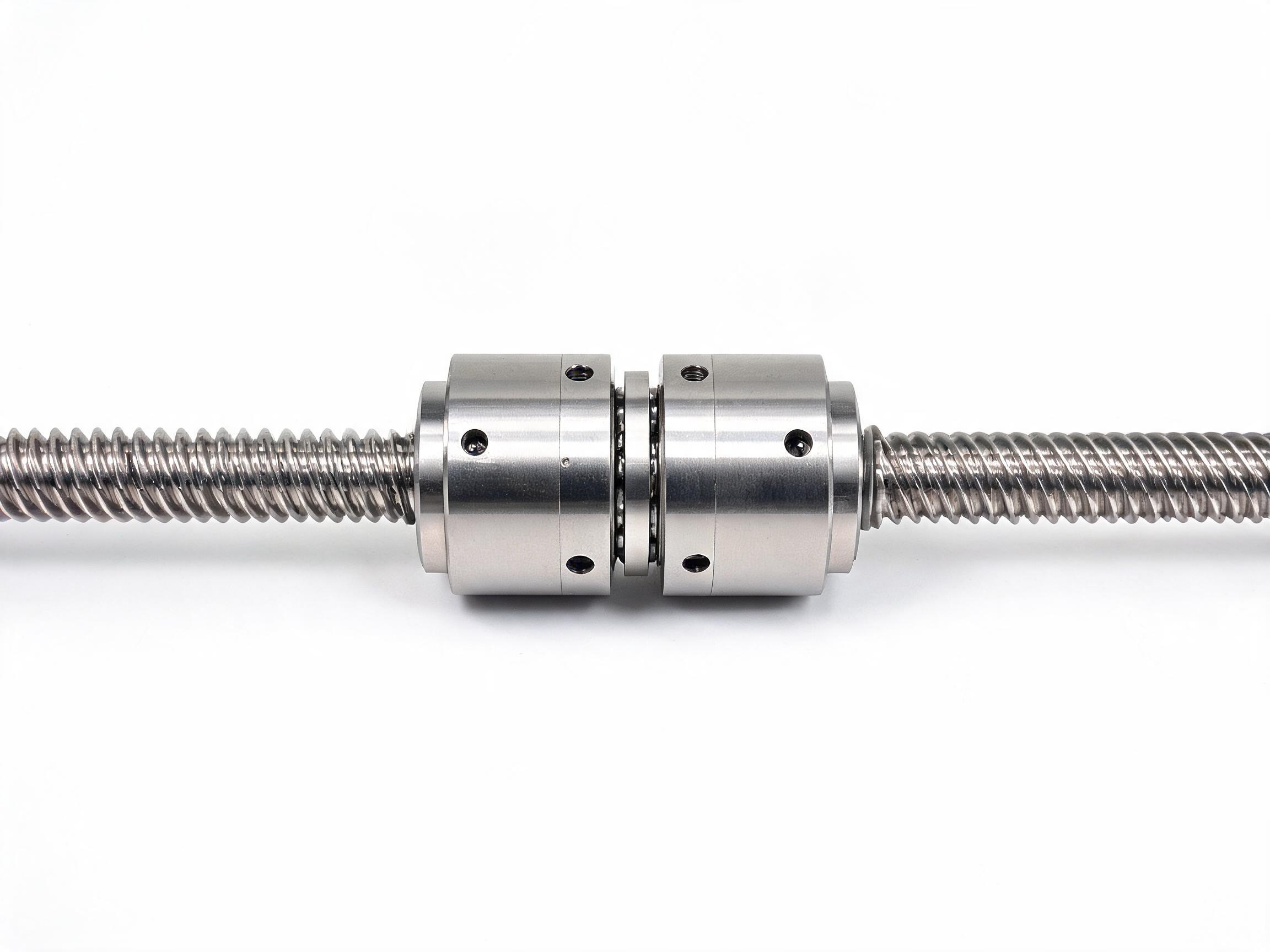
A buyer-focused explanation of zero-backlash ball screws: how a spacer-preloaded double nut works, why the DFU2005 C7 carries 10.2 kN against 6.8 kN for a single nut, and what to specify (pre-load class, grade, diameter, lead, length) when you order.
"Zero backlash" is one of the most loosely used phrases in ball screw catalogues. For a buyer comparing a double-nut screw against a single-nut screw, the practical question is not whether the number is zero, but what the number is measured against, how the nut achieves it, and whether your application needs to pay for it. This article answers those three questions for the DFU series double nut and ends with the specification list to send with an enquiry.
What buyers actually mean by zero backlash
Axial backlash is the small free movement between screw and nut when the direction of load reverses. Rotate the screw one way and the nut advances; reverse the rotation and for a short distance the nut does not move because the contact faces have to cross the gap that manufacturing tolerance leaves behind.
A conventional single-nut rolled ball screw carries that gap by design. Per the DFU product page, single-nut screws have inherent axial play of roughly 0.005 to 0.02 mm. Whether that matters depends entirely on what the axis does:
- One-directional pushing or lifting — the load never reverses, so the gap is never crossed and play has almost no effect on positioning.
- Reversing motion, bi-directional cutting forces, or holding a position under alternating load — the gap shows up directly as a position error or as a dead band at each reversal.
- Metrology, dispensing, pick-and-place with fine repeatability demands — even a small dead band may sit outside the process window.
"Zero backlash" in commercial language therefore means the residual axial movement has been reduced to a value far below the single-nut range. On the DFU series the stated figure is less than 0.003 mm measured in both directions. That is a residual value, not a claim of absolute rigidity: the screw, nut and support bearings are still elastic bodies and will deflect under load. What the double nut removes is the free play at reversal, which is the part that no amount of machine stiffness can compensate for.
How the spacer-preloaded double nut works
The mechanism is mechanical rather than electronic, and it is worth understanding because it explains both the benefit and the cost of specifying it.
Two nuts are fitted onto one shaft. A precision spacer ring sits between them and applies opposing axial force — the spacer pushes the two nut bodies apart along the screw axis. Because the two nuts are pushed in opposite directions, each nut's ball set is forced into contact with one flank of the ball groove: the front nut loads one side of the thread profile, the rear nut loads the other. The clearance that a single nut leaves open is effectively taken up by this opposed pre-load, and it is taken up in both directions at once.
- Two nuts on one shaft — the load path is split between two ball sets rather than one.
- Precision spacer ring — sets and holds the opposed axial force; the spacer's dimensions determine how much pre-load is built in.
- Result — axial backlash below 0.003 mm in both directions, with contact maintained across the reversal.
The load benefit of splitting the ball sets
Because two nut bodies share the work, the DFU series carries a dynamic load rating 1.5 times that of a single nut of the same diameter. The comparison the product data gives is direct: a DFU2005 C7 is rated at 10.2 kN dynamic load, against 6.8 kN for an SFU2005.
| Property | DFU2005 C7 (double nut) | SFU2005 (single nut) |
|---|---|---|
| Dynamic load rating | 10.2 kN | 6.8 kN |
| Axial backlash | Below 0.003 mm, both directions | Inherent axial play about 0.005–0.02 mm |
| Nut design | Two nuts with precision spacer ring, opposed pre-load | Single nut body |
| Pre-load class | Selected at order: P0 / P1 / P2 | Not applicable in the same form |
The higher rating matters for buyers sizing an axis near the edge of a single nut's capacity, or for those who want margin for shock and reversal without stepping up to a larger screw diameter. It is a load rating from the product data, not a service-life estimate — actual life still depends on your duty cycle, lubrication and mounting, which the DFU data sheet does not specify. The single-nut alternative is described on the SFU series rolled ball screw assembly page if you want to compare the same size class directly.
Choosing pre-load class: P0, P1 or P2
Pre-load is not a single fixed value on this series. Three classes are offered and the class is specified at order:
- P0 — light pre-load. The lowest drag torque of the three. Suited to axes where you want the backlash removed but the drive motor is small, or where friction heat and smooth manual feel matter more than rigidity.
- P1 — medium pre-load. The middle setting, and the usual starting point when the application needs backlash control plus reasonable stiffness under reversing load.
- P2 — heavy pre-load. The highest axial rigidity of the three, at the cost of the highest drag torque.
The trade-off is straightforward: more pre-load means less elastic deflection under load and a stiffer axis at reversal, but also more friction to overcome, more heat generated in continuous running, and more torque demanded from the motor and coupling. If your axis runs continuously in one direction only, heavy pre-load buys rigidity you are not using. If it reverses frequently under load at fine resolution, the lighter classes may leave more deflection than the process can absorb. Neither case is a rule — the right class follows from your load, reversal frequency and drive sizing, and it is worth discussing that combination with the supplier rather than picking the heaviest option by default.
What to specify when you order
The configuration variables on the DFU series are finite, and stating them up front avoids a round of clarification. Prepare the following:
Screw geometry
- Shaft diameter — available from 16 to 40 mm.
- Lead — 5, 10 or 20 mm, depending on size. Not every lead is available in every diameter, so confirm the combination you need.
- Overall length — standard lengths run from 300 to 2000 mm.
Precision grade
- C7 — rolled screw.
- C5 — ground screw, with lead accuracy of plus or minus 0.008 mm per 300 mm.
Grade and pre-load are separate decisions. Grade controls how accurately the screw itself advances per revolution over its length; pre-load controls how much free play remains at the nut. A C7 screw with the double nut still delivers the backlash figure, but its lead accuracy is the rolled grade's, not the ground grade's.
Pre-load class and end support
- Pre-load class — P0, P1 or P2, stated explicitly on the order.
- Support bearing blocks — BK and BF series blocks are size-matched to the screw, so quote the screw size when you ask for them.
Material and shaft hardness
The series is made from GCr15 chrome steel, with shaft hardness in the HRC 58–62 range. If your application has any condition that bears on material choice, state it in the enquiry rather than assuming the standard specification covers it.
Order checklist: diameter (16–40 mm) · lead (5 / 10 / 20 mm) · overall length (300–2000 mm) · grade (C7 rolled or C5 ground) · pre-load class (P0 / P1 / P2) · support blocks (BK / BF) if required · quantity and required delivery date.
Is the double nut worth specifying?
Specify it when the axis reverses under load and the residual play of a single nut would show up in the work — positioning at reversal, holding torque under alternating force, or a process window tighter than the 0.005–0.02 mm single-nut range. The DFU series page for the DFU double nut zero-backlash ball screw lists the full configuration.
Stay with a single nut when the axis pushes in one direction, when the inherent play is inside your tolerance, or when minimising drag torque and cost matters more than eliminating reversal error. In those cases the extra nut body and spacer add parts and friction without buying anything the application uses.
FAQ
Does "below 0.003 mm" mean the axis has no position error at all?
No. It is the residual axial backlash of the nut assembly, measured in both directions. Elastic deflection of the screw and support bearings under load is a separate effect and is not included in that figure.
Can I retrofit a double nut onto a screw I already have?
The DFU series is supplied as a matched screw and double-nut assembly. Whether a nut can be supplied separately for an existing screw depends on its dimensions and condition — raise it with the supplier with the screw details.
Which pre-load class should I start with?
There is no universal default. Light pre-load (P0) suits low-torque, low-reversal axes; medium (P1) is a common starting point for reversing load; heavy (P2) is for maximum axial rigidity. Give the supplier your load and reversal pattern so the class matches the drive.
Is the C5 grade available in every diameter and lead?
The series covers C7 rolled and C5 ground, with diameters from 16 to 40 mm and leads of 5, 10 or 20 mm depending on size. Confirm the specific diameter, lead and grade combination before ordering.
Do I need to order the support bearings separately?
BK and BF series support bearing blocks are size-matched to the screws. State the screw size and whether you need blocks when you enquire, so they can be quoted together.