
Ball Screw Assembly Components and Configurations
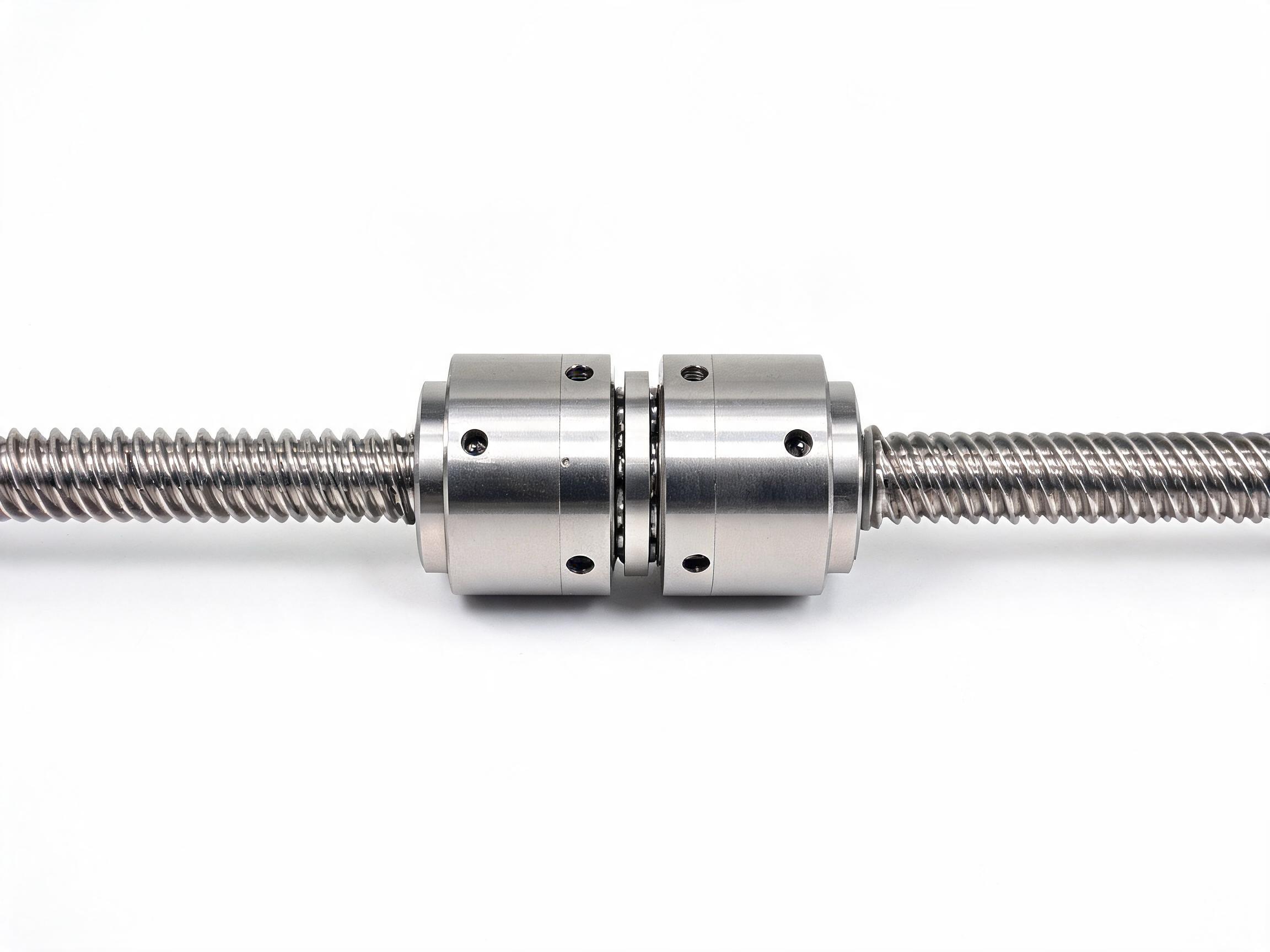
A ball screw assembly is a complete power transmission unit that converts rotary motion to linear motion using recirculating balls between a screw shaft and nut. Dongfeng Bearing provides complete ball screw assemblies that include the screw shaft, nut, balls, return system, seals, support bearings, and end machining. Understanding the components and their interactions helps buyers specify the correct assembly for their application and evaluate supplier proposals.
The assembly's performance depends on the interaction of all components: the screw shaft's lead accuracy determines positioning precision, the nut's ball circuit design affects load capacity and smoothness, the support bearings handle axial and radial loads, and the end machining ensures proper coupling to the drive motor. A weak link in any component compromises the entire assembly's performance.
| Component | Function | Material | Key Specification |
|---|---|---|---|
| Screw shaft | Provides helical raceway for balls | GCr15 (58-62 HRC) | Lead accuracy, diameter, length |
| Nut | Contains ball circuits, mounts to table | Bearing steel | Type (flange/cylindrical), preload |
| Balls | Rolling elements between shaft and nut | GCr15 chrome steel | Diameter, sorting grade |
| Return system | Recirculates balls from end to start | Steel or polymer | Internal deflector or external tube |
| Seals | Retain lubricant, exclude contaminants | NBR or FKM rubber | Lip seal, double seal, scraper |
| Support bearings | Handle axial and radial loads at shaft ends | Bearing steel | Angular contact thrust pair |
| End machining | Interfaces with motor coupling and bearings | Same as shaft | Journal, keyway, thread, flat |
Types of Ball Screw Assemblies
Ball screw assemblies are classified by their nut configuration, preload method, and accuracy grade. Dongfeng Bearing offers the following assembly types:
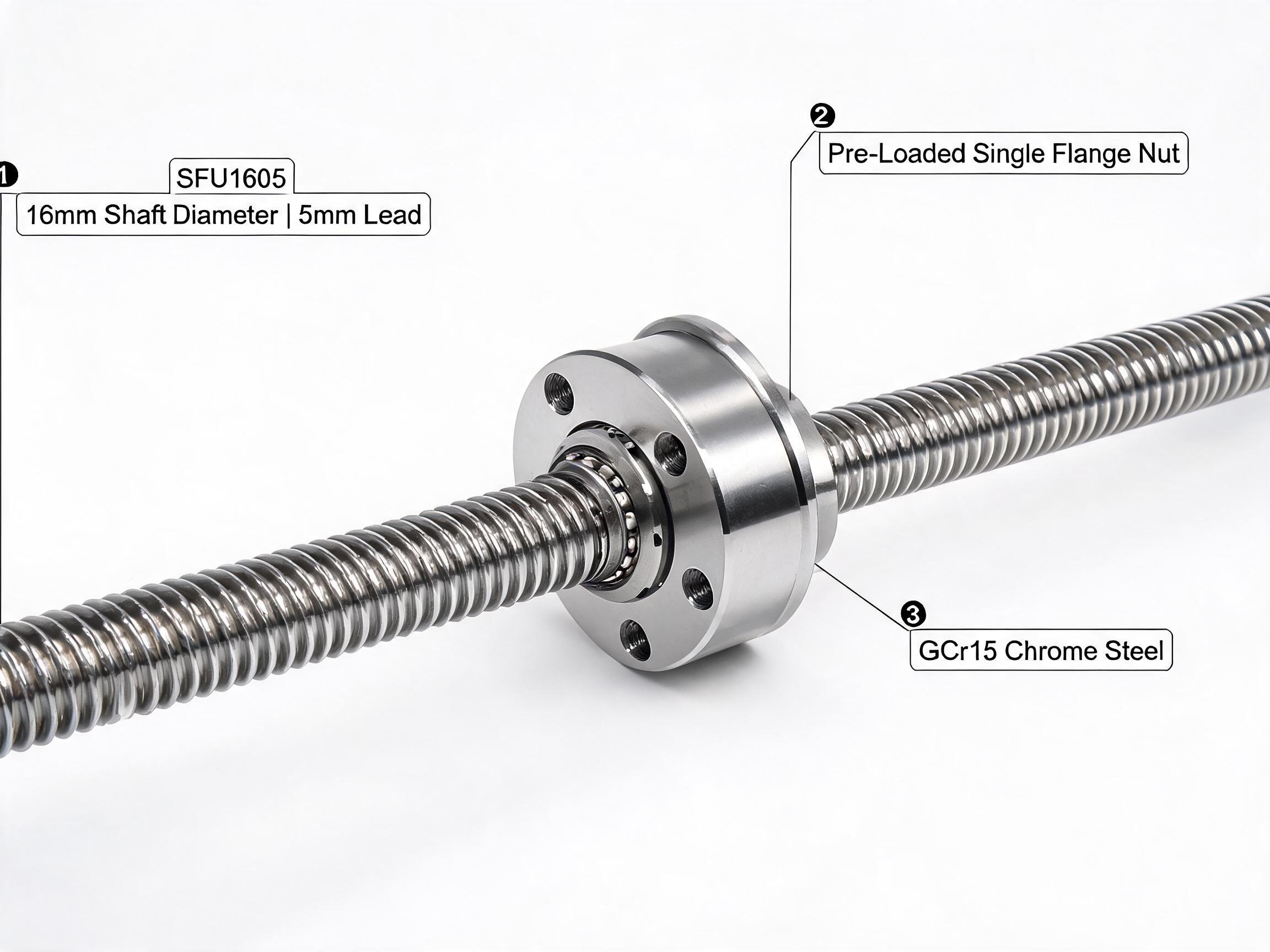
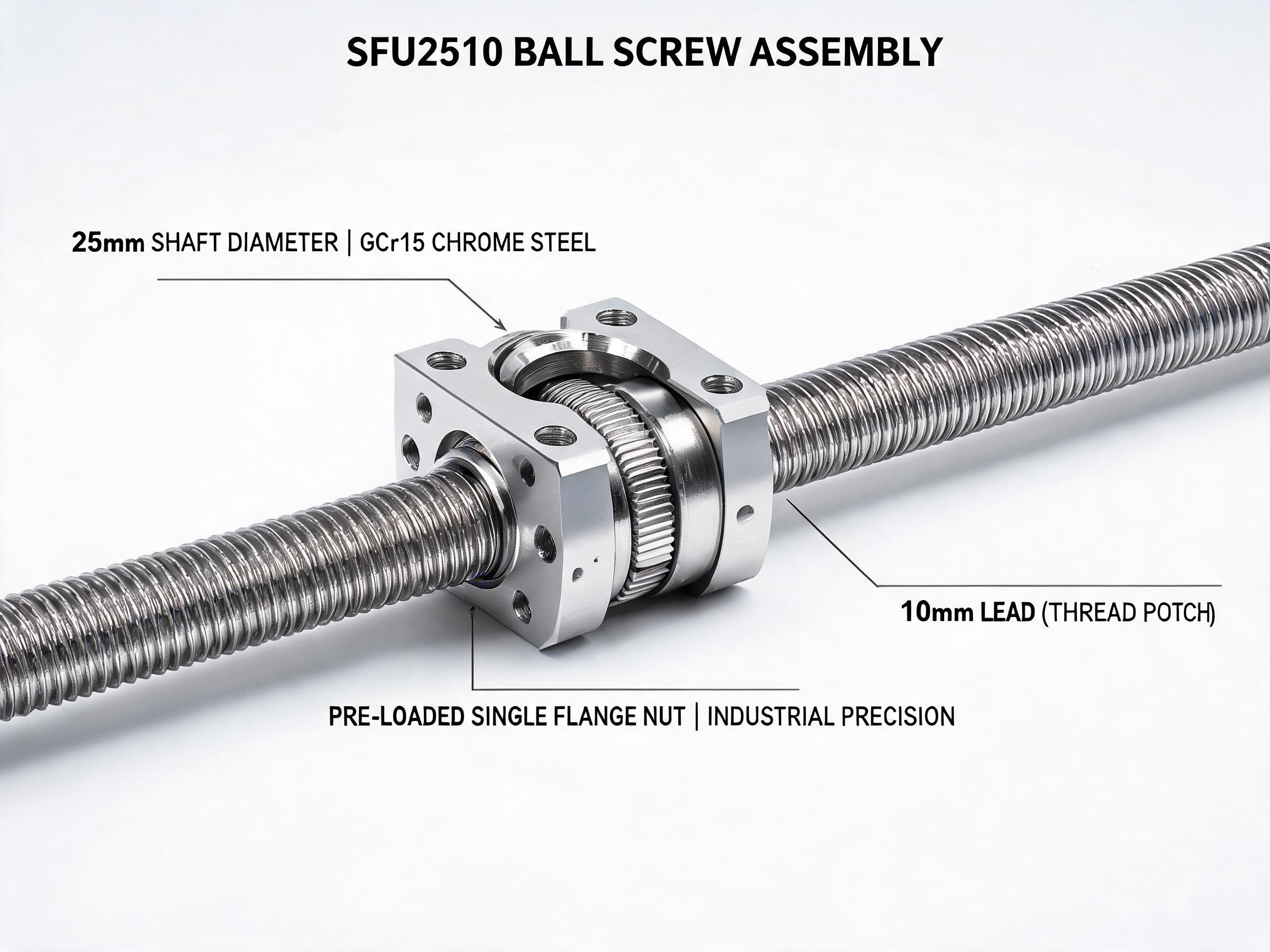
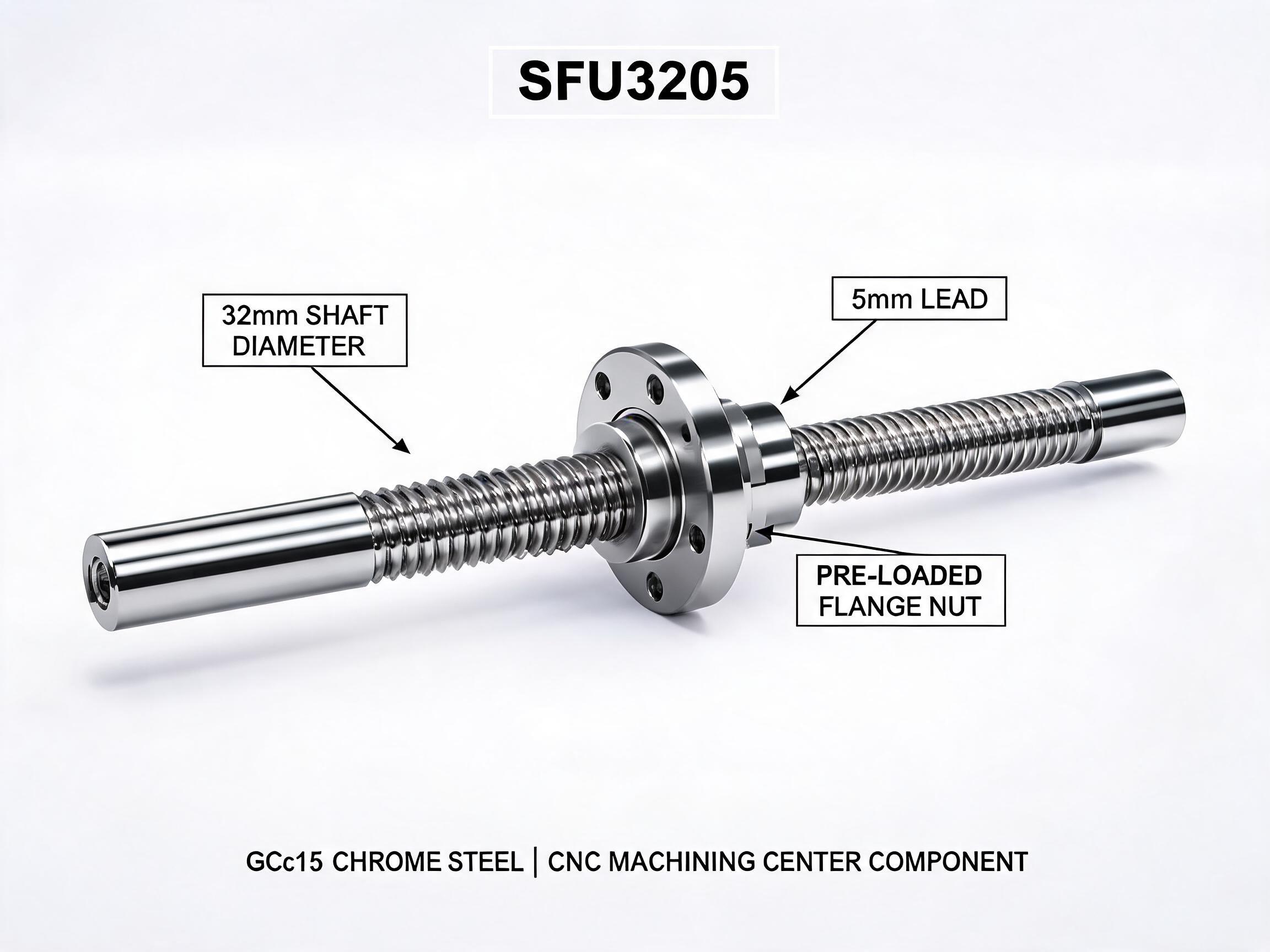
- SFU single-nut assembly (rolled C7): The most economical configuration, suitable for general CNC, automation, and 3D printing. Standard backlash of 0.01-0.05 mm. Available in shaft diameters 12-32 mm with leads of 4-10 mm.
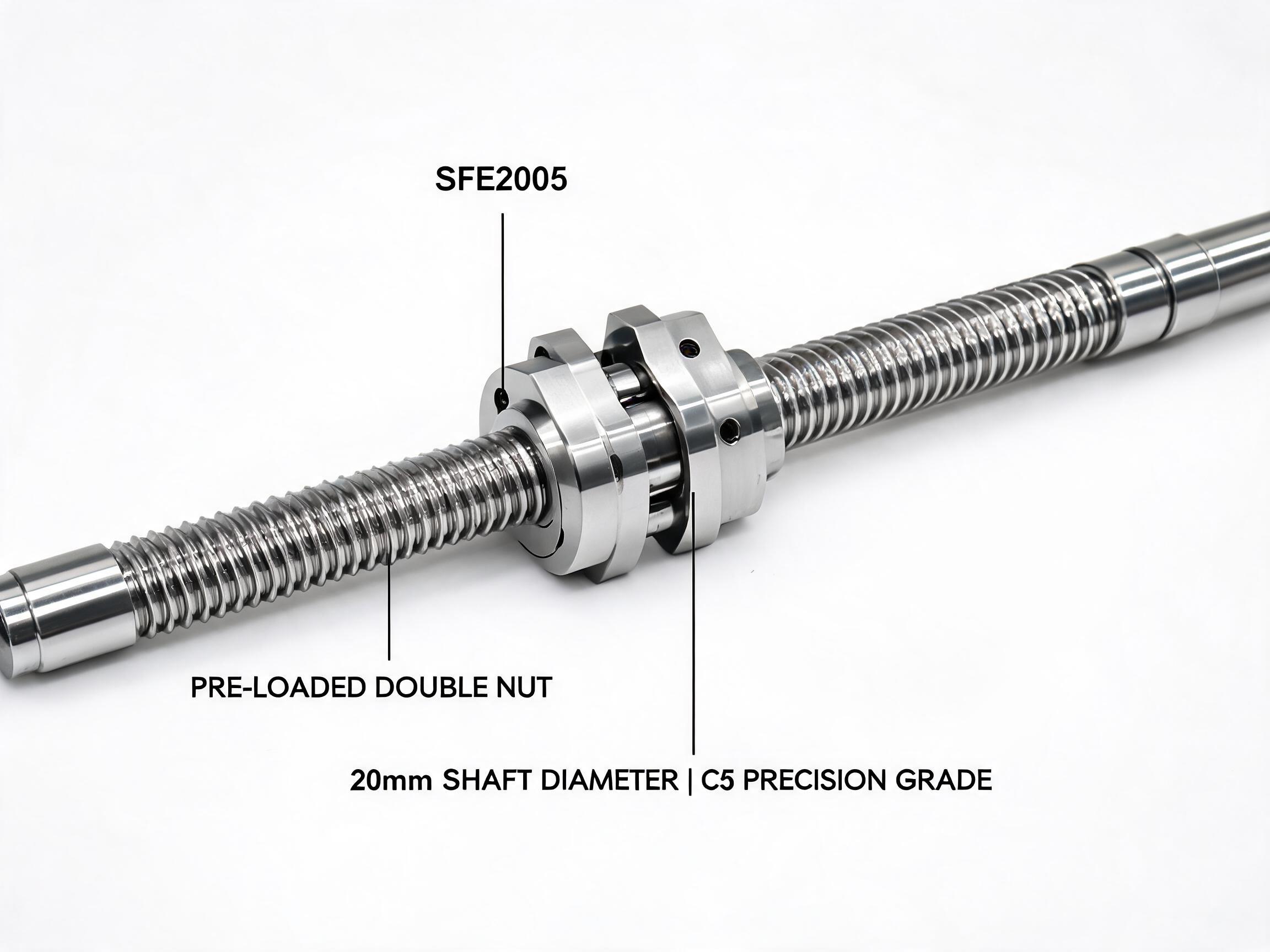
- DFU double-nut assembly (rolled C7, zero backlash): Uses two single nuts with a precision spacer for zero-backlash operation. Recommended for applications requiring bidirectional positioning accuracy. Longer and more expensive than single-nut.
- SFE ground assembly (ground C5): Precision assembly with ground raceway for C5 accuracy. Used in CNC machine tools, semiconductor equipment, and metrology instruments. Available with double-nut preload.
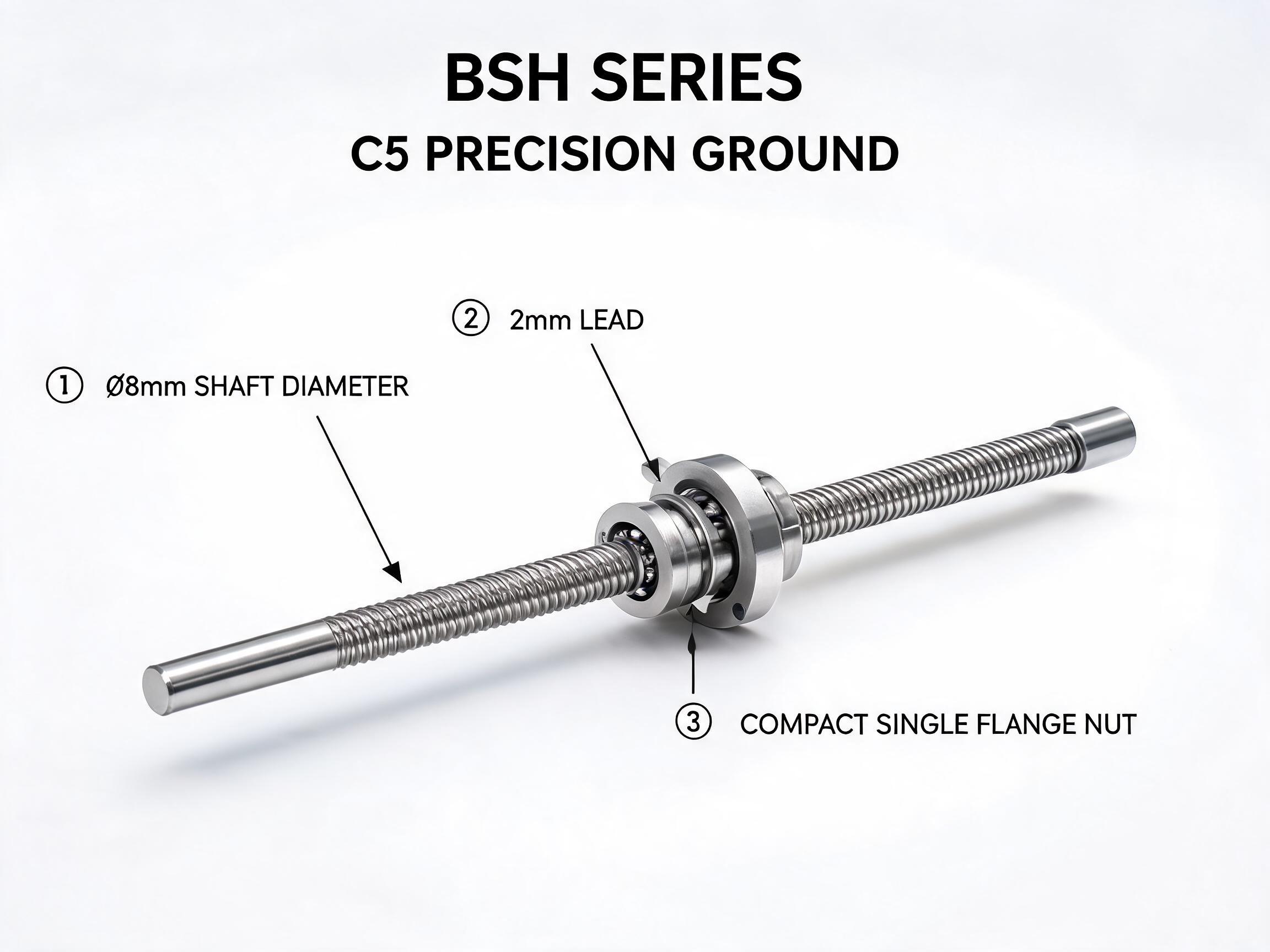
- BSH miniature ground assembly (ground C5): Compact assembly for small-diameter screws (6-12 mm). Used in medical devices, optical instruments, and micro-positioning stages.
| Assembly Type | Accuracy | Backlash | Diameter Range | Typical Application | Cost Level |
|---|---|---|---|---|---|
| SFU single-nut | C7 | 0.01-0.05 mm | 12-32 mm | General CNC, automation | Low |
| DFU double-nut | C7 | ~0 (zero) | 12-32 mm | Bidirectional positioning | Medium |
| SFE ground | C5 | 0-0.02 mm | 12-32 mm | Precision CNC, metrology | High |
| BSH miniature | C5 | 0-0.02 mm | 6-12 mm | Medical, instruments | High |
Selecting the Right Ball Screw Assembly
Choosing the correct ball screw assembly requires evaluating several application parameters:
- Required positioning accuracy: Determine the maximum acceptable positioning error. If 0.05 mm per 300 mm is acceptable, C7 rolled (SFU/DFU) is sufficient. If 0.018 mm per 300 mm is required, C5 ground (SFE/BSH) is necessary.
- Load calculation: Calculate the axial load including payload weight, guide rail friction, cutting forces (for machine tools), and acceleration/deceleration forces. Select a screw with a dynamic load rating that provides the desired L10 travel life (typically 10,000-50,000 km) at the calculated equivalent load with a safety factor of 1.5-2.0.
- Speed and critical speed: The maximum rotational speed is limited by the screw's critical speed (resonance) and the DN value (diameter × RPM). For screws over 1500 mm long, critical speed may be the limiting factor. Use a larger diameter or intermediate support to increase critical speed.
- Backlash requirements: If the application involves bidirectional positioning (CNC machining), select a double-nut preloaded assembly (DFU or SFE with double nut). If backlash is acceptable (manual positioning, unidirectional load), a single-nut SFU is more economical.
- Drive torque calculation: Calculate the required motor torque based on the axial load, lead, and efficiency (90%+ for ball screws). Verify that the selected motor and coupling can deliver the required torque with margin.
- Environmental considerations: For contaminated environments (machining, woodworking), specify seals and scrapers. For corrosive environments, specify stainless steel. For cleanroom applications, specify low-outgassing grease and sealed nut covers.
Support Bearing Configurations
The support bearing configuration is a critical part of the ball screw assembly that affects rigidity, accuracy, and thermal behavior:
| Configuration | Fixed-Supported | Fixed-Fixed | Fixed-Free |
|---|---|---|---|
| Drive end | Angular contact pair (back-to-back) | Angular contact pair | Angular contact pair |
| Non-drive end | Single deep groove bearing | Angular contact pair | Unsupported |
| Axial rigidity | Medium | Highest | Low |
| Thermal expansion | Accommodated (free end floats) | Constrained (preload increases) | Accommodated |
| Max speed | Medium-High | Medium (bearing drag) | High |
| Application | Most CNC, automation | High-rigidity machine tools | Short screws, low precision |
The fixed-supported configuration is the most common, providing adequate rigidity for most applications while allowing thermal expansion. Fixed-fixed provides maximum rigidity but requires careful preload management to avoid excessive stress from thermal expansion. Fixed-free is limited to short screws (under 500 mm) and low-precision applications.
End Machining Specifications
The shaft ends must be machined to interface with the support bearings and motor coupling. Key end machining specifications include:
- Bearing journal: Precision ground to bearing inner race tolerance (typically h5 or h6). Surface finish Ra 0.4 μm or better. Shoulder for bearing positioning must be square to the journal within 0.005 mm.
- Threaded end: For locknut installation to secure the bearing inner race. Thread class 6g, with a washer surface for the locknut to seat against.
- Keyway or flat: For coupling engagement. Keyway width per ISO standard (3-8 mm depending on shaft size). Alternatively, a flat can be milled for clamp-type couplings.
- Coupling journal: Diameter matched to the coupling bore, typically the motor shaft diameter. This ensures coupling interchangeability with standard motor sizes.
- Overall length: The total shaft length equals the thread (effective travel) length plus the two end machining lengths. The end machining length is typically 50-100 mm per end, depending on the bearing and coupling configuration.
Specify the bearing type and dimensions, motor coupling type, required overall length, and any special features (such as a second flat for a rotary encoder) when ordering.
Calculating Travel Life and Load Capacity
The travel life of a ball screw assembly is determined by the dynamic load rating, the equivalent applied load, and the operating conditions. The L10 life (distance at which 90% of screws survive) is calculated as:
L10 = (C / P × f
Where C is the basic dynamic load rating, P is the equivalent axial load, and fw is the load factor (1.0 for smooth operation, 1.2 for normal operation, 1.5 for impact/vibration). To convert revolutions to travel distance, multiply by the lead.
| Application | Load Factor (fw) | Typical L10 Life Target |
|---|---|---|
| General automation | 1.0-1.2 | 5,000-10,000 km |
| CNC machine tools | 1.2-1.5 | 10,000-20,000 km |
| Precision equipment | 1.0-1.2 | 20,000-50,000 km |
| Heavy machinery | 1.5-2.0 | 5,000-10,000 km |
For preloaded assemblies, the equivalent load should account for the preload force. Our engineering team provides free load calculation and life estimation based on your application parameters.
Installation and Commissioning
Proper installation is critical for ball screw assembly performance and life:
- Shaft alignment: Align the screw parallel to the linear guide rails within 0.05 mm over the full length. Misalignment causes radial loads on the nut, increasing friction and wear. Use a dial indicator on the nut or shaft during alignment.
- Bearing preload: Set the angular contact bearing preload to the manufacturer's specification using precision ground spacers. Insufficient preload allows axial play; excessive preload increases friction and heat.
- Coupling alignment: Align the motor shaft and screw shaft within 0.05 mm radial and angular misalignment. Use a flexible coupling with zero backlash (bellows or disk type) for positioning applications. Avoid rigid couplings.
- Initial lubrication: Apply ball screw grease before first operation. Run the assembly through several full travel cycles at low speed to distribute grease. Check for smooth motion, unusual noise, or excessive heat.
- Run-in: For precision applications, run the assembly at 25% of maximum speed for 1-2 hours to allow components to seat and preload to stabilize. Recheck alignment and bearing preload after run-in.
- Encoder alignment: If using a rotary encoder on the screw end, align the encoder coupling carefully. Misalignment causes positioning error that varies with rotation angle, which is difficult to diagnose.
Maintenance and Troubleshooting
Regular maintenance extends ball screw assembly life and prevents premature failure:
| Symptom | Likely Cause | Action |
|---|---|---|
| Increased friction or heat | Insufficient lubrication, contamination, or excessive preload | Clean, relubricate, check preload and alignment |
| Unusual noise | Ball damage, raceway wear, or loose return system | Inspect nut and balls; replace if damaged |
| Positioning error | Lead wear, bearing wear, coupling looseness | Measure lead accuracy; check bearings and coupling |
| Vibration at specific speed | Critical speed resonance | Reduce operating speed or increase screw diameter |
| Backlash increase | Ball wear, preload loss, nut loosening | Check ball diameter, re-torque nut, or replace assembly |
Relubricate every 500-1000 km of travel or every 3-6 months. In contaminated environments, clean the shaft and relubricate more frequently. Use wiper seals to remove debris from the shaft before it enters the nut. For continuous-duty applications, consider forced oil lubrication with a filtration system.
Frequently Asked Questions
What is included in a ball screw assembly?
A complete assembly includes the screw shaft, nut (with balls, return system, and seals), support bearings, end machining (bearing journals, keyway/flat, threaded end), and optionally a coupling. Specify whether you need a bare shaft and nut or a complete assembly with bearings and end machining.
How do I choose between single-nut and double-nut?
Single-nut (SFU) is more economical and suitable when backlash of 0.01-0.05 mm is acceptable. Double-nut (DFU) provides zero backlash through spacer preload and is recommended for bidirectional positioning applications like CNC machining. The trade-off is longer assembly length and higher cost.
What is the efficiency of a ball screw assembly?
Ball screws achieve 90%+ mechanical efficiency, significantly higher than ACME lead screws (30-70%). This means less motor torque is required, reducing energy consumption and heat generation. The high efficiency also means ball screws are not self-locking; a brake may be needed for vertical applications.
Can I use a ball screw in a vertical application?
Yes, but ball screws are not self-locking due to their high efficiency. When the motor is de-energized, the load can drive the screw in reverse. Use a brake (electromagnetic or mechanical) on the motor to hold the load, or select a lower-lead screw to increase the drive ratio and reduce back-driving force.
What is the critical speed of a ball screw?
Critical speed is the rotational speed at which the screw shaft resonates, causing vibration and potential damage. It depends on the screw diameter, length, and end fixity. For a fixed-supported configuration, the critical speed can be estimated using the formula Nc = 2.7 × 10⁶ × d / L² (RPM, where d is root diameter in mm and L is length in mm). Always operate below 80% of critical speed.
How do I specify end machining?
Provide the bearing type and inner/outer diameters, motor coupling type and bore diameter, required overall shaft length, and any special features (encoder flat, second keyway). We machine the ends to your specifications with bearing journals, keyways, coupling flats, and threaded ends as required.
What is the difference between lead and pitch in ball screws?
Pitch is the distance between adjacent thread crests. Lead is the linear distance traveled per one revolution. For single-start screws, lead equals pitch. For multi-start screws, lead = pitch × number of starts. Ball screws are typically specified by lead, not pitch, because lead directly determines the linear travel per revolution.
Are stainless steel ball screw assemblies available?
Yes. Stainless steel (9Cr18Mo / 440C, 56-58 HRC) is available for all sizes, particularly for the BSH miniature series. Stainless steel provides corrosion resistance for medical, food-processing, and marine applications. FDA food-grade compliance documentation is available.
What is the warranty on ball screw assemblies?
All ball screw assemblies carry a 24-month warranty against manufacturing defects from the date of shipment. The warranty covers material defects, dimensional non-conformance, and premature failure under rated load conditions. Normal wear under proper use and maintenance is not covered.
How can I extend the life of my ball screw assembly?
Proper lubrication (correct grease, correct interval), proper alignment (parallel to guides, within 0.05 mm), proper bearing preload, contamination protection (seals, scrapers, bellows), and operation below 80% of critical speed all contribute to maximum travel life. Regular inspection for noise, friction, and positioning accuracy changes can detect issues before failure.