Linear Ball Bearing Product Series Overview
Dongfeng Bearing manufactures a comprehensive range of linear ball bearings for precision shaft-based linear motion. The product line includes LM standard, LME metric flange, LMF square flange, LMK double-length, LMUU sealed extended, and SC plain bushing series. These bearings use recirculating ball circuits to convert applied load into smooth rolling motion along hardened precision shafts, achieving efficiencies of 90%+ with friction coefficients as low as 0.002-0.005.
Linear ball bearings are distinguished from sleeve bearings by their use of rolling balls rather than sliding surfaces. This provides lower friction, higher speed capability, higher load capacity, and longer service life. The trade-off is sensitivity to contamination and shaft quality.
| Series | Type | Shaft Dia. Range | Key Feature | Typical Application |
|---|---|---|---|---|
| LM | Standard | 6-50 mm | Compact, economical | General automation, 3D printers |
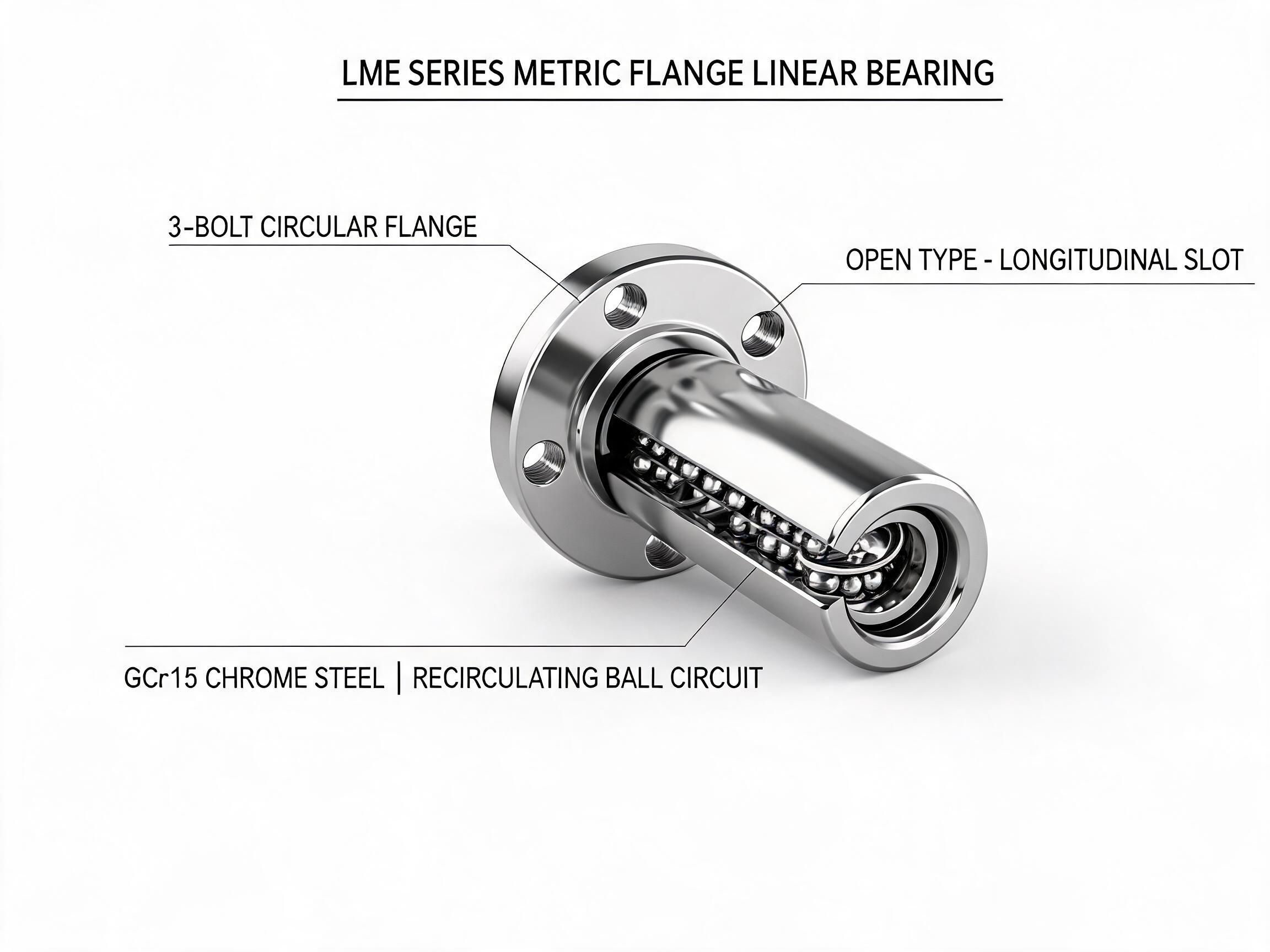
| LME | Round flange | 6-60 mm | Flange mounting | CNC routers, XY tables |
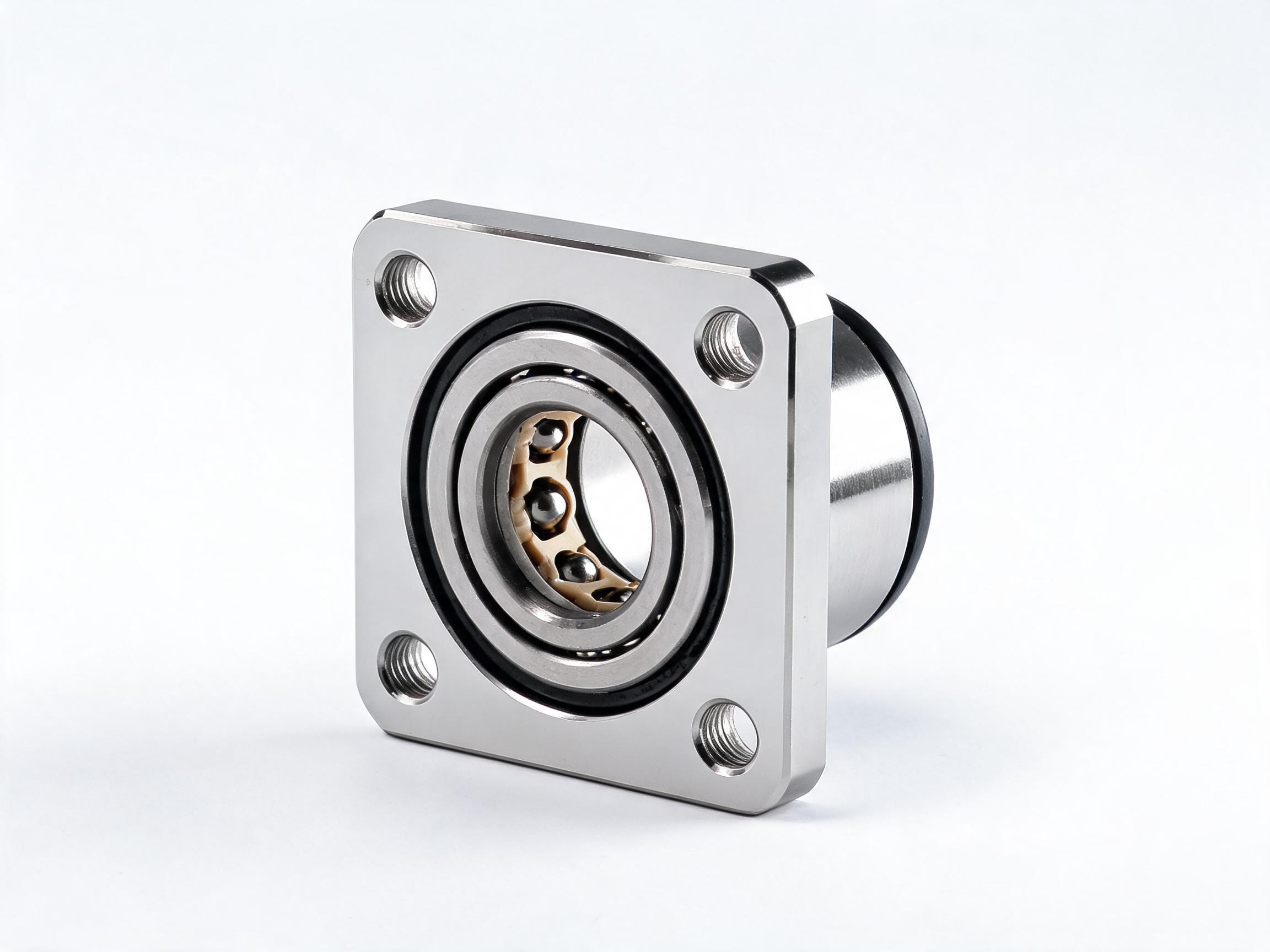
| LMF | Square flange | 12-50 mm | High mounting stability | CNC machines, heavy automation |
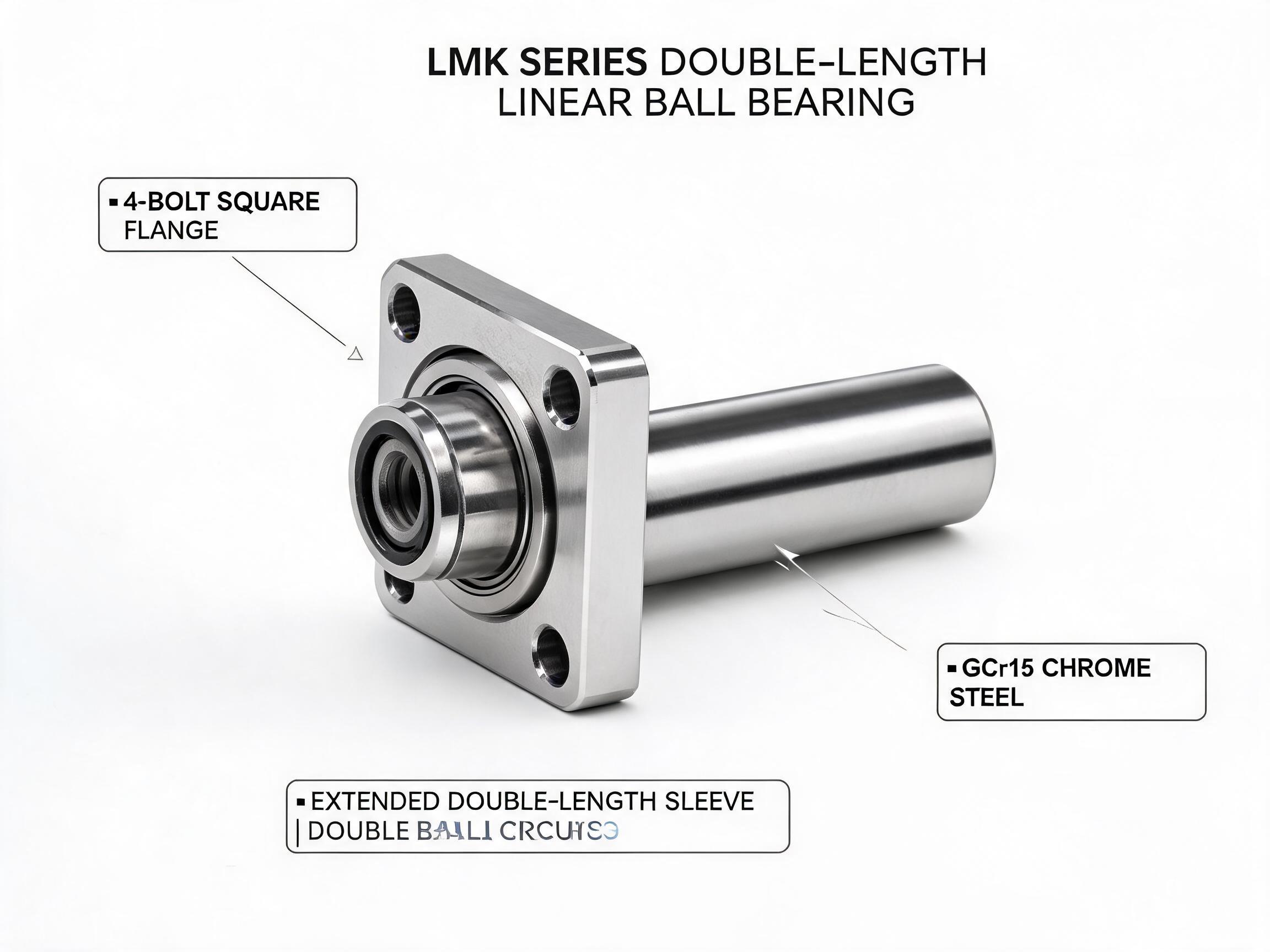
| LMK | Double-length | 12-50 mm | Higher load, moment capacity | Heavy-duty positioning |
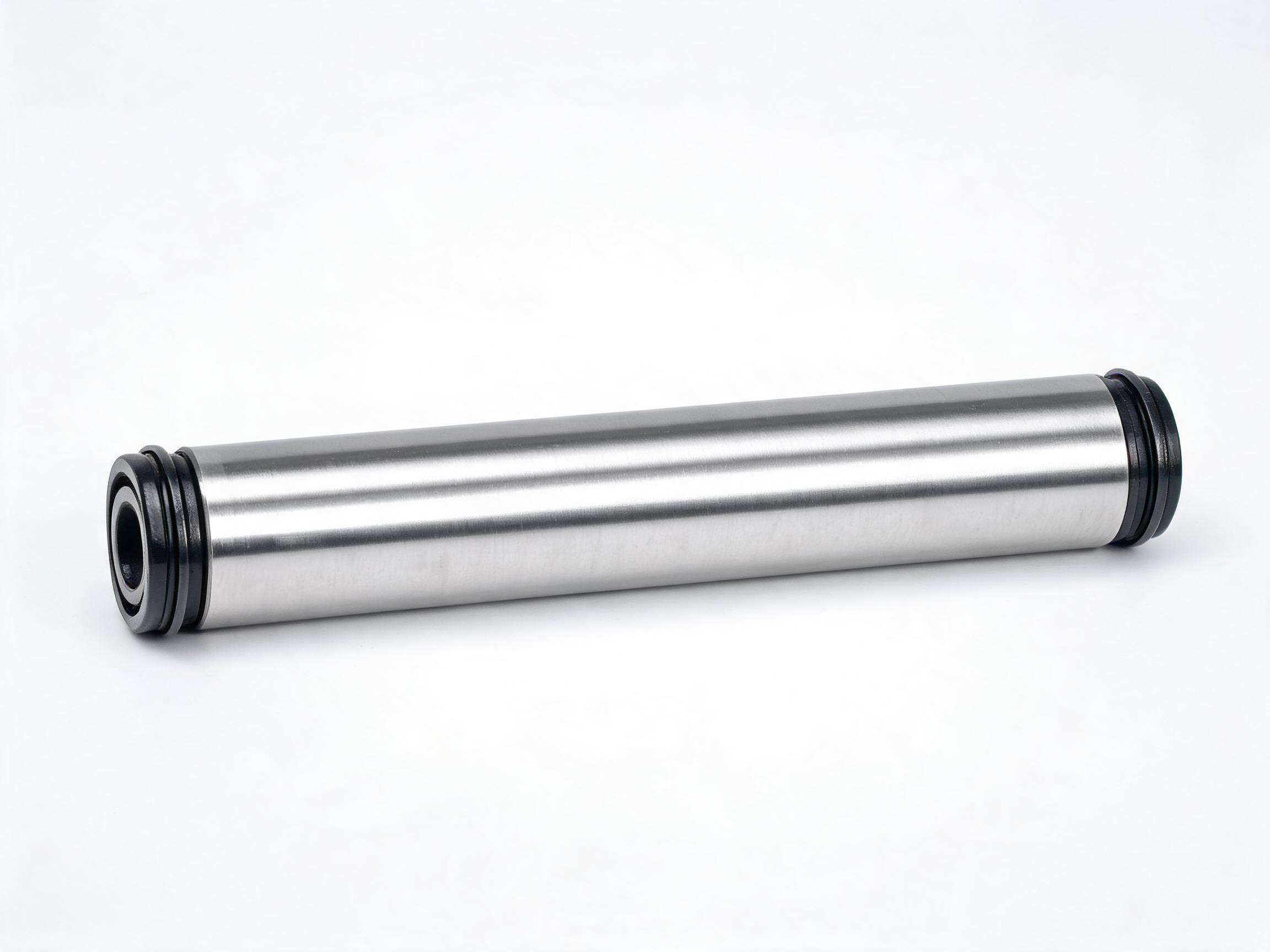
| LMUU | Sealed extended | 6-50 mm | Double seals, more circuits | Contaminated environments |
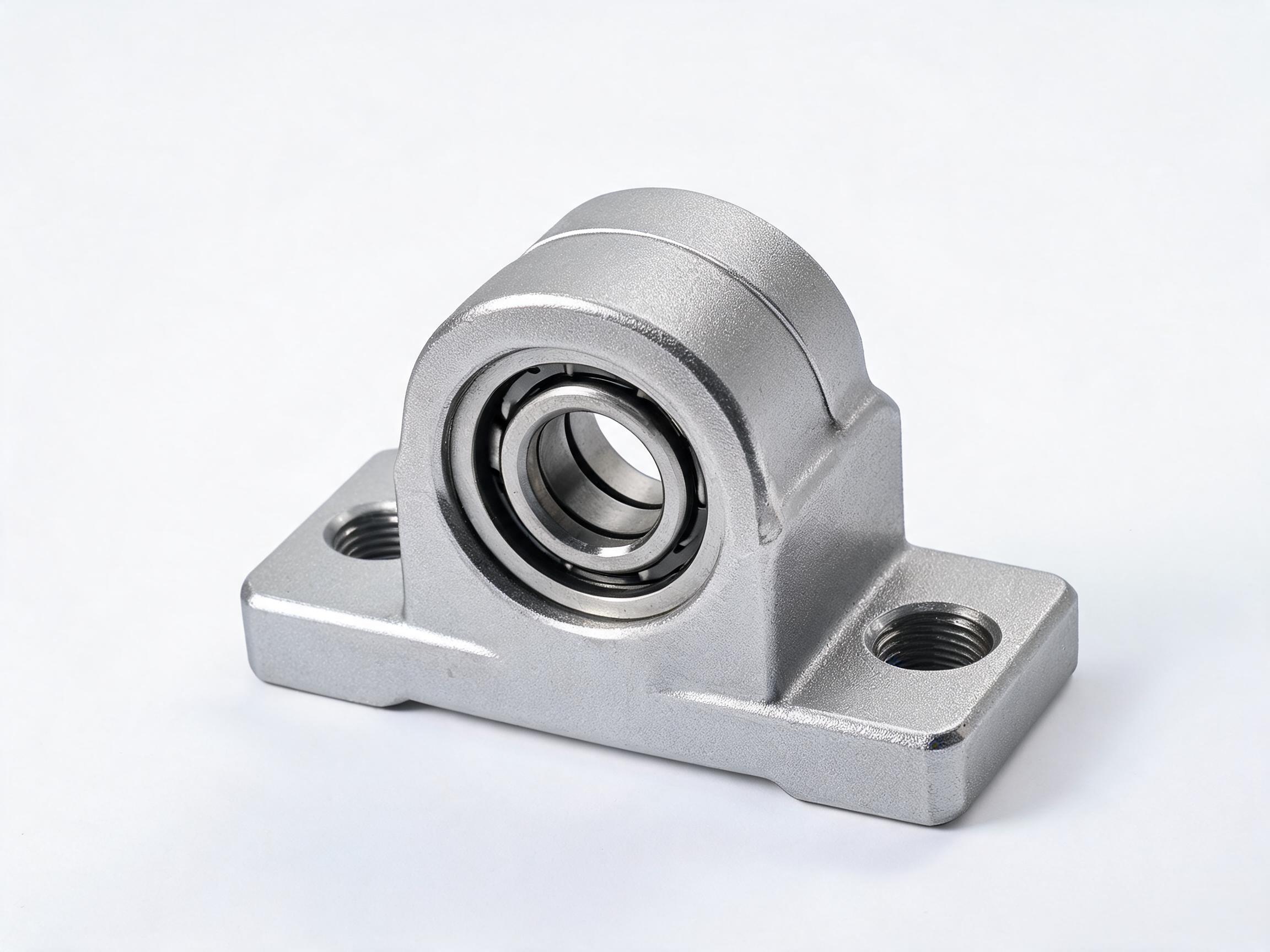
| SC | Plain bushing | 6-60 mm | PTFE liner, no balls | High temp, dirty environments |
How Linear Ball Bearings Work
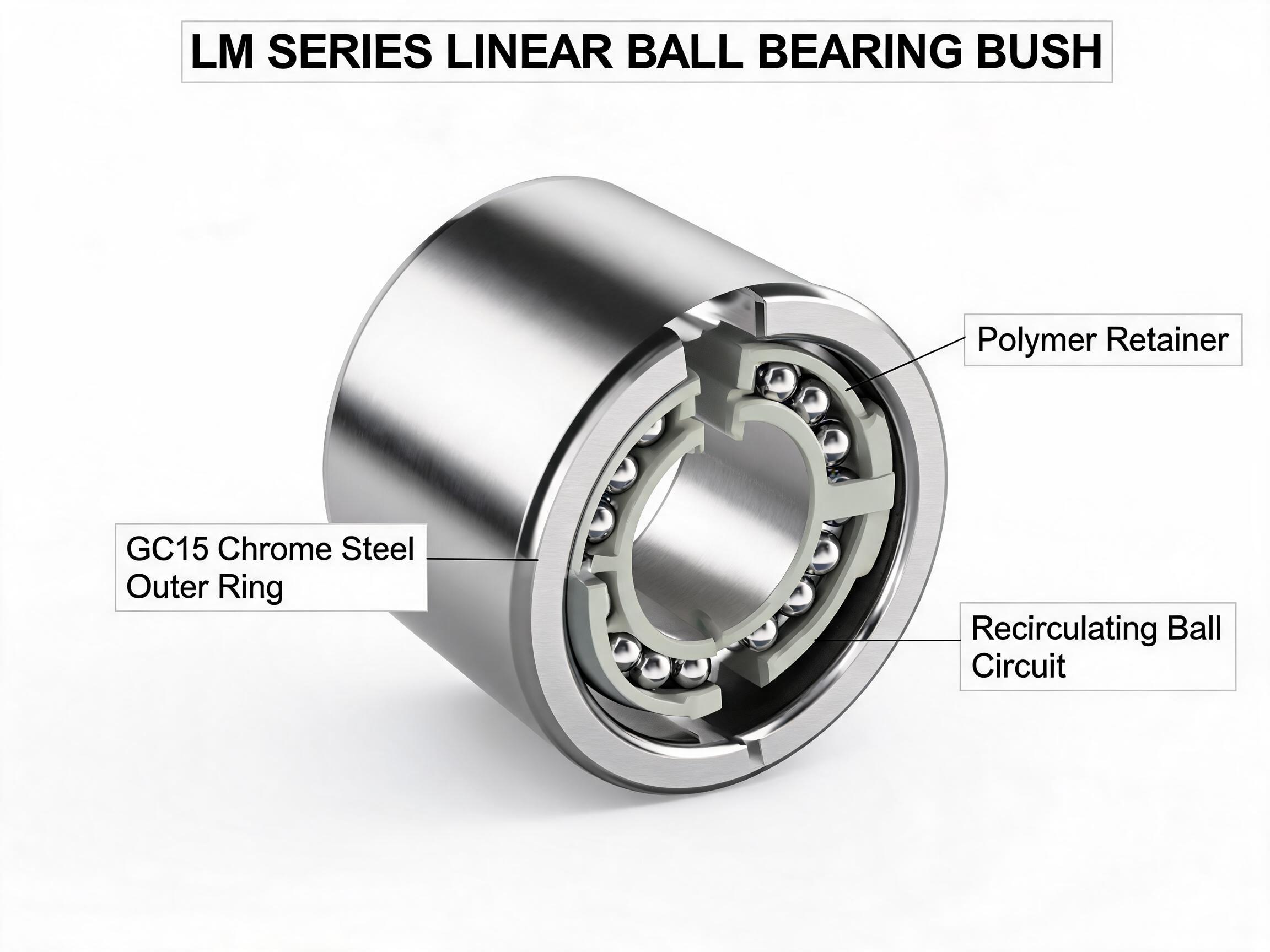
A linear ball bearing contains multiple ball circuits arranged around the bearing bore. Each circuit has a load zone where balls roll between the shaft and the bearing inner raceway, and a return zone where balls recirculate. Balls are held in a retainer that spaces them evenly and prevents ball-to-ball contact.
In the load zone, balls make point contact with the shaft surface. The contact geometry creates a narrow elliptical contact area that concentrates stress, limiting load capacity compared to roller bearings or sleeve bearings. However, point contact also means very low rolling resistance, enabling high efficiency and smooth motion at low driving forces.
The number of ball circuits varies by size: standard LM bearings have 3-4 circuits, LMK double-length have 6-8, and LMUU sealed have 4-6 circuits with additional sealing elements.
Load Capacity and Life Calculation
The dynamic load rating is the load at which 90% of bearings survive 50 km of travel (L10 life). Actual travel life depends on applied load, operating conditions, and shaft quality:
L10 = 50 x (C / P x fw)^3 (km)
Where C is dynamic load rating, P is equivalent load, and fw is the load factor (1.0 smooth, 1.2 normal, 1.5 impact).
| Bearing Size | Dynamic Load (C) | Static Load (C0) | L10 at P=0.5C (km) | L10 at P=0.25C (km) |
|---|---|---|---|---|
| LM12 | 0.88 kN | 1.45 kN | 400 | 3,200 |
| LM16 | 1.55 kN | 2.65 kN | 400 | 3,200 |
| LM20 | 2.45 kN | 4.20 kN | 400 | 3,200 |
| LM25 | 3.65 kN | 6.30 kN | 400 | 3,200 |
Operating at 25% of the dynamic load rating provides 8x longer life than operating at 50%. For 10,000+ km life, operate at 20-25% of the dynamic load rating.
Selecting the Right Linear Ball Bearing
- Determine shaft diameter: Usually set by mechanical design (stroke length, space, load requirements).
- Calculate equivalent load: Add payload weight, carriage weight, and external forces. Divide by number of bearings. Apply load factor.
- Select bearing type: LM for compact, LME/LMF for flange mounting, LMK for higher loads, LMUU for contamination, SC for extreme conditions.
- Verify life calculation: Calculate L10 life. If insufficient, increase bearing size or use LMK double-length.
- Check moment loads: Use two bearings per shaft or LMK double-length for offset payloads.
- Select retainer material: Steel for high loads, polymer for low noise, resin shell for lowest friction.
Plain Bushing (SC Series) for Extreme Conditions
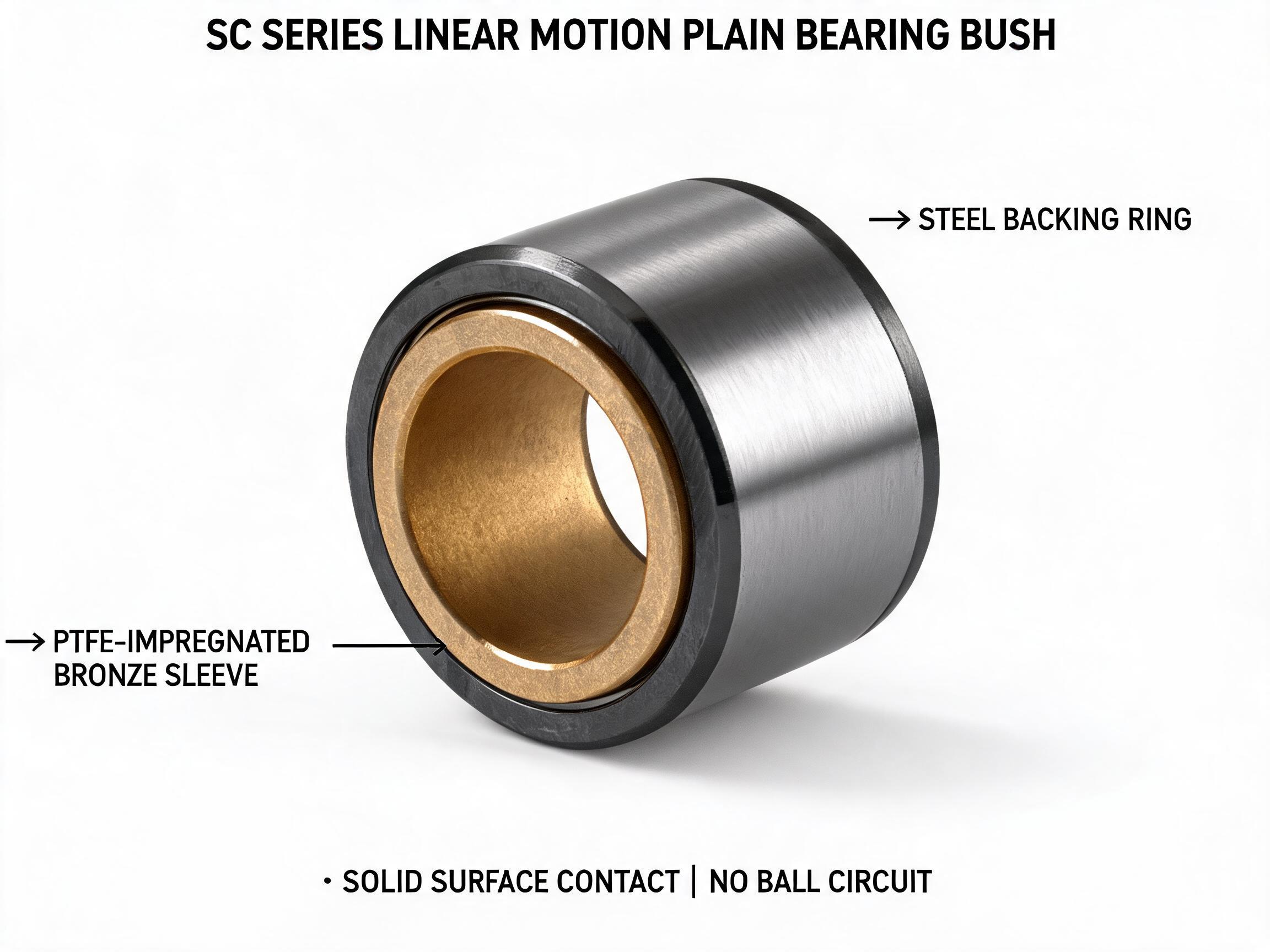
The SC series plain (sleeve) linear bearing replaces the ball circuit with a PTFE-impregnated bronze bushing. Instead of rolling contact, the bushing slides on the shaft with surface contact. This design is engineered for environments where ball bearings fail:
| Parameter | SC Plain Bushing | LM Ball Bearing |
|---|---|---|
| Contact type | Surface (sliding) | Point (rolling) |
| Friction coefficient | 0.08-0.12 dry, 0.04-0.06 greased | 0.002-0.005 |
| Shock load resistance | Excellent | Poor (brinelling risk) |
| Temperature range | -50 to +200°C | -20 to +120°C |
| Contamination tolerance | Excellent | Poor |
| Self-lubricating | Yes (PTFE-impregnated) | No (requires grease) |
| Speed | Slow/oscillating | Up to 60 m/min |
SC bearings are ideal for foundry equipment, stamping presses, woodworking machinery, packaging lines, and high-temperature industrial equipment where dust, chips, grit, thermal expansion, or shock loads would cause ball bearings to fail.
Shaft Quality Requirements
- Material: GCr15 bearing steel or 9Cr18Mo stainless, hardened to 58-62 HRC or 56-58 HRC respectively.
- Surface finish: Ra 0.4 μm or better. Precision-ground shafts recommended.
- Diameter tolerance: h5 or h6 per ISO.
- Straightness: 0.1 mm per 1000 mm. For long shafts, intermediate support required.
- Hardness depth: Through-hardened or induction-hardened with case depth of at least 1.5 mm.
Installation Considerations
- Bearing housing: Housing bore must be H7 tolerance for proper press fit.
- Press fitting: Use a bearing press. Do not hammer. Press on the outer ring only.
- Shaft installation: Chamfer shaft end to prevent seal damage. Clean and lubricate before installation.
- Parallelism: For dual-shaft installations, maintain within 0.05 mm per 300 mm.
- End support: Shafts must be supported at both ends. For shafts over 1000 mm, consider intermediate support.
Maintenance, Cleaning, and Replacement
- Lubrication: Lithium-based grease (NLGI 2) before initial operation. Relubricate every 50-100 km or 2-3 months.
- Cleaning: If noisy or rough, remove and clean ball circuits with solvent. Inspect balls for wear. Replace if damaged.
- Shaft inspection: Inspect for wear tracks, brinelling, or corrosion. Replace if wear exceeds 0.02 mm.
- Replacement indicators: Replace when noise increases, friction becomes inconsistent, or accuracy degrades. Replace in pairs on the same shaft.
Comparing Linear Ball Bearings to Alternatives
| Parameter | Linear Ball Bearing | Linear Guideway | Sleeve Bearing |
|---|---|---|---|
| Friction | 0.002-0.005 | 0.002-0.005 | 0.04-0.12 |
| Load capacity | Low-Medium | High | Medium-High |
| Speed | Up to 60 m/min | Up to 120 m/min | Slow/oscillating |
| Contamination tolerance | Poor | Medium | Excellent |
| Cost | Low | High | Low |
Linear ball bearings provide the best value for light to medium loads in relatively clean environments. For heavy loads or long travel, linear guideways are superior. For dirty, high-temperature, or high-shock environments, sleeve bearings (SC series) are more reliable.
Frequently Asked Questions
What is the difference between LM and LME bearings?
LM is the standard series without a flange, for press-fit installation. LME has a round flange for direct bolt-on mounting. Both use the same ball circuit design.
What shaft hardness is required for linear ball bearings?
58-62 HRC for GCr15 carbon steel or 56-58 HRC for 9Cr18Mo stainless steel. Through-hardened shafts are preferred.
Can linear ball bearings handle shock loads?
Not recommended. Point contact causes brinelling under impact. For shock loads, use SC series plain bushings with PTFE-impregnated bronze.
What is the difference between ball and plain linear bearings?
Ball bearings use recirculating balls (friction 0.002-0.005, high speed). Plain bearings (SC series) use PTFE-impregnated bronze sleeve (friction 0.08-0.12 dry, self-lubricating, high temperature).
How do I know what size linear bearing to use?
Calculate the equivalent load per bearing. Select a bearing whose dynamic load rating is 4-5 times the equivalent load for 10,000+ km L10 life.
Are sealed linear ball bearings available?
Yes, the LMUU series features double seals and extended body with more ball circuits.
What is the maximum temperature for linear ball bearings?
Standard with steel retainers: -20 to 120°C. Polymer retainers: -20 to 80°C. Above 120°C, use SC plain bushings rated to 200°C.
Can linear ball bearings be used in food processing?
Yes, stainless steel bearings with NSF H1 food-grade grease. FDA food-grade compliance available.
How long do linear ball bearings last?
L10 life: at 50% of dynamic load, 400 km; at 25%, 3,200 km; at 20%, 6,250 km. Proper lubrication extends actual life beyond L10.
What is the warranty on linear ball bearings?
24-month warranty against manufacturing defects from date of shipment.