Rolled Ball Screw Product Range and Specifications
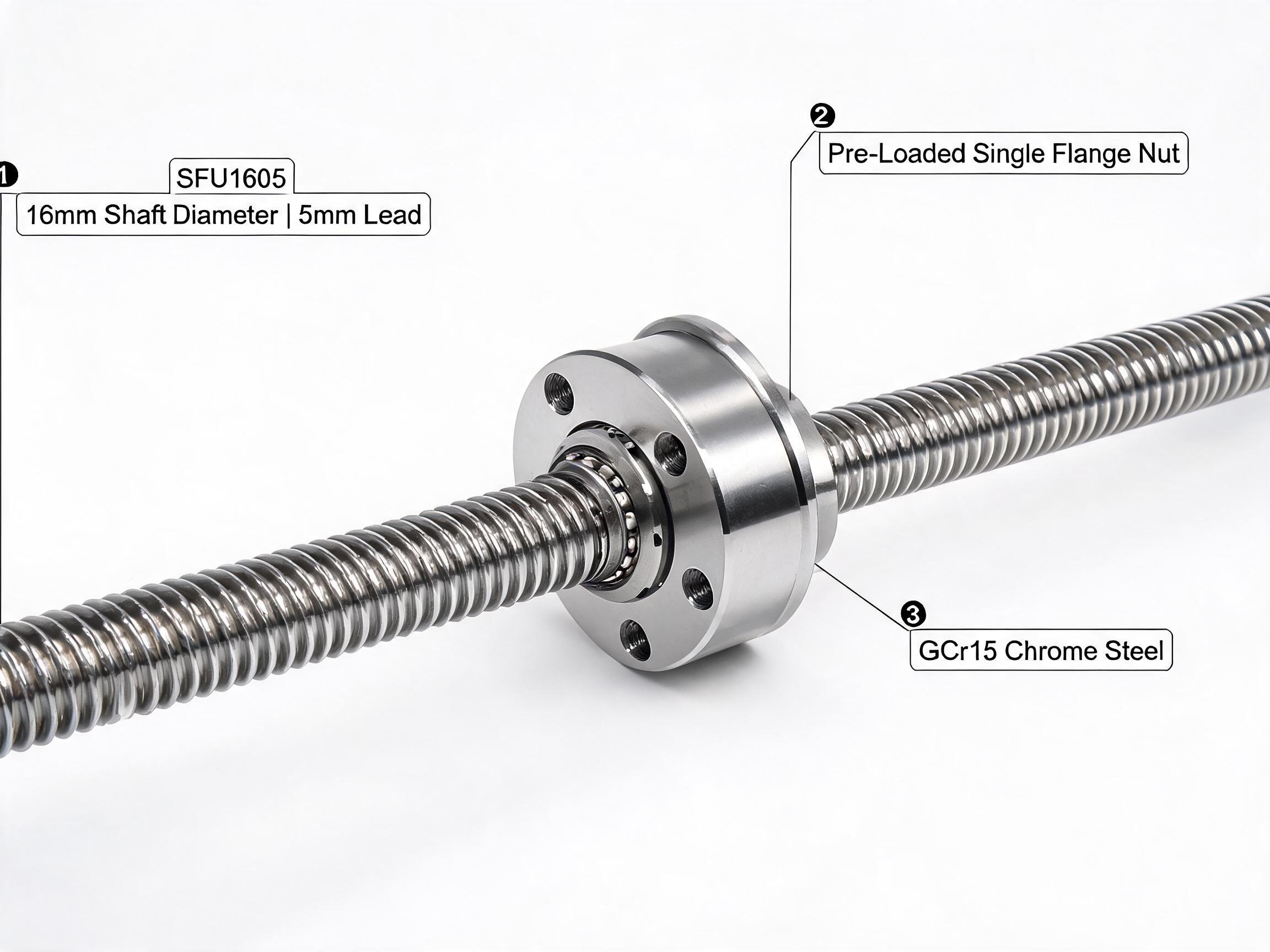
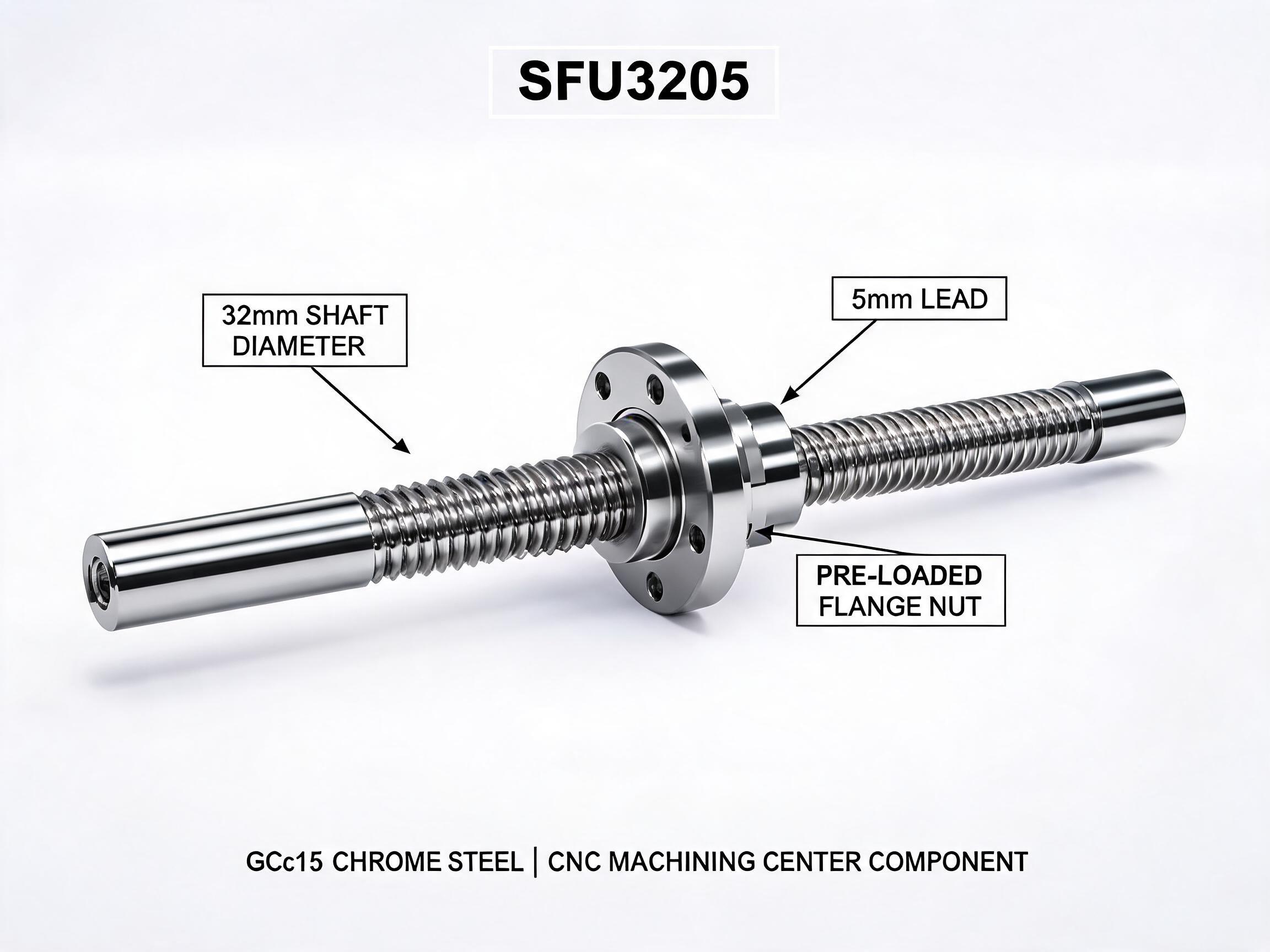
Dongfeng Bearing's rolled ball screw series includes SFU1204, SFU1605, SFU1610, SFU2005, SFU2510, and SFU3205 models, covering shaft diameters from 12 mm to 32 mm and lead pitches from 4 mm to 10 mm. Rolled ball screws are manufactured through a thread rolling process that forms the helical raceway by displacing material between rotating cylindrical dies, producing a smooth, work-hardened surface without removing material. This process achieves C7 lead accuracy (0.05 mm deviation per 300 mm of travel), which is sufficient for most general automation and CNC applications.
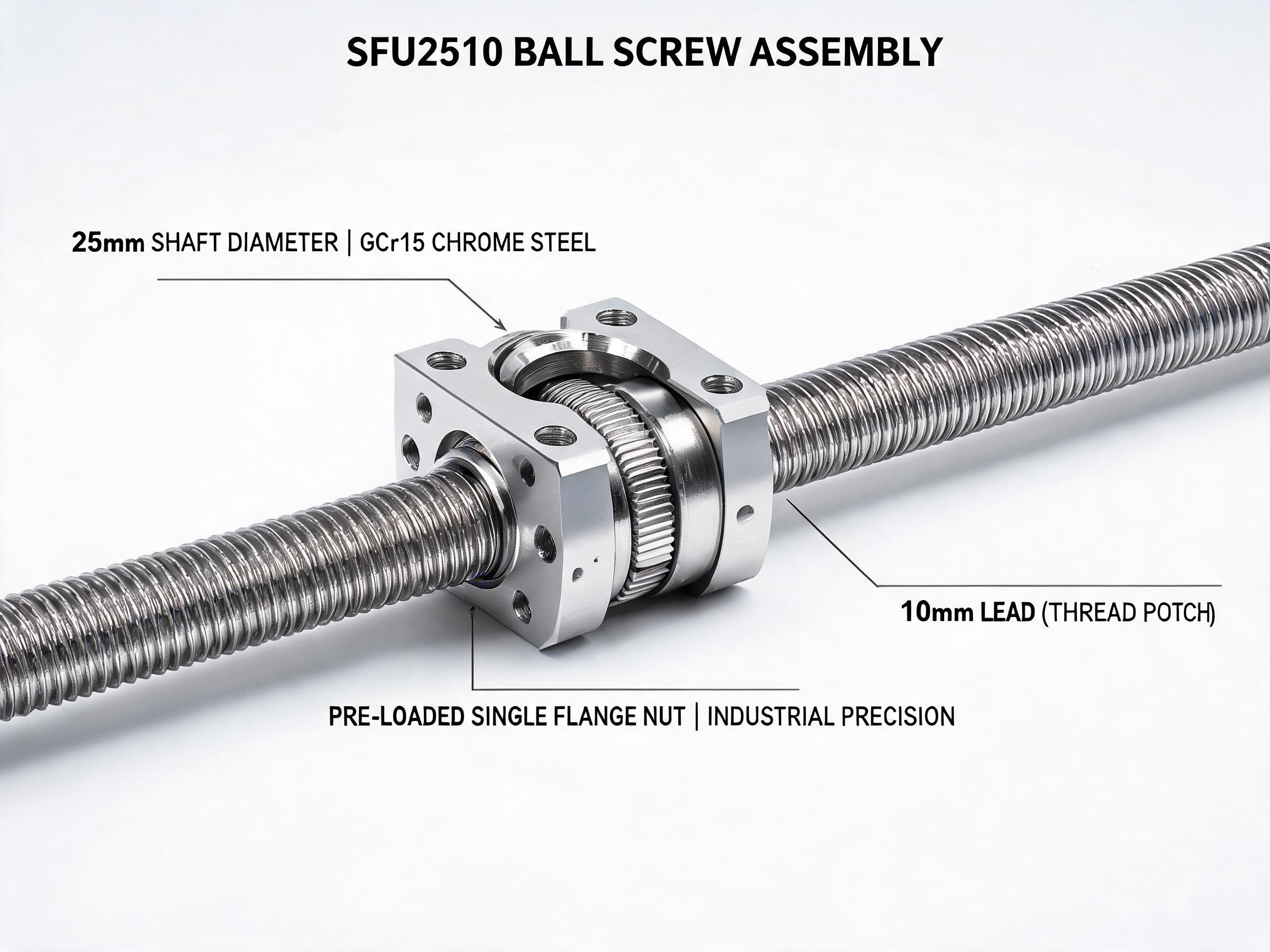
The SFU series uses a single nut with internal ball recirculation and a flange mounting interface. Shaft material is high-carbon chromium bearing steel (GCr15) hardened to 58-62 HRC through induction hardening of the raceway surface. The nut body is bearing steel with precision-machined ball return channels. Balls are GCr15 chrome steel, sorted to sub-micron diameter tolerances for consistent preload and smooth operation.
| Model | Shaft Dia. | Lead | Lead Accuracy | Dynamic Load | Static Load | Max Length |
|---|---|---|---|---|---|---|
| SFU1204 | 12 mm | 4 mm | C7 (0.05/300mm) | 5.4 kN | 9.8 kN | 2000 mm |
| SFU1605 | 16 mm | 5 mm | C7 (0.05/300mm) | 7.6 kN | 14.2 kN | 3000 mm |
| SFU1610 | 16 mm | 10 mm | C7 (0.05/300mm) | 11.3 kN | 20.8 kN | 3000 mm |
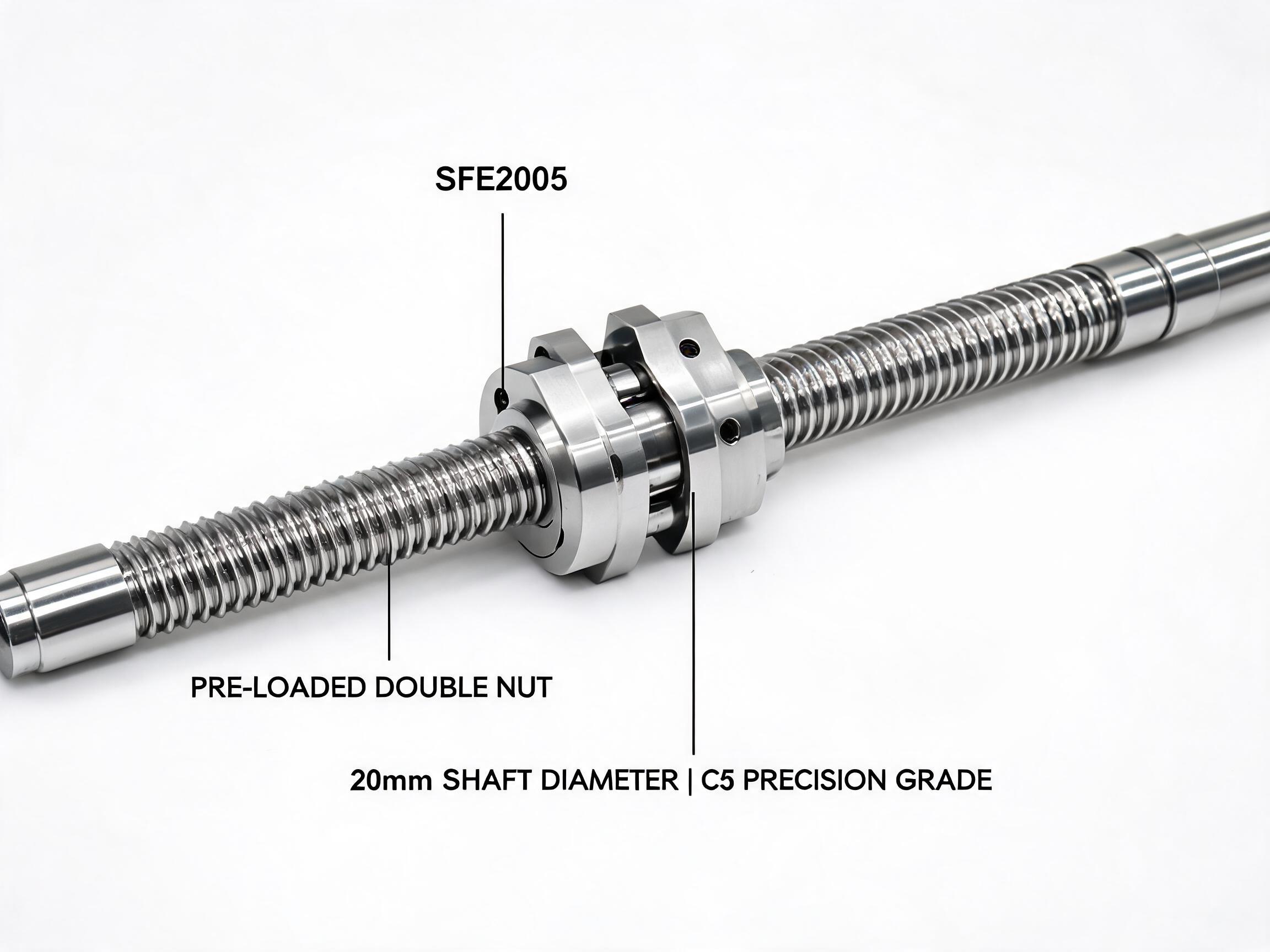
| SFU2005 | 20 mm | 5 mm | C7 (0.05/300mm) | 12.5 kN | 23.5 kN | 3000 mm |
| SFU2510 | 25 mm | 10 mm | C7 (0.05/300mm) | 21.6 kN | 41.2 kN | 3000 mm |
| SFU3205 | 32 mm | 5 mm | C7 (0.05/300mm) | 30.8 kN | 62.5 kN | 3000 mm |
How Rolled Ball Screws Are Manufactured
The rolled ball screw manufacturing process differs fundamentally from ground ball screws and affects both performance characteristics and cost. Understanding this process helps buyers make informed sourcing decisions:
- Material preparation: GCr15 bearing steel round bar is cut to length and straightened. The shaft surface is prepared for the rolling process by turning to the correct blank diameter, which is slightly smaller than the final raceway root diameter.
- Thread rolling: The shaft is rotated between cylindrical dies that have the reverse helical profile of the ball screw raceway. The dies displace material plastically, forming the gothic arch groove geometry without removing metal. This work-hardens the raceway surface, increasing surface hardness and compressive residual stress, which improves fatigue life.
- Induction hardening: After rolling, the raceway surface is induction hardened to 58-62 HRC. The hardening depth is controlled to provide a hardened case of 1.5-2.5 mm while maintaining a tough core. This is verified by hardness depth profiling in SGS material test reports.
- Nut machining: The nut body is machined from bearing steel with precision-bored internal raceway grooves matching the shaft profile. Ball return channels are machined or cast into the nut body, providing smooth ball recirculation.
- Ball sorting and assembly: Balls are sorted into diameter groups with sub-micron variation. The appropriate ball size is selected to achieve the specified preload. The nut is assembled onto the shaft with balls, return caps, and seals installed.
- Lead accuracy verification: Each screw is tested for lead deviation using laser measurement over the full travel length. The C7 specification allows 0.05 mm deviation per 300 mm of travel and 0.21 mm per arbitrary 300 mm segment.
Rolled vs. Ground Ball Screws: When to Choose Which
The choice between rolled and ground ball screws depends on the required accuracy, budget, and application:
| Parameter | Rolled (C7) | Ground (C5) |
|---|---|---|
| Lead accuracy | 0.05 mm / 300 mm | 0.018 mm / 300 mm |
| Surface finish | Work-hardened, smooth | Ground, mirror finish |
| Hardness | 58-62 HRC (induction hardened) | 58-62 HRC (through hardened) |
| Cost | Lower (60-70% of ground) | Higher |
| Production time | Shorter (10-15 days) | Longer (20-30 days) |
| Typical application | General CNC, automation, 3D printers | Precision CNC, semiconductor, metrology |
| Backlash | Standard: 0.01-0.05 mm; Double-nut: ~0 | Standard: 0.005-0.02 mm; Double-nut: ~0 |
Rolled ball screws are recommended when C7 accuracy is sufficient for the application, which includes most CNC router machines, 3D printers, plasma cutters, and general automation axes. Ground ball screws are necessary when positioning accuracy better than 0.02 mm per 300 mm is required, such as in precision grinding machines, coordinate measuring machines, and semiconductor wafer stages.
Applications of Rolled Ball Screws
Rolled ball screws convert rotary motion to linear motion with efficiency exceeding 90%, significantly higher than lead screws (30-70%) or hydraulic systems. Key applications include:
- CNC router and plasma cutting machines: SFU1605 and SFU2005 are commonly used for X and Y axes where positioning accuracy of 0.1 mm is acceptable and high feed rates are required. The 5 mm lead provides a good balance of speed and resolution with standard stepper or servo motors.
- 3D printers and additive manufacturing: SFU1204 with 4 mm lead provides high resolution for Z-axis positioning. The 90%+ efficiency enables smaller motors and lower power consumption compared to lead screws.
- Automation and material handling: SFU2510 and SFU3205 are used in linear actuators, gantry systems, and lift mechanisms where higher loads (20-30 kN) are present. The 10 mm lead provides fast traverse speeds.
- Medical and laboratory equipment: SFU1605 with stainless steel option is used in syringe pumps, sample handlers, and adjustable-height workstations where quiet, smooth motion is required.
- Woodworking machinery: SFU2005 and SFU2510 drive the positioning axes of CNC wood routers, edge banders, and panel saws. The C7 accuracy is sufficient for woodworking tolerances.
Understanding Lead Accuracy Grades
Lead accuracy is the most critical specification for ball screws, directly determining positioning precision. The lead accuracy grade defines the maximum permissible deviation of actual travel from theoretical travel:
| Grade | Per 300mm Travel | Per Arbitrary 300mm | Over Full Length | Manufacturing Method |
|---|---|---|---|---|
| C7 | ±0.05 mm | 0.21 mm | Varies by length | Rolled |
| C6 | ±0.023 mm | 0.10 mm | Varies by length | Rolled or ground |
| C5 | ±0.018 mm | 0.07 mm | Varies by length | Ground |
| C3 | ±0.008 mm | 0.04 mm | Varies by length | Ground, precision |
For most CNC and automation applications, C7 rolled ball screws provide sufficient accuracy. The 0.05 mm per 300 mm deviation translates to approximately 0.17 mm per meter of travel, which is well within the positioning tolerance of general-purpose CNC machines. For applications requiring closed-loop positioning with linear encoders, the ball screw lead accuracy is less critical since the encoder compensates for lead error in real time.
Backlash and Preload in Rolled Ball Screws
Backlash is the lost motion when the direction of rotation is reversed, caused by clearance between the balls and the raceway. In single-nut rolled ball screws, backlash is typically 0.01-0.05 mm depending on the size and ball selection. For applications requiring zero backlash, a double-nut preloaded configuration is used.
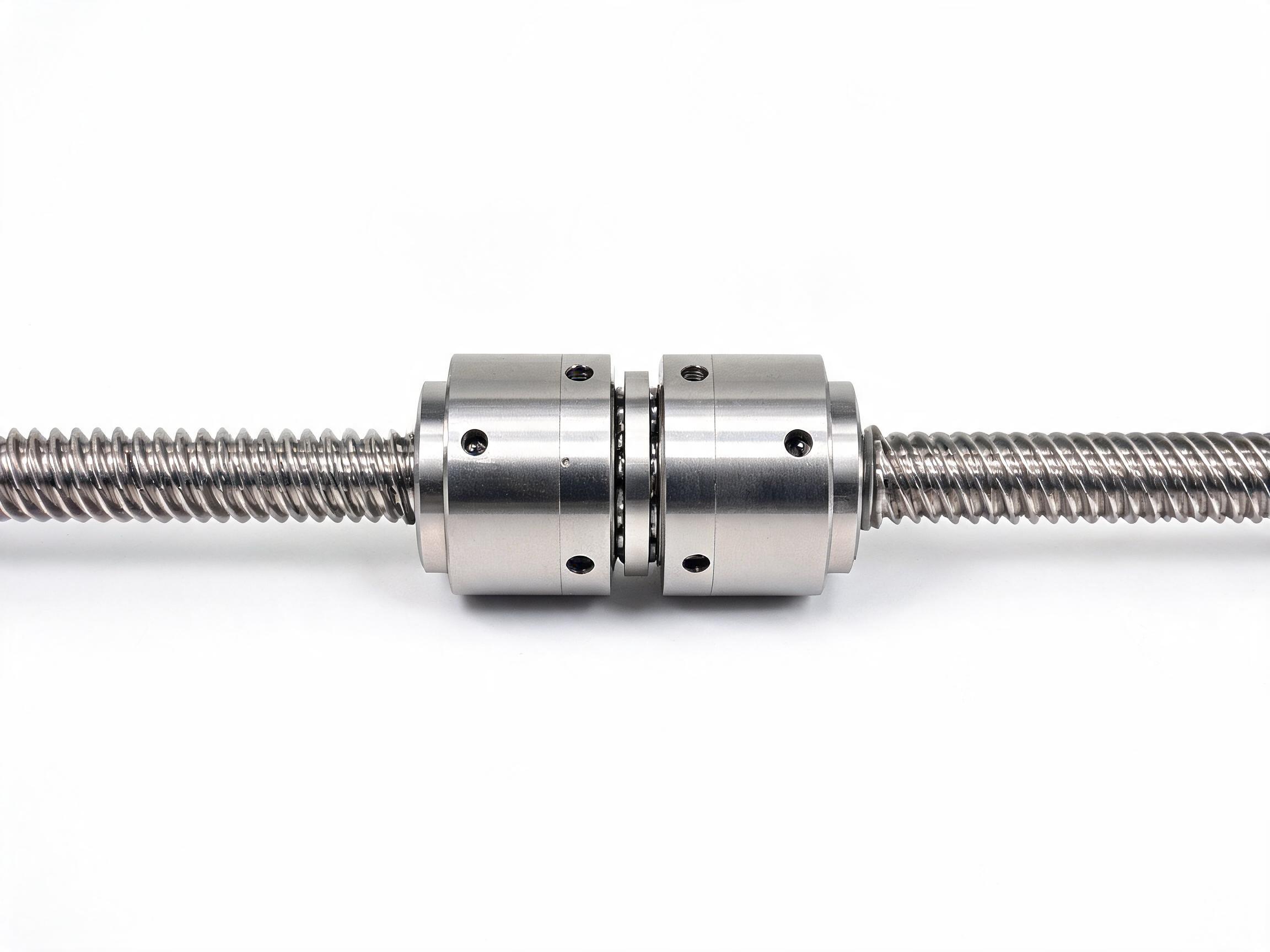
The DFU series double-nut ball screw uses two nuts with a spacer between them. The spacer is precision-ground to create a preload force between the two nuts, eliminating backlash in both directions. The preload is typically set at 10% of the dynamic load rating, providing zero backlash without excessive friction. For applications where backlash is acceptable (manual positioning, non-critical axes), single-nut SFU screws provide a more economical solution.
Preload affects several performance characteristics:
| Configuration | Backlash | Friction | Rigidity | Travel Life | Cost |
|---|---|---|---|---|---|
| Single nut, no preload | 0.01-0.05 mm | Low | Standard | Standard | Lowest |
| Single nut, oversized balls | 0.005-0.02 mm | Medium | Higher | Slightly reduced | Medium |
| Double nut, spacer preload | ~0 (zero) | Higher | Highest | Reduced by 10-20% | Higher |
Nut Types and Mounting Configurations
The ball screw nut converts the rotary motion of the shaft into linear motion of the nut (or vice versa). The nut type determines the mounting interface, ball recirculation method, and external dimensions:
- SFU flange nut: The most common type, with a circular flange containing 4-8 mounting holes. The flange is bolted directly to the carriage or table. Suitable for most CNC and automation applications.
- Cylindrical nut: Has a smooth cylindrical body without a flange, mounted using a clamp or key. Used when space is limited or when the mounting surface cannot accommodate a flange.
- DFU double-nut: Two single nuts separated by a precision spacer, preloaded against each other. Used for zero-backlash applications. The double-nut assembly is longer and heavier than a single nut.
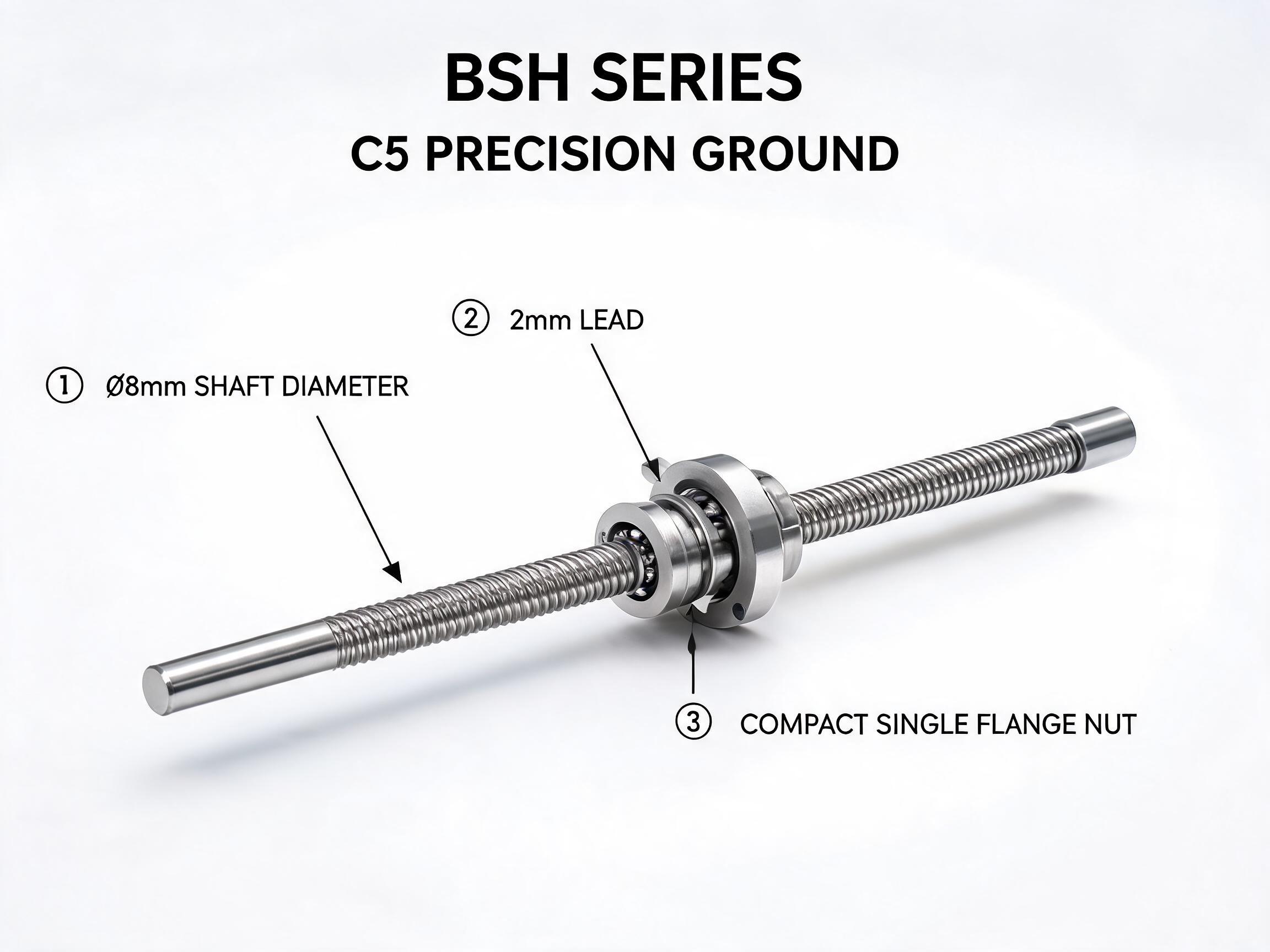
- BSH miniature nut: Compact design for small-diameter shafts (6-12 mm). Used in precision instruments, medical devices, and miniature positioning stages.
Ball recirculation methods include the internal return (deflector) type used in SFU series and the external return (tube) type used in larger-diameter screws. Internal return is more compact and quieter; external return handles higher ball counts and is used for larger leads.
Support Bearings and End Machining
A ball screw assembly requires support bearings at both ends to handle axial and radial loads. The end machining of the shaft is critical for proper bearing installation:
- Fixed end (drive end): Typically uses a pair of angular contact thrust bearings in back-to-back configuration to handle bidirectional axial loads. The shaft end is machined with bearing journals, keyway or flat for coupling, and threaded end for locknut.
- Supported end (non-drive end): Uses a single deep groove ball bearing or angular contact bearing to provide radial support without significant axial constraint. This allows thermal expansion of the shaft without inducing stress.
- Free end: In short screws or low-speed applications, the non-drive end may be left unsupported. This is not recommended for high-speed or high-precision applications.
Dongfeng Bearing provides end machining services including bearing journal grinding, keyway milling, thread cutting, and coupling flats. Specify the bearing type and dimensions, motor coupling type, and required overall shaft length when ordering.
Quality Control and Compliance Documentation
Every rolled ball screw batch undergoes comprehensive quality control:
- Lead accuracy measurement using laser interferometer over the full travel length
- Shaft straightness verification (within 0.05 mm per meter for standard, 0.03 mm for precision)
- Raceway hardness testing (58-62 HRC for GCr15, verified per batch)
- Nut internal diameter and raceway profile inspection using CMM
- Ball diameter sorting verification (sub-micron group tolerance)
- Backlash measurement for preloaded assemblies
- Friction torque test across full travel to verify smooth operation
Products carry CE conformity marking, SGS material test reports (including hardness depth profiling and steel composition analysis), RoHS compliance certificates, and REACH registration documentation. A 24-month warranty against manufacturing defects applies from the date of shipment.
Installation, Lubrication, and Maintenance
Proper installation and maintenance are essential for achieving the rated travel life of rolled ball screws:
- Shaft alignment: The screw must be aligned parallel to the linear guide rails within 0.05 mm over the full length. Misalignment causes side loads on the nut, increasing friction and wear. Use a dial indicator to verify alignment before final tightening.
- Bearing preload: The fixed-end angular contact bearings must be preloaded to the manufacturer's specification to eliminate axial play. Insufficient preload allows the screw to move axially under reversing loads; excessive preload increases friction and heat.
- Coupling selection: Use a flexible coupling between the motor and screw to accommodate slight misalignment. The coupling should have zero backlash (bellows or disk type) for positioning applications. Avoid rigid couplings that transmit motor misalignment to the screw.
- Lubrication: Apply ball screw grease (lithium-based, NLGI 2, with EP additives) before initial operation. For high-speed applications, use oil lubrication (forced circulation). Relubrication interval: every 500-1000 km of travel or every 3-6 months.
- Cleaning: In contaminated environments, use a wiper or scraper on the nut to remove debris from the shaft before it enters the ball circuits. Bellows or telescopic covers protect the screw from chips, dust, and coolant.
Comparing Rolled Ball Screws to Lead Screws and Belt Drives
Buyers evaluating different linear motion drive technologies should understand the trade-offs:
| Parameter | Rolled Ball Screw | Lead Screw (ACME) | Belt Drive |
|---|---|---|---|
| Efficiency | 90%+ | 30-70% | 95%+ |
| Backlash | 0-0.05 mm (depending on nut) | 0.05-0.15 mm | 0.05-0.2 mm |
| Load capacity | High (5-30+ kN) | Medium | Low-Medium |
| Speed | Up to 3000 RPM (size-dependent) | Up to 1500 RPM | Up to 5000+ mm/s |
| Positioning accuracy | C7: 0.05 mm/300mm | 0.1-0.2 mm/300mm | 0.05-0.1 mm (repeatability) |
| Cost | Medium | Low | Low-Medium |
| Maintenance | Lubrication required | Lubrication required | Minimal |
Rolled ball screws provide the best balance of accuracy, load capacity, and efficiency for most CNC and automation applications. Belt drives are preferred for very long travel distances (over 3 meters) where screw whip becomes a limitation. Lead screws are suitable for manual or low-speed applications where efficiency and backlash are not critical.
Frequently Asked Questions
What is the difference between C7 and C5 lead accuracy?
C7 allows 0.05 mm deviation per 300 mm of travel, while C5 allows 0.018 mm per 300 mm. C7 is achieved through rolling, while C5 requires grinding. For most CNC and automation applications, C7 is sufficient. C5 is recommended for precision machining, measuring equipment, and semiconductor handling where sub-0.02 mm accuracy is required.
Can I get a rolled ball screw with zero backlash?
Yes. The DFU double-nut series uses two nuts preloaded against each other with a precision spacer, achieving zero backlash in both directions. Single-nut screws can also use oversized balls to reduce backlash to 0.005-0.02 mm, though this is not true zero-backlash.
What is the maximum length for a rolled ball screw?
Standard maximum shaft length is 3000 mm for most sizes. For longer travel, the shaft can be supported at intermediate points or a larger diameter can be used to prevent whipping at high speeds. Custom lengths up to 6000 mm are available on request with extended lead times.
How do I calculate the required ball screw size?
Calculate the axial load (including payload weight, friction, and acceleration forces), determine the required travel life (typically 10,000-50,000 km), and select a screw with a dynamic load rating that provides the desired life with a safety factor of 1.5-2.0. Our engineering team provides free sizing and selection calculation.
What material are rolled ball screws made of?
Standard screws use GCr15 high-carbon chromium bearing steel, induction hardened to 58-62 HRC on the raceway surface. Stainless steel (9Cr18Mo / 440C, 56-58 HRC) is available for corrosive environments. Nut bodies are bearing steel; balls are GCr15 chrome steel.
Do rolled ball screws require lubrication?
Yes. Apply lithium-based ball screw grease (NLGI 2, with EP additives) before initial operation. For high-speed or continuous-duty applications, forced oil lubrication is recommended. Relubricate every 500-1000 km of travel or every 3-6 months. Clean and regrease if the screw has been stored for more than 6 months.
What is the difference between SFU and DFU series?
SFU is a single-nut design with standard backlash (0.01-0.05 mm). DFU is a double-nut design with a precision spacer that preloads the nuts against each other, achieving zero backlash. DFU is longer and more expensive but necessary for applications requiring bidirectional positioning accuracy.
Can the shaft ends be machined to my specifications?
Yes. We provide custom end machining including bearing journals, keyways, coupling flats, and threaded ends. Specify the bearing type and dimensions, motor coupling, and overall shaft length. Standard end machining configurations are also available for common bearing sizes.
What certifications are provided?
All products carry CE conformity marking, SGS material test reports (with hardness depth profiling and steel composition), RoHS compliance certificates, and REACH registration. CMM inspection reports and lead accuracy measurement data are included with every shipment. A 24-month warranty applies.
What is the lead time for rolled ball screws?
Standard production lead time is 10-15 working days for common sizes (SFU1204-SFU2510). Custom lengths, special end machining, or double-nut configurations require 15-25 working days. Sample orders for qualification testing can typically be shipped within 7-10 working days.